

More news on this day
Thousands of travellers across Australia and New Zealand are facing major disruption as airlines including Qantas, Jetstar, Virgin Australia and Air New Zealand grapple with 63 cancellations and more than 370 delays across key hubs such as Melbourne, Sydney, Auckland and Wellington.
Get the latest news straight to your inbox!
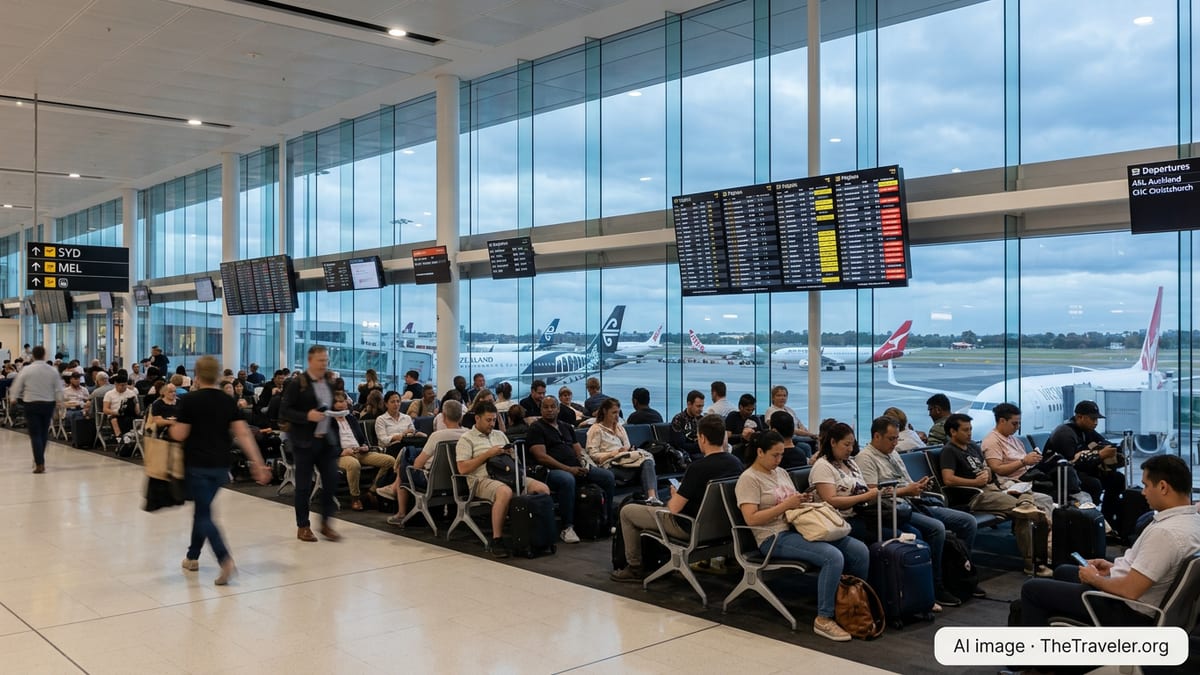
Widespread Disruptions Hit Major Trans-Tasman Hubs
Published aviation data and industry monitoring show a fresh wave of disruption sweeping across some of the busiest airports in the Australia and New Zealand network, with dozens of flights cancelled and hundreds more operating hours behind schedule. The latest snapshot points to at least 63 cancellations and around 370 delays affecting services across Melbourne, Sydney, Auckland, Wellington and several secondary airports.
Reports indicate that the impact is being felt most acutely on high-frequency domestic and trans-Tasman routes, where even small schedule disruptions can quickly cascade through the network. Short-haul links between Sydney and Melbourne, as well as key city pairs such as Auckland to Wellington and Auckland to Christchurch, have reported clusters of delayed services as airlines work to reset their operations.
Travel and aviation news outlets tracking same-day performance describe departure boards packed with late-running services and rolling gate changes. While many flights are still operating, a significant proportion are departing outside their scheduled windows, creating missed connections, longer dwell times in terminals and mounting pressure on airport resources.
The pattern of disruption follows other recent days of turbulence for the region’s aviation sector, highlighting the ongoing sensitivity of schedules to staffing constraints, weather variability and operational bottlenecks across both air traffic control and ground handling.
Major Carriers Under Pressure Across Domestic and Trans-Tasman Routes
Publicly available flight-tracking and airport operations data show that Qantas, Jetstar, Virgin Australia and Air New Zealand are among the most affected carriers, alongside a mix of international and regional airlines operating through the same hubs. These four brands collectively account for a large share of movements in the Australia and New Zealand markets, meaning any operational strain is quickly magnified for passengers.
Travel industry coverage notes that the latest disruptions come on top of an already demanding operating environment, with high travel demand and tight capacity across many popular routes. Recent coverage of on-time performance trends has highlighted that while reliability has generally improved compared with the worst of the pandemic-era disruptions, punctuality in both countries remains vulnerable to spikes in congestion and knock-on delays.
In Australia, Melbourne Tullamarine and Sydney Kingsford Smith are again at the center of the turbulence, with flight-status boards showing banks of delayed departures and arrivals on core domestic corridors. In New Zealand, Auckland and Wellington are reporting similar strains, particularly during peak morning and evening waves when aircraft and crews are tightly scheduled.
According to aviation analysts cited in published reports, the concentration of disruption among the dominant carriers reflects their exposure to high-density routes and the limited slack within their fleets to absorb unplanned changes. When a key rotation runs late or is cancelled, there are fewer spare aircraft and crews available to restore normal timetables quickly.
Knock-On Effects Ripple Through Secondary Cities
The immediate impact of the current wave of disruption is most visible in the largest hubs, but operations in secondary airports across both countries are also being affected as aircraft and crew imbalances ripple through the system. Regional centers in Australia and New Zealand depend heavily on feed from mainline services in Melbourne, Sydney, Auckland and Wellington, making them vulnerable when those hubs experience sustained delays.
Published travel reports describe passengers in cities such as Christchurch, Brisbane and Adelaide facing extended waits as inbound aircraft arrive late from larger hubs, forcing airlines to compress turnaround times or adjust schedules further down the line. Some services have been retimed or consolidated, while in a limited number of cases regional flights have been cancelled outright when crews or aircraft cannot be positioned in time.
The strain on regional connectivity is particularly challenging for travellers with essential commitments, including medical appointments, business meetings and family events, who often have few alternative options. With load factors remaining relatively high on many routes, same-day rebooking can be difficult, increasing the likelihood that travellers will be stranded overnight or forced to take indirect routings.
Aviation observers point out that such ripple effects illustrate the structural fragility of networks that operate at or close to capacity for extended periods. When disruptions accumulate across multiple hubs simultaneously, recovery windows shrink and operational planners must prioritize where limited spare resources are deployed.
Airports and Airlines Adjust Operations to Manage Backlog
Airport operators across the affected cities are adjusting gate allocations and staffing patterns in an effort to manage surging passenger volumes in departure halls and at check-in counters. Publicly accessible operational updates from major airports indicate that some terminals have extended queuing areas, redeployed staff to high-demand points and adjusted security and border processing to move passengers through more efficiently when delayed flights are ready to board.
Airlines, for their part, are using schedule changes, aircraft swaps and selective flight cancellations to stabilize their networks. Disruption information published by major carriers outlines options such as free rebooking within defined travel windows, credit vouchers, or, in some circumstances, refunds for passengers whose flights have been cancelled or significantly delayed.
Travel advisories carried by regional and international media recommend that passengers monitor their flight status closely via airline apps and airport information boards, arrive earlier than usual for departures, and allow extra connection times, particularly when transferring between domestic and international services. Observers note that while these measures cannot eliminate disruption, proactive planning can reduce the risk of missed flights and extended airport stays.
Industry coverage also highlights the role of air traffic control capacity and weather-related constraints in compounding airline and airport challenges. Even when carriers have aircraft and crews available, restrictions on takeoff and landing rates or temporary runway closures can force last-minute schedule changes, further complicating recovery efforts.
Stranded Travellers Face Long Queues and Uncertain Timelines
For many travellers caught up in the latest wave of cancellations and delays, the most immediate reality is long queues at service desks, crowded seating areas and uncertainty about when they will reach their destinations. Social media posts and local news coverage from across Melbourne, Sydney, Auckland and Wellington depict busy terminals where passengers are lining up to seek new itineraries, accommodation options or updated information.
Travel commentators report that some passengers have been offered same-day alternatives on later services, while others have been rebooked onto flights in the following days as airlines weigh limited spare capacity. In certain cases, particularly for regional and late-evening departures, stranded travellers have had to secure overnight accommodation while they wait for the next available seat.
Consumer advocates quoted in recent aviation coverage emphasize the importance of passengers understanding their rights under applicable consumer and airline policies, particularly when disruptions are within an airline’s control. Guidance from public agencies and industry bodies typically encourages affected travellers to retain documentation, keep receipts and use official airline channels for claims and follow-up.
With school holidays and business travel demand continuing to underpin high passenger volumes, observers suggest that episodes of concentrated disruption may persist across the Australia and New Zealand markets in the near term. Travellers planning journeys on busy routes are being urged by travel advisers to build additional flexibility into itineraries and to remain prepared for further schedule changes as airlines and airports work to stabilize operations.