

More news on this day
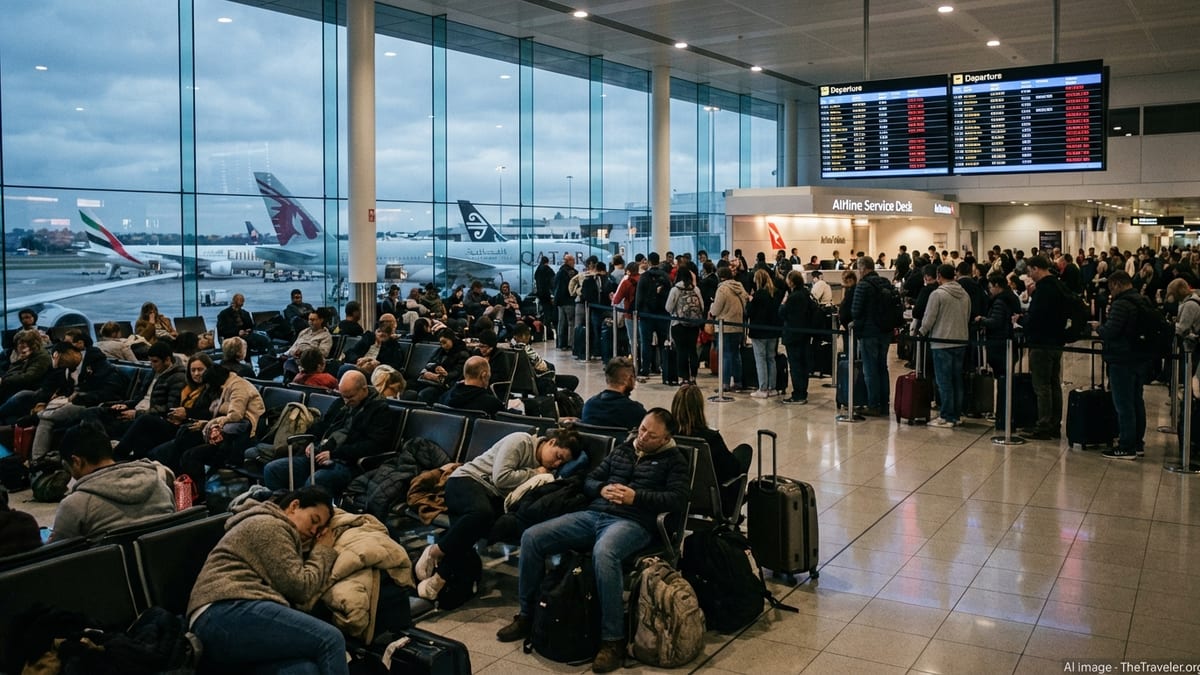
Thousands of passengers across Australia and New Zealand have been left stranded or severely delayed as 587 flights were reported late and 65 cancelled across Sydney, Melbourne, Brisbane, Auckland and Christchurch, snarling operations for Emirates, Qatar Airways, Jetstar, Air New Zealand and several other carriers.
Regional Hubs Buckle Under Mounting Disruptions
The latest wave of disruption has rippled through some of the region’s busiest international gateways, with long-haul and trans-Tasman services among the hardest hit. At Sydney and Melbourne, passengers on overnight flights to Europe and the Middle East reported being turned back to terminals after boarding, while early morning domestic departures stacked up on tarmacs and in holding patterns.
Brisbane, a key jumping-off point for Europe-bound travellers via the Gulf, saw mounting delays as aircraft and crews fell out of position. Similar scenes played out in Auckland and Christchurch, where a mix of international and domestic sectors were affected, leaving onward connections in disarray and forcing many travellers to queue at service desks well into the night.
Airport operators in both countries urged passengers to check flight status before travelling, but terminals were still crowded with people who had already cleared security when cancellations were announced. Many described confusion at departure gates as staff waited for operational updates and revised routings.
Gulf Carriers and Local Airlines Hit Hard
Emirates and Qatar Airways, which funnel large numbers of Australian and New Zealand passengers to Europe and Africa via their Middle Eastern hubs, were among the worst affected international airlines. Several evening and overnight departures from Sydney, Melbourne and Brisbane to Dubai and Doha were cancelled or forced to return to gates after regional airspace restrictions and fast-changing safety assessments upended long-haul schedules.
Downstream effects quickly filtered through to codeshare and partner services, including flights marketed by Australian carriers but operated by Gulf airlines. Travellers reported being rebooked on later departures where possible, but limited spare capacity on already busy routes meant many faced waits of 24 hours or more to secure an alternative seat.
Closer to home, Jetstar and Air New Zealand struggled with a combination of aircraft availability issues and knock-on delays. Jetstar’s dense domestic and trans-Tasman schedule left little slack to recover quickly once rotations slipped, while Air New Zealand’s network felt the strain as disrupted long-haul services cascaded into its domestic banks through Auckland and Christchurch.
Scenes of Exhaustion in Packed Terminals
Inside terminals, the human impact of the disruption was clear. At Sydney and Melbourne, families with young children tried to sleep across rows of metal seats and on the floor as late-night cancellations left them with no hotel options nearby. Travellers reported that accommodation within easy reach of the airports quickly sold out, with major events in the cities adding extra pressure to an already tight room market.
In Auckland and Christchurch, long queues formed at rebooking counters as passengers waited to be placed on later flights or rerouted through alternative hubs. Some described waiting several hours for firm information as airline operations teams worked through cascading schedule changes, crew duty limits and aircraft repositioning plans.
Many stranded travellers expressed frustration at limited communication and sparse staffing at peak disruption times, particularly overnight. Others acknowledged that frontline staff were working under intense pressure, fielding questions from hundreds of affected passengers while dealing with constantly shifting operational directives.
Knock-On Effects Across the Network
Industry analysts noted that the disruption illustrated the fragility of tightly wound airline schedules across Australia and New Zealand. With fleets running close to full utilisation and limited spare aircraft available, an initial cluster of cancellations and lengthy delays in key hubs such as Sydney, Melbourne and Auckland quickly echoed through secondary airports and regional routes.
Trans-Tasman services in particular proved vulnerable, as late-running long-haul aircraft arriving from Asia and the Pacific upset carefully timed connections onward to New Zealand. Once those links broke, airlines faced the dual challenge of reaccommodating passengers across two countries and repositioning both aircraft and crews to restore normal patterns.
Operational data from recent months already suggested that on-time performance across Australian airlines had remained below long-term averages, leaving them with less margin to absorb sudden shocks. In New Zealand, carriers have similarly been operating in a tight labour and capacity environment, meaning that unexpected disruption can quickly spill over into multiple days of schedule instability.
Passengers Seek Clarity on Rights and Next Steps
With thousands of journeys disrupted, attention is turning to what compensation or support affected passengers can expect. Australia and New Zealand do not have the same comprehensive statutory compensation regimes for delays and cancellations seen in some other markets, leaving travellers largely dependent on individual airline policies and travel insurance coverage.
Consumer advocates urged passengers to document their disruption, retain receipts for meals and accommodation, and seek written confirmation from airlines about the cause of cancellations, which can influence eligibility for reimbursement. They also advised travellers whose itineraries involve multiple carriers to clarify which airline bears responsibility for onward connections once the first sector fails.
Airports and airlines on both sides of the Tasman have signalled that recovery may take time as they clear backlogs, reposition aircraft and reset schedules. Travellers with upcoming flights through Sydney, Melbourne, Brisbane, Auckland and Christchurch were being advised to build in additional connection time, stay closely in touch with their airlines and consider flexible tickets or alternative routings where possible.