

More news on this day
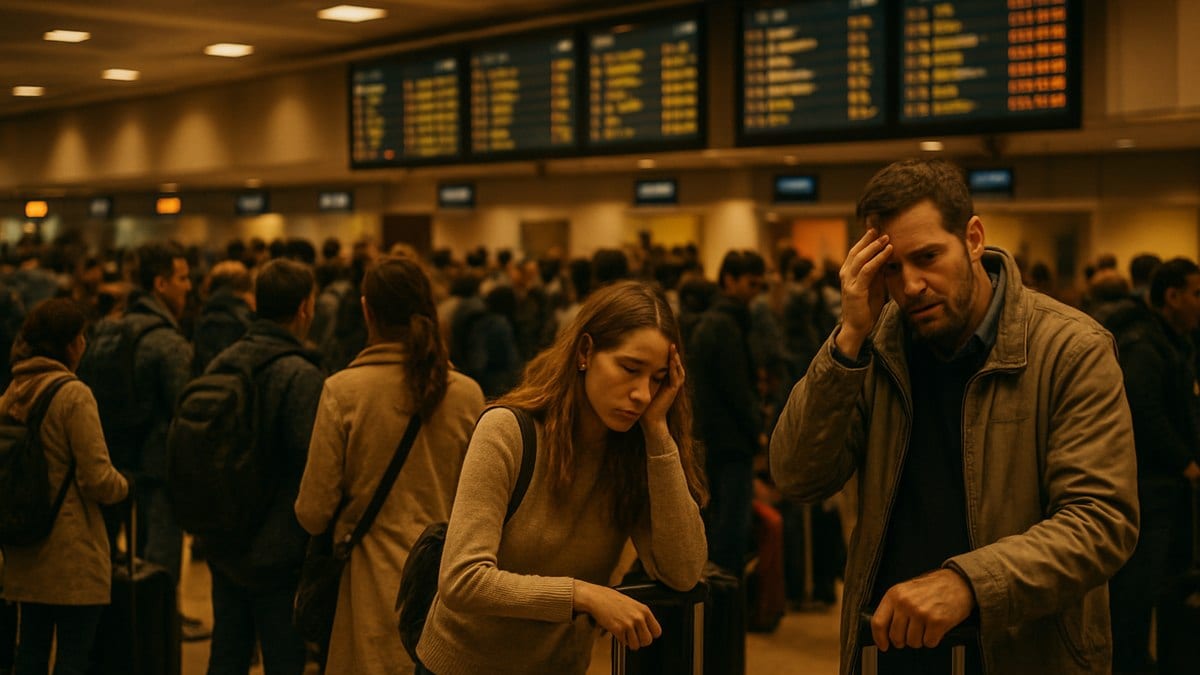
Thousands of airline passengers have been stranded at major US hubs in April 2026, as a volatile mix of spring storms, record travel demand and already stretched airline operations triggered cascading delays and cancellations from Florida and Texas to the Midwest and Northeast.
Get the latest news straight to your inbox!
Storm Systems and Holiday Demand Trigger a New Wave of Disruption
Travel-tracking data and recent coverage indicate that disruption began building in late March, when a powerful storm system crossing the eastern United States led to more than a thousand delayed flights in a single day at hubs in Illinois, New York and Massachusetts. As aircraft and crews fell out of position, knock-on effects lingered into the first days of April, complicating already busy Easter holiday operations.
Across the first week of April, reports show tens of thousands of delays and well over 2,000 cancellations nationwide, with major connecting airports bearing the brunt. Miami, Chicago, Newark and other high-traffic hubs struggled to absorb the shock, leaving passengers facing missed connections, overnight airport stays and rebookings stretched over several days.
The Easter weekend intensified the pressure. Coverage of Miami International Airport described one of the heaviest disruption zones, with hundreds of delayed flights and additional cancellations on April 6 alone, affecting both domestic and transatlantic routes. Similar strain was reported at Orlando and Fort Lauderdale, where already tight schedules left little spare capacity to recover when storms or late-arriving aircraft disrupted the timetable.
The pattern has carried into mid-April, with fresh reports on April 11 of significant delays at Harry Reid International Airport in Las Vegas and substantial disruption at Detroit Metropolitan Wayne County Airport. These localized hotspots are part of a broader national picture in which even modest weather systems can tip a tightly wound network into widespread delay.
Major Hubs Bear the Brunt From Atlanta to Las Vegas
Data compiled from flight-status services and industry analyses highlight how the burden of this April’s disruption has fallen on a familiar set of major hubs. Atlanta, Chicago, Denver, Houston, Phoenix, Washington, Miami, Las Vegas and Detroit all feature prominently in reports of elevated delays and cancellations in recent days.
On April 9, published information from passenger-rights advocates pointed to widespread disruption at six of the country’s largest connecting airports, with more than 3,000 flights delayed and well over a hundred cancelled in a single day. The most severe congestion centered on Atlanta, Denver, Houston, Phoenix, Washington Dulles and Las Vegas, amplifying ripple effects across domestic and international networks.
Separate coverage focused on Georgia, Illinois, California, Massachusetts and New York shows similar patterns, with hundreds of flights delayed and dozens cancelled across multiple days. Airlines with large footprints at those hubs, including the biggest US carriers and regional operators, have seen clusters of cancellations that disrupt entire connection banks even when airport infrastructure remains open.
Reports from Detroit and Las Vegas on April 11 underline that this is not a single-day shock but a rolling period of strain. At Detroit, more than one hundred flights were delayed or cancelled, leaving terminals crowded with passengers waiting for rebooking. In Las Vegas, Harry Reid International saw an unusually high volume of late departures and protracted waits at departure gates, as airlines worked through a backlog created by earlier weather and airspace constraints.
System Fragility Exposed by Weather, Staffing and Control Issues
Industry commentators note that weather alone does not fully explain the severity of April’s turmoil. Publicly available information highlights how a fragile aviation system, shaped by high demand, lean staffing and infrastructure stress, has turned manageable disruptions into multi-day breakdowns.
The ongoing federal government funding standoff has placed additional pressure on aviation. Analysis of the Department of Homeland Security and wider federal shutdown impacts points to longer security lines, reduced staffing and checkpoint closures at some airports, including widely reported wait times of several hours at major hubs such as Houston earlier in the year. Those strains have not disappeared and continue to limit the system’s ability to recover quickly when weather or air traffic issues arise.
In the Washington region, recent air-traffic control disruptions linked to issues at the Virginia TRACON facility have provided another reminder of how a single node can affect an entire network. Reports of repeated ground stops and flow restrictions at Washington National, Dulles and Baltimore/Washington in late March and early April demonstrate how regional control challenges can cascade into missed connections and rolling delays as aircraft and crews end up in the wrong place at the wrong time.
Carriers are also contending with operational aftershocks from earlier winter storms, a major telecommunications outage in January and localized airport incidents that disrupted aircraft rotations. Taken together, these factors have created what analysts describe as a thin margin for error, where even routine thunderstorms or brief ground delays can trigger widespread schedule changes and strand travelers far from their final destinations.
Passengers Face Long Queues, Limited Options and Rising Costs
For passengers caught up in the April flight chaos, the experience has been defined by long queues at check-in and rebooking counters, crowded customer-service phone lines and limited same-day alternatives. Travel reports from Easter weekend describe terminal concourses filled with travelers sleeping on seats and floors as they waited for replacement flights after missed connections in Miami, Chicago and Newark.
Rebooking has proved particularly challenging at peak times. Airlines have been operating near or at capacity on many popular leisure routes, which means that when a flight is cancelled there are fewer empty seats available to accommodate displaced passengers. Families traveling together often face a choice between splitting across multiple flights or waiting an extra day or more for seats on the same service.
Accommodation has also been strained, especially near hub airports. Coverage of recent disruptions notes that airport-area hotels in some cities reached high occupancy as stranded travelers sought last-minute rooms. Those who did secure lodging often did so at elevated rates, with some passengers turning to distant suburbs or alternative transport options when nearby hotels filled.
Consumer advocates emphasize that US regulations give passengers fewer automatic compensation rights than in some other regions, but passengers may still be entitled to meal vouchers, hotel stays or refunds in certain circumstances. Guidance from advocacy groups in recent days has urged travelers to document delays, retain receipts and monitor airline policies, particularly when disruptions are not directly caused by severe weather.
What April’s Turbulence Signals for the Summer Travel Season
The breadth of April’s flight disruption is raising questions about how the system will cope with the even heavier volumes expected in late spring and summer. Forecasts cited by major outlets in March projected that US airlines would carry around 2.8 million passengers per day between March and the end of April, with further growth likely into June and July as school holidays and peak vacation travel begin.
Analysts suggest that, unless carriers can rebuild schedule resilience and staffing buffers, the combination of extreme-weather risk and record passenger numbers could lead to repeated episodes of disruption similar to those seen this month. The events of early April, where storms in a handful of states produced nationwide knock-on delays, are being viewed as a stress test that exposed weak points in both airline and airport operations.
Travel industry commentary has renewed calls for passengers to adapt their own strategies in response. Common recommendations include favoring early-morning departures, allowing extra connection time at busy hubs, traveling with carry-on luggage when possible and closely monitoring flight status through official airline channels. Some analysts also highlight the value of choosing routes with multiple daily frequencies or alternative carriers, which can make it easier to rebook when a particular flight is heavily delayed or cancelled.
For now, with April only half over, the picture remains fluid. But the pattern emerging across Atlanta, Chicago, Miami, Las Vegas, Detroit and other major airports suggests that this spring’s flight chaos is not an isolated incident. Instead, it appears to be another chapter in a longer period of strain on US air travel, in which any disturbance, from thunderstorms to staffing gaps, can leave thousands of passengers unexpectedly grounded.