

More news on this day
Vacationers leaving Mexico’s Caribbean coast are facing an unexpected extended stay as widespread flight cancellations and rolling delays ripple through Cancún International Airport, leaving hundreds of passengers stuck in one of the world’s busiest beach gateways.
Storms and Security Turmoil Collide
Airlines serving Cancún have been scrambling to reset schedules after a volatile long weekend that combined a historic North American winter storm with security upheaval in parts of western Mexico. While Cancún itself remains calm, its flight network is deeply intertwined with hubs across the United States and other Mexican cities now struggling to recover from days of disruption.
The powerful February 2026 North American blizzard, dubbed Winter Storm Hernando by U.S. media, forced the cancellation of thousands of flights across the Northeast and Midwest between February 22 and 24. Major hubs including Boston, New York, Philadelphia and Chicago curtailed operations amid whiteout conditions, high winds and widespread power outages, creating a domino effect that quickly spread to leisure routes serving Cancún.
At the same time, security operations and cartel-related violence centered in states such as Jalisco, Nayarit and Sinaloa prompted airlines to suspend or sharply reduce service to Puerto Vallarta, Guadalajara and Mazatlán. Many of those flights connect with or share aircraft and crews with routes to and from Cancún, further tightening capacity just as anxious tourists tried to rebook journeys home.
Industry analysts say the combination of a paralyzing winter storm and domestic Mexican security concerns has produced an unusually complex disruption pattern. Instead of a single weather event that passes through, carriers are juggling multiple constraints on crews, aircraft positioning and airport slots in several countries at once, making it harder to stabilize timetables quickly.
Cancún Sees Dozens of Cancellations and Long Delays
Airport data from the last 48 hours shows that Cancún International has logged at least two dozen outright cancellations and dozens more significant delays on international routes, particularly to U.S. and Canadian cities. Local travel trade outlets reported around 23 cancellations and about 40 delayed flights at the height of the disruption, with airlines warning of additional last-minute changes as aircraft fail to arrive from snowbound or security-affected airports.
Most affected are northbound departures to major U.S. gateways such as New York, Boston, Chicago and Toronto, where aircraft remain out of position or crews have hit legal duty-time limits after days of irregular operations. Some Mexico City and regional connections have also been thinned out as carriers prioritize limited resources on core routes and daylight hours.
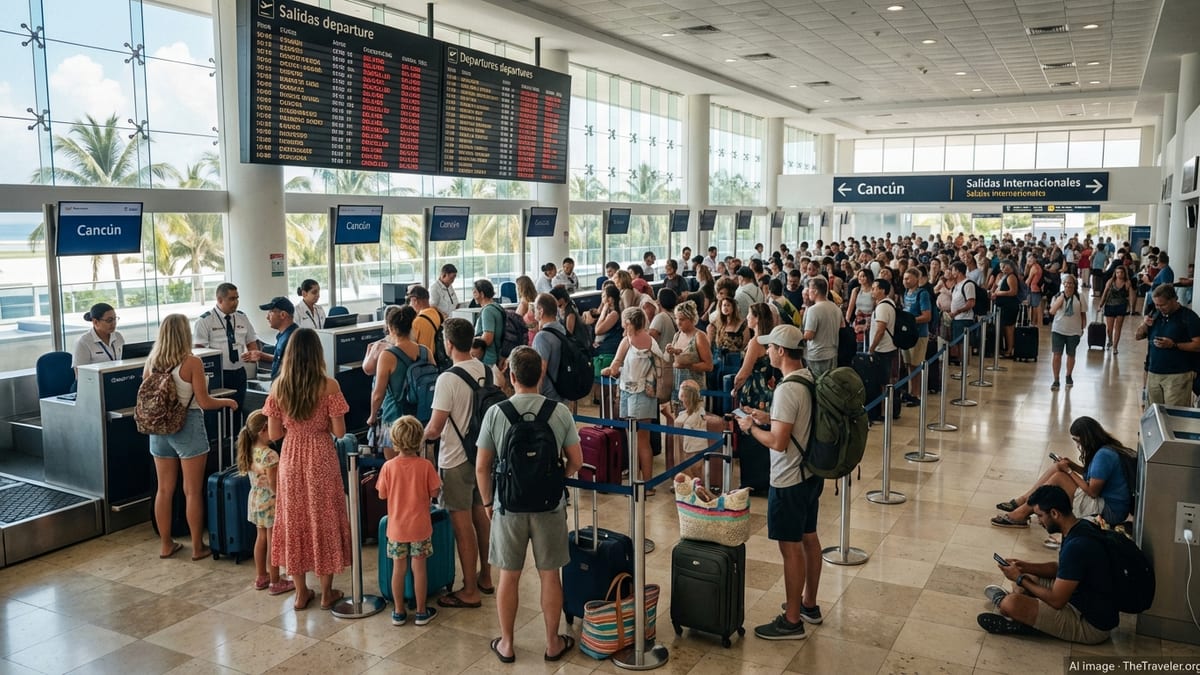
Despite the turbulence, Cancún’s terminals remain open and operating. Check-in counters and security lanes are busy but functional, and there have been no reports of system-wide shutdowns. Instead, the picture is one of an airport operating under strain, with departure boards showing long strings of delayed flights, estimated times that shift hour by hour, and a steady stream of announcements about gate changes and rolling schedule updates.
Mexican carriers including Aeroméxico, Volaris and Viva Aerobus have adjusted frequencies on some domestic links, while U.S. airlines have issued flexible travel waivers for passengers booked on certain dates and routes. However, with many northbound flights fully booked for the coming days and aircraft in short supply, rebooking options out of Cancún are limited, especially for families and groups who need multiple seats on the same service.
Stranded Tourists Face Mounting Costs and Uncertainty
For the thousands of visitors who came to the Riviera Maya for a winter escape, the travel mess is turning into an expensive and stressful extension of their holidays. Lines to speak with airline agents snake through departure halls as travelers try to secure new itineraries, while others camp out on the floor near power outlets, scrolling through airline apps and messaging family and employers back home.
Hotel availability in Cancún’s hotel zone and along the coast toward Playa del Carmen and Tulum has tightened as delayed travelers scramble for extra nights. Several resorts are reporting near full occupancy, with some offering distressed passenger rates for guests who present flight disruption documentation. Travel agents say last-minute room prices have risen noticeably, particularly at beachfront properties and all-inclusive resorts.
Many visitors are discovering that, under international rules, compensation for weather-related cancellations is limited, especially on flights touching the United States. In cases where delays stem from severe storms or security issues deemed outside an airline’s control, carriers are generally not required to pay financial compensation, though some provide meal vouchers, hotel discounts or fee waivers on a discretionary basis.
Beyond the financial hit, uncertainty is wearing down travelers’ patience. With schedules changing rapidly and some routes canceling with only a few hours’ notice, visitors are unsure whether to remain at their resort or head to the airport early, only to face long waits and the risk of further delays once they arrive at the terminal.
Airlines, Airports and Authorities Push to Stabilize Operations
Airlines are gradually restoring service as conditions improve at storm-battered U.S. airports and Mexican authorities move to secure affected regions in the west of the country. Carriers have added a limited number of extra sections and upgauged aircraft on select high-demand routes from Cancún in an effort to clear the backlog of stranded passengers over the coming days.
Airport authorities in Cancún say they are coordinating closely with airlines and ground handlers to manage passenger flows and maintain essential services. Additional staff have been deployed to information desks and security checkpoints at peak hours, and operators are encouraging travelers to arrive early and remain in close contact with their airline via digital channels before heading to the airport.
Travel industry observers note that Cancún’s role as a major international leisure hub makes it highly sensitive to external shocks, particularly those affecting its primary source markets in North America. A weather system or security incident thousands of miles away can rapidly translate into crowded gates, missing aircraft and confused tourists under the Yucatán sun.
In the short term, operational recovery will depend on how quickly U.S. airports can clear their winter weather backlog and how swiftly Mexican carriers can reestablish normal rotations on domestic routes. Even with improving conditions, irregular operations often linger for several days, which means travelers flying in and out of Cancún this week should expect continued schedule changes and the possibility of same-day disruptions.
What Travelers Should Expect in the Coming Days
Travel advisors are urging anyone with upcoming flights to or from Cancún to monitor their bookings closely and to consider adjusting plans while flexible waivers remain in place. Passengers are being advised to confirm flight status directly with airlines before leaving their hotel, to keep boarding passes and receipts for any disruption-related expenses, and to build extra time into connections, particularly when linking through U.S. hubs that were hit hardest by the storm.
Those yet to travel are being encouraged to review the fine print on travel insurance policies, many of which offer coverage for additional accommodation and rebooking costs when flights are significantly delayed or canceled due to severe weather. Policies linked to premium credit cards may also provide some protections, although coverage terms vary widely.
On the ground in Cancún, tourist boards and hotel associations are coordinating messaging with airlines and consular services to reassure visitors that the resort area itself remains open and welcoming, even as air links temporarily falter. For now, the turquoise water and white-sand beaches continue to offer some solace to travelers caught in the disruption, turning what was meant to be a quick getaway into an unplanned, and often costly, extra stay in paradise.