

More news on this day
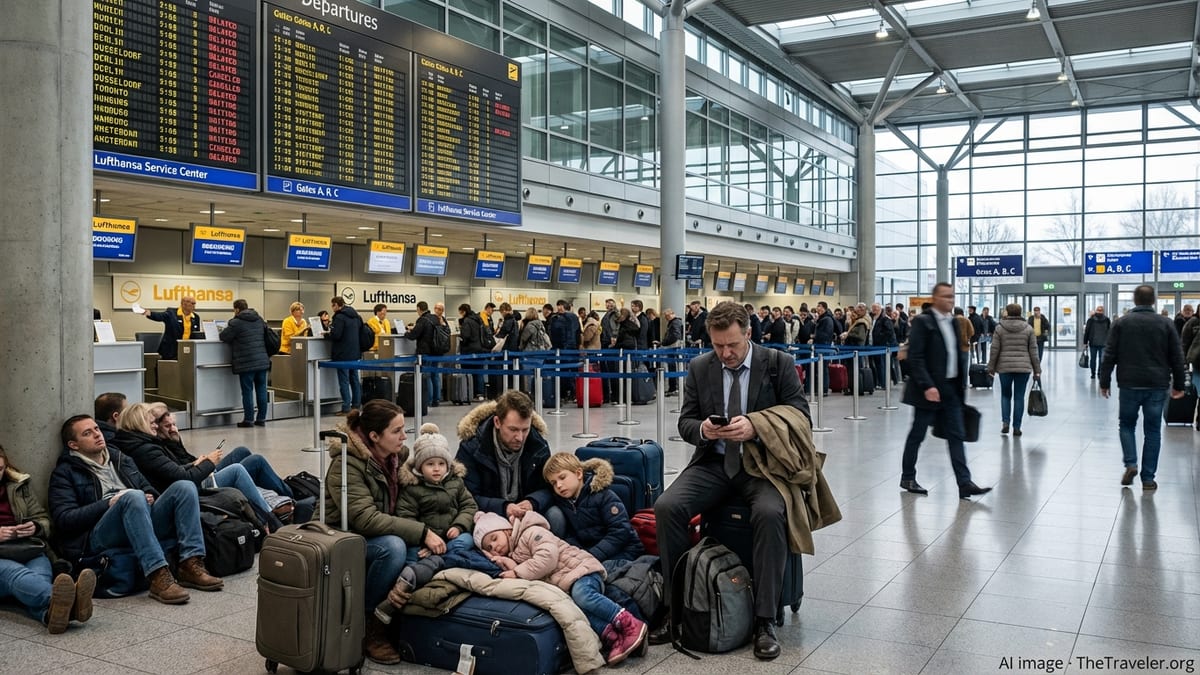
Hundreds of travelers were left stranded across Germany today as at least 14 flights were canceled and more than 200 delayed, with disruptions rippling through major hubs in Frankfurt, Munich, Düsseldorf and Berlin and affecting services operated by Lufthansa, Air Canada, Brussels Airlines, Air Baltic, KLM and other international carriers.
Major German Hubs Buckle Under Mounting Disruptions
Operational data from German airports on Tuesday indicate that the country’s busiest hubs once again found themselves at the center of widespread schedule disruption. Frankfurt and Munich, the two primary intercontinental gateways, reported clusters of cancellations in combination with a much larger wave of rolling delays, affecting short haul European services as well as long haul connections to North America, Asia and the Middle East.
Frankfurt Airport, one of Europe’s largest transit nodes, saw a sharp build-up of delayed departures during the morning wave, particularly on routes served by Lufthansa and its partners. Even where scheduled flights operated, turnaround times stretched well beyond normal, with several departures to cities such as Toronto, Montreal and key European capitals leaving more than an hour behind schedule. The delays quickly cascaded into missed onward connections for transfer passengers.
Munich, Lufthansa’s secondary hub, recorded a similar pattern, with relatively few outright cancellations but a high proportion of flights departing late. Regional European routes and feeder services into the long haul network, including flights shared with carriers such as Air Canada and Brussels Airlines, were particularly exposed, leaving passengers heading for transatlantic and intra-European connections uncertain about their arrival times.
Berlin Brandenburg and Düsseldorf, while smaller than Frankfurt and Munich in hub terms, nonetheless experienced concentrated pockets of disruption in the late morning and early afternoon. Several KLM and Air Baltic flights into and out of these airports were among those impacted, compounding pressure on already crowded terminals as passengers queued to be rebooked or to obtain updated information.
Lufthansa at the Epicenter as Knock-on Effects Spread
Lufthansa once again sat at the center of the disruption picture, both as Germany’s dominant carrier and as the largest operator at Frankfurt and Munich. While the total number of canceled Lufthansa flights remained limited in comparison with the overall schedule, the carrier’s high volume of delayed operations translated into significant inconvenience for passengers relying on tight connections.
Recent industrial tensions and staffing constraints have left the airline with limited flexibility to absorb operational shocks. A series of labor actions announced for February has already forced Lufthansa to trim parts of its timetable and reposition aircraft and crews, and the aftershocks of those adjustments were still evident today. Even where flights were able to operate, aircraft and crew were not always in the optimal place at the right time, creating bottlenecks during peak periods.
Codeshare partners and fellow Star Alliance members were drawn into the turbulence. Flights jointly marketed by Lufthansa and Air Canada between Germany and Canadian hubs, for example, faced departure delays and tight turnarounds as schedule buffers eroded. Passengers traveling on Brussels Airlines itineraries via Germany encountered similar issues when their German domestic or European feeder sectors ran late, forcing last minute rebookings onto alternative connections where seats were available.
For Lufthansa, the day’s disruption added to an already challenging winter season, marked by a combination of industrial disputes, seasonal weather events and tight staffing levels. The carrier reiterated previous advice for passengers to check flight status frequently and to allow extra time for connections, but many travelers caught mid-journey had little choice but to endure extended waits at crowded gate areas and transfer desks.
International Carriers from Canada to the Baltics Affected
The operational strain was not limited to German and neighboring European airlines. Air Canada, which serves Germany through key gateways such as Frankfurt and Munich, reported delays on several transatlantic rotations as inbound aircraft from North America arrived late and outbound services waited for connecting passengers and bags. In some cases, lengthy security and immigration queues added further time to already compressed connection windows.
Brussels Airlines, an important regional and long haul player within the Lufthansa Group, was also touched by the day’s disruptions. Services linking German airports with Brussels, and onward to African and European destinations, experienced schedule adjustments as aircraft arriving late into Germany were turned around as quickly as possible for their return legs. Even short segments of 60 to 90 minutes saw departure times pushed back, in some cases triggering missed onward connections for time-sensitive itineraries.
Air Baltic, which has expanded its footprint in Germany with links to the Baltic states and beyond, encountered delays at airports including Düsseldorf and Berlin. The carrier’s network relies heavily on precise timing at its home bases, so late departures from Germany reverberated through its wave of onward departures in Riga and other hubs, forcing retiming and, in a small number of cases, local cancellations to stabilize operations.
KLM, the Dutch flag carrier, reported disruption on services between Amsterdam and key German cities such as Frankfurt, Munich and Berlin. These routes are heavily trafficked by transfer passengers heading to long haul flights at Amsterdam Schiphol. Delays on the German side therefore risked undermining onward travel plans for passengers connecting to destinations in North America, Africa and Asia, adding yet another layer of complexity for airline operations teams.
Passengers Face Long Queues, Missed Connections and Overnight Stays
For travelers, the statistics translated into a difficult day on the ground and in the air. Long lines quickly formed at check-in counters, rebooking desks and airline transfer service points as cancellations and prolonged delays were announced across terminal information screens. In Frankfurt and Munich, passengers reported waiting upwards of an hour simply to speak with an agent about alternative options.
Transfer passengers were among the hardest hit. Those arriving late into Frankfurt or Munich often found that their onward flights had already closed or departed. Some were automatically rebooked by airline systems onto later departures, while others were instructed to collect their baggage and queue again at ticketing desks to be re-routed via alternative hubs. Families and elderly travelers in particular struggled with the lack of clear, multilingual guidance during the busiest periods.
With hotel capacity near the airport already tight in mid-February, some stranded passengers at the largest hubs were informed that accommodation would be provided in nearby towns rather than at airport hotels, adding transfer time to already extended journeys. Others, particularly those on short haul intra-European itineraries, chose to cancel their trips altogether and request refunds or travel vouchers, deciding that the uncertainty and stress outweighed the need to complete their journeys.
At Berlin Brandenburg and Düsseldorf, where terminals are more compact than at Frankfurt, crowding became an issue as delayed passengers accumulated at gates and in departure halls. Food and beverage outlets reported surging demand as travelers sought to pass the time between rolling schedule updates, with some operators temporarily running low on supplies during the busiest waves.
Operational Causes: Winter Weather, Tight Crewing and Earlier Strikes
Industry analysts pointed to a familiar constellation of causes behind the day’s disruptions. Seasonal winter weather across parts of Europe, including low cloud, rain and intermittent fog, continued to slow traffic flows into key hubs. Air traffic control imposed temporary flow restrictions at various points in the day, lengthening the intervals between arrivals and departures and forcing airlines to adjust schedules on short notice.
At the same time, carriers across the continent remain under pressure from tight crew availability. Several airlines serving Germany, including Lufthansa and its partners, have struggled to rebuild staffing levels to match post-pandemic demand while also accommodating rest and duty time regulations. When one early rotation in the day suffers a delay or technical issue, it frequently has a knock-on effect on multiple subsequent flights operated by the same aircraft or crew.
Recent and ongoing labor disputes have further complicated matters. In the weeks leading up to mid-February, Germany’s aviation sector has seen a series of strike announcements and actions affecting pilots, cabin crew and ground handling staff. These have required airlines to reduce or reshape schedules on particular days, and some of the aircraft and crew positioning decisions taken to accommodate those events are still working their way through networks, contributing indirectly to current irregularities.
Airport infrastructure and ground handling capacity also played a role. Turnaround times for heavily loaded long haul aircraft were extended at peak hours as baggage systems, de-icing services and refueling teams raced to keep up. Even modest slowdowns on the ramp translated into knock-on delays for outbound departures, especially at Frankfurt, where runway capacity is already tightly managed.
Focus on Frankfurt, Munich, Düsseldorf and Berlin as Strategic Gateways
The concentration of disruptions at Frankfurt, Munich, Düsseldorf and Berlin underscored the strategic importance of these hubs for both Germany’s domestic mobility and its role as a European transit crossroads. Frankfurt in particular is a key gateway for passengers traveling between North America, the Middle East, Africa and Asia, with many itineraries built around narrow connection windows of 60 to 90 minutes.
When delays accumulate at Frankfurt, the impact spreads far beyond Germany’s borders, affecting passengers as far away as Vancouver or Vilnius whose itineraries pass through the hub. Airlines such as Lufthansa, Air Canada, Brussels Airlines and KLM depend on these coordinated connection banks to feed long haul flights, so even a small number of cancellations or a few dozen delayed departures can force significant last-minute reshuffling of loads and routings.
Munich, while smaller than Frankfurt, has carved out an important role as a premium long haul hub, particularly for routes to North America and Asia. Disruptions there today complicated travel plans for business and leisure passengers alike, many of whom had chosen Munich specifically to avoid congestion at larger hubs. The combination of weather constraints and network knock-ons meant that even this comparatively efficient airport was unable to escape the ripple effect.
Berlin Brandenburg and Düsseldorf, meanwhile, are essential gateways for point-to-point traffic, connecting Germany’s political and industrial heartlands to major European capitals and regional centers. Cancellations and delays on these routes have immediate consequences for corporate travelers, trade fair visitors and tourists, many of whom are operating on tight schedules tied to meetings and events.
Advice for Affected and Upcoming Travelers
With irregular operations persisting into the afternoon and airlines warning of potential residual delays into the evening, travel experts urged passengers to adopt a proactive approach. Those scheduled to travel to or from Frankfurt, Munich, Düsseldorf or Berlin in the coming 24 hours were advised to monitor their flight status closely through airline apps and airport information channels and to enable real-time notifications wherever possible.
Passengers with tight connections, especially on itineraries involving long haul legs with Lufthansa, Air Canada, Brussels Airlines, Air Baltic or KLM, were encouraged to consider rebooking onto earlier feeder flights or flights with longer connecting times, even if this meant a less convenient departure time. Many carriers continued to offer flexible rebooking options for passengers traveling during periods of known operational stress.
Travel planners also recommended that passengers build extra time into their journeys to account for potential queues at security, check-in and border control. Arriving at the airport earlier than usual, carrying essential items such as medications and a change of clothes in hand baggage, and keeping digital copies of travel documents readily accessible were all cited as simple steps that can help reduce stress during irregular operations.
For travelers who have already experienced cancellations or very long delays, consumer groups reiterated that European air passenger regulations may entitle them to assistance and, in certain circumstances, financial compensation, depending on the cause of disruption and the length of delay. Passengers were urged to retain boarding passes, booking confirmations and any written notices from airlines as documentation for potential claims.