

More news on this day
Asia’s busy air corridors faced fresh disruption as a combined 33 flight cancellations and 416 delays involving China Eastern and Lao Airlines rippled across key routes, stranding travelers from mainland China to Laos and neighboring hubs.
Get the latest news straight to your inbox!
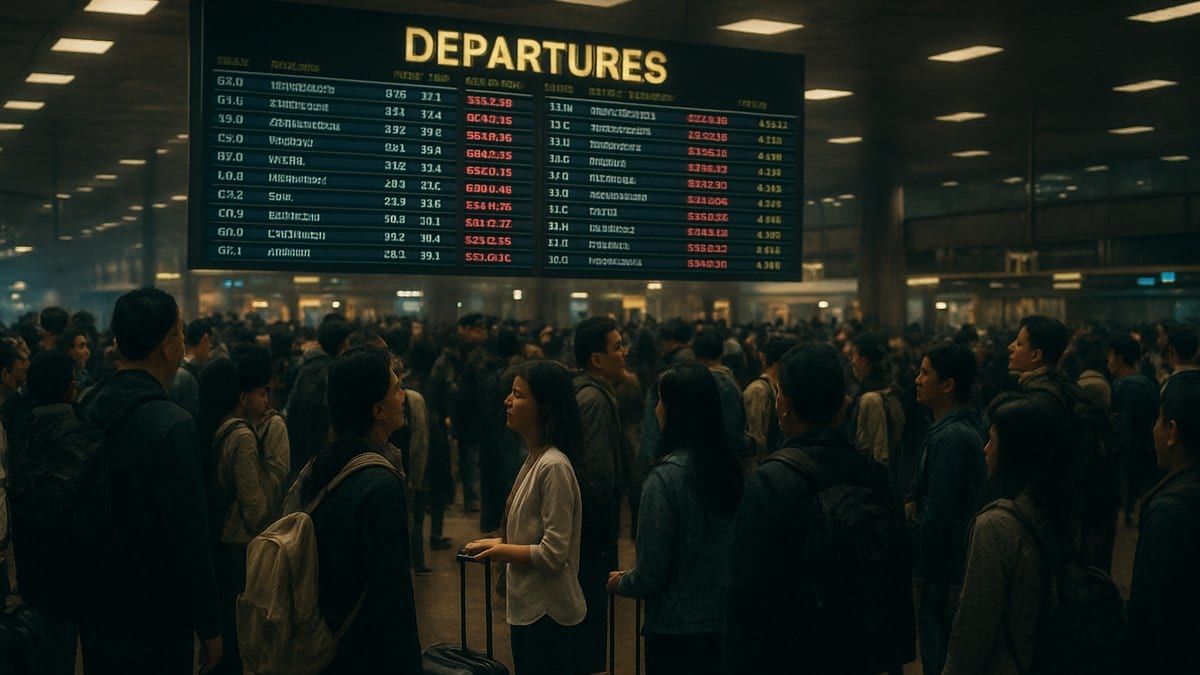
Fresh Wave of Disruptions Across Regional Hubs
The latest figures, drawn from publicly available flight-tracking dashboards and industry monitoring sites on April 8, indicate that China Eastern accounted for the majority of cancellations and late departures, with Lao Airlines also recording notable schedule instability. While the total represents a fraction of the region’s overall traffic, the concentration of disruption on a small cluster of carriers and routes magnified the effect on passengers and airport operations.
China Eastern’s network, heavily centered on Shanghai and key provincial capitals, has been particularly exposed to knock-on effects from earlier weather issues, airspace bottlenecks and rolling congestion at major Chinese airports. Recent coverage has highlighted elevated delay and cancellation rates for several Chinese carriers as schedules remain tightly wound around peak domestic and regional demand.
Lao Airlines, which operates a far smaller network focused on Vientiane, Luang Prabang and a handful of regional links, has seen delays compound quickly whenever aircraft and crew are out of position. With limited spare capacity, even a short burst of disruption can cascade into hours of missed connections and rescheduled departures for travelers connecting between Laos, Thailand, China and Vietnam.
Published aviation data show that these latest cancellations and delays did not occur in isolation but added to a steady drumbeat of irregular operations across Asia in recent weeks, particularly on China-centered itineraries.
China Eastern Feels the Strain of Crowded Skies
China Eastern’s performance metrics in early April point to a network under pressure. Real-time tracking platforms on April 8 showed an elevated share of the airline’s flights arriving late or being scrubbed, echoing trends reported in late March and early April, when Chinese hubs recorded hundreds of delays concentrated at Beijing, Shanghai, Guangzhou and Chengdu.
Industry coverage over the past month has repeatedly noted a convergence of stress factors affecting Chinese carriers: lingering weather disruptions, continuing reroutes around restricted airspace on westbound services, and the sheer volume of domestic traffic now running close to or above pre-pandemic levels. Where flight schedules have been rebuilt aggressively to capture demand, even minor disturbances can trigger wider gridlock across a day’s operations.
Reports focused on China’s main aviation markets in early April described thousands of passengers facing last-minute changes, with China Eastern named among carriers experiencing heightened disruption as they shuffled aircraft and crew. Analysts have pointed to Shanghai’s twin-airport system as both a strength and vulnerability, with dense banks of departures leaving little room for recovery once operations slip behind schedule.
Although detailed route-by-route breakdowns for April 8 are still being compiled, the pattern of 33 cancellations and 416 delays broadly aligns with the elevated irregularity observed on China Eastern’s network over recent weeks, particularly on short-haul regional services that feed into long-haul departures.
Lao Airlines Caught in Regional Knock-On Effects
Lao Airlines, while much smaller than its Chinese counterparts, has not escaped the turbulence. Publicly available timetable and tracking data show that even a modest number of delayed or canceled flights can have a disproportionate impact on its network, which relies on tight rotations and a limited fleet to serve key routes from Vientiane and Luang Prabang.
Recent regional reports have drawn attention to how second-tier carriers in Southeast Asia are being affected indirectly by constraints elsewhere, especially when flights connect into congested hubs in Thailand and China. When upstream services arrive late, Lao Airlines faces compressed turnaround times, slot constraints and crew duty limits that can quickly translate into additional delays or cancellations.
For travelers, the practical implications are significant. A single late inbound aircraft can disrupt multiple subsequent sectors in a day, affecting passengers bound for regional capitals or onward long-haul services. According to industry commentary, carriers such as Lao Airlines often have limited spare aircraft standing by, making recovery from an operational shock slower than for larger airlines with deeper resources.
The inclusion of Lao Airlines in the tally of 33 cancellations and 416 delays underlines how tightly interwoven Asia’s aviation networks have become, with instability in one part of the system rapidly spilling across borders.
Broader Asia-Pacific Context of Repeated Flight Turmoil
The latest figures arrive against a wider backdrop of recurrent flight chaos across Asia-Pacific in 2026. In March, aviation news outlets documented days when the region saw hundreds of cancellations and more than two thousand delays in a single 24-hour period, as weather systems, geopolitical tensions and airspace closures converged on already stretched airline timetables.
Coverage of Chinese and Middle Eastern routes in recent weeks has highlighted how ongoing airspace restrictions over parts of the Middle East have forced significant rerouting for long-haul flights between Asia, Europe and Africa. China Eastern has been among the carriers adjusting schedules and offering flexibility to affected passengers, with ripple effects spreading to aircraft availability on other sectors.
Separately, Japan- and Korea-bound markets have seen waves of cancellations and capacity reshuffles since late winter, as Chinese airlines recalibrated seasonal plans. Publicly available data show that on some days, cancellation rates on routes between mainland China and Japan spiked sharply, prompting extended refund and rebooking windows by multiple Chinese carriers.
In this context, the 33 cancellations and 416 delays recorded for China Eastern and Lao Airlines on April 8 represent another chapter in a season marked by fragile reliability and limited margin for error in Asia’s skies, rather than a one-off shock.
What Travelers Are Experiencing on the Ground
For passengers, the operational statistics translate into long queues at service desks, missed connections and last-minute changes to travel plans. Consumer-focused outlets across the region have reported growing frustration among travelers caught in recurring waves of disruption, particularly those with complex itineraries involving multiple airlines and tight connections.
Travel forums and advisory platforms have responded by reiterating practical guidance: monitor airline apps closely on the day of departure, consider longer connection windows through busy hubs such as Shanghai, Beijing and Bangkok, and be prepared for same-day rerouting when operating conditions deteriorate. Publicly available airline policies indicate that fee-free changes and refunds are sometimes offered when delays or cancellations are significant, although eligibility varies by carrier and ticket type.
In markets like China, where passenger numbers have surged, aviation specialists note that airport and airspace capacity have struggled at times to keep pace with demand. Academic work on terminal area management in complex metro regions such as Shanghai has underscored how quickly imbalance between traffic volume and capacity can generate long queues in the air and on the ground.
As of the afternoon of April 8, monitoring sites showed disruption gradually easing but still elevated for China Eastern and selected regional operators, suggesting that residual delays may continue to affect evening departures and early rotations on April 9.