

More news on this day
Major disruptions across Asian skies are stranding thousands of travelers this week, as widespread delays and cancellations ripple through China, Malaysia, Indonesia and regional hubs such as Kuala Lumpur, Bangkok and Manila, following large-scale schedule upheavals at carriers including Hainan Airlines, Gulf Air and AirAsia.
Get the latest news straight to your inbox!
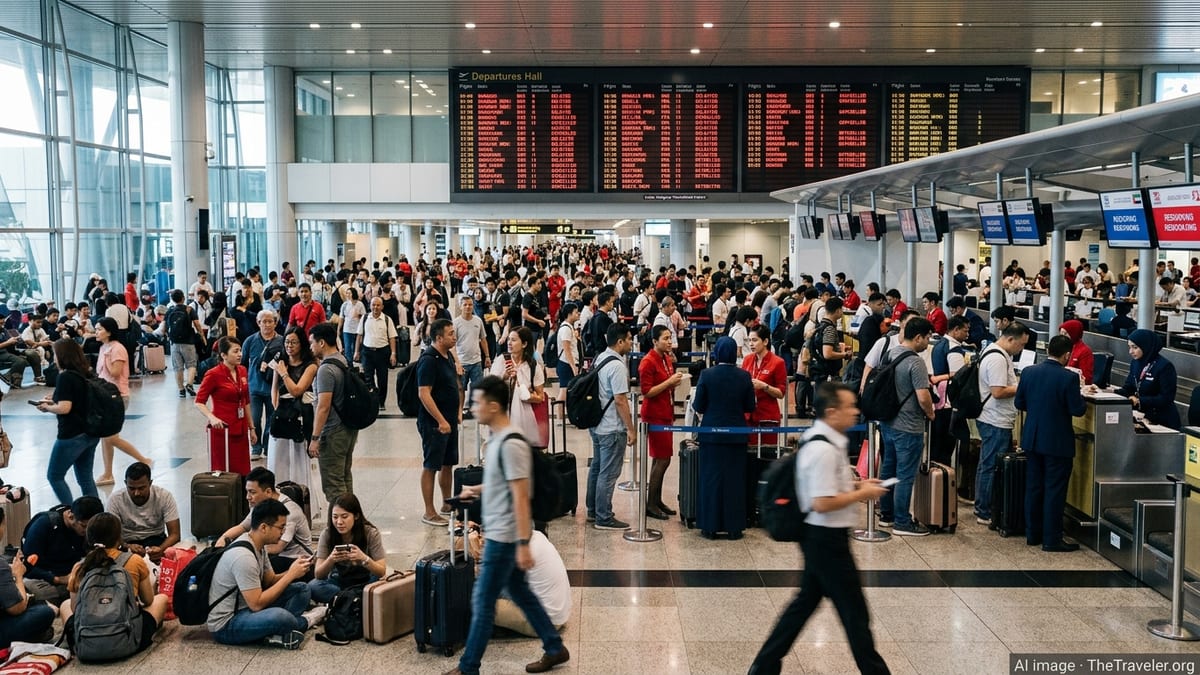
Regional Hubs Struggle With Wave Of Delays
Flight status data and regional aviation advisories show a sharp spike in late and cancelled services across key Asian hubs, with at least 624 flights delayed and 36 cancelled on affected days. Operations at Kuala Lumpur, Bangkok and Manila have been particularly strained, with knock-on disruption reported across connecting routes into China and Indonesia.
Published travel advisories from aviation regulators in Malaysia describe “operational disruptions” linked to evolving airspace closures along major East–West corridors, warning that airlines may be forced into retiming, rerouting or cancelling flights at short notice. Publicly available information indicates that these changes have compressed capacity through alternative routes, creating bottlenecks at already busy airports.
The impact on passengers has been immediate. Travelers transiting through Kuala Lumpur International Airport report extended ground holds and rolling departure time changes as carriers attempt to secure revised routings. Similar accounts from Bangkok and Manila point to crowded terminals, lengthy queues at rebooking counters and increased pressure on ground handling and security screening.
While disruption patterns vary by carrier and route, schedule data suggests that services linking Southeast Asia with North Asia, the Middle East and Europe are bearing the brunt. Flights operating overnight or in peak evening waves have been especially prone to extended delays as traffic bunches around limited airspace windows.
Airlines Reroute Around Middle East Airspace Closures
According to travel advisories and industry briefings, recent closures and restrictions in parts of Middle Eastern airspace have forced airlines to redesign long haul paths between Asia, the Gulf and Europe. Analysis from global mobility and aviation consultancies highlights that only a narrow corridor over Saudi Arabia remains fully available for many East–West services, concentrating traffic through a limited band of skies.
Publicly available operational guidance notes that carriers including Gulf Air and other Gulf-based airlines have retimed or suspended selected services as they adapt to the new routing environment. Longer flight paths, revised cruising levels and congestion along remaining corridors are adding both time and complexity to operations, which in turn contributes to late departures and missed connection windows at downstream hubs.
For airlines in East and Southeast Asia, the effect is both direct and indirect. Some services that previously crossed now-restricted airspace must divert onto longer arcs, increasing fuel requirements and reducing schedule flexibility. Other flights, while not overflying the affected region, are still delayed as aircraft and crews arrive late from disrupted rotations elsewhere in the network.
Analysts note that these factors are converging at major transit points such as Kuala Lumpur, Bangkok and Manila, where a mix of Gulf, Asian and European carriers interconnect. When even a small portion of long haul arrivals run late, the tightly timed waves of regional departures that feed China and Indonesia can quickly unravel, producing the kind of large-scale delay totals recorded this week.
Hainan Airlines, Gulf Air, AirAsia And Others Under Pressure
Publicly accessible flight status records indicate that services operated by Hainan Airlines, Gulf Air, AirAsia and several other regional carriers have been heavily affected during the disruption period. For Hainan Airlines, which maintains key links between mainland China, Southeast Asia and Europe, delays on one sector can cascade rapidly across multi-stop itineraries, particularly when aircraft are scheduled on tight turnarounds.
Gulf Air and other Gulf-based operators have faced additional challenges as they adjust to altered routings through the Middle East. Longer block times and dynamic air traffic control restrictions have reduced schedule resilience, leaving less margin to absorb even minor operational issues. This has contributed to late arrivals into Asian hubs and pushed some departures beyond their planned slots.
AirAsia, a major low cost carrier in Southeast Asia with dense networks radiating from Kuala Lumpur and Bangkok, appears prominently in disruption tallies for short and medium haul sectors. Its point-to-point model relies on high aircraft utilization and quick turnarounds, which become more difficult to maintain when upstream services encounter delays or when ground handling resources are stretched by wider airport congestion.
Other regional airlines, including full service and low cost operators based in Malaysia, Thailand, the Philippines and Indonesia, have also adjusted timetables, swapped aircraft types or consolidated frequencies. While these changes aim to stabilize operations, they have in some cases resulted in last minute cancellations as schedules are recalibrated around available aircraft, crews and overflight permissions.
China, Malaysia And Indonesia See Network Ripple Effects
The wave of delays has highlighted how closely interconnected national aviation networks in Asia have become. In China, publicly visible schedule changes show that international flights linking major coastal cities with Southeast Asia and the Gulf have been reslotted or in some cases removed from sale for selected days, as airlines seek to maintain reliability on core routes.
Malaysia’s position as a regional hub means that disruptions at Kuala Lumpur can quickly spill over into domestic services and secondary international routes. Passengers heading to destinations such as Penang, Kota Kinabalu or Indonesian cities via Kuala Lumpur have reported missed connections and forced overnight stays as inbound long haul flights arrive outside planned connection banks.
Indonesia, with its archipelagic geography and reliance on air links, is experiencing its own ripple effects. When services from hubs like Jakarta or Denpasar to Bangkok, Kuala Lumpur or Manila run late or are rescheduled, aircraft and crews may not return in time to operate subsequent domestic legs. Industry observers note that this can lead to late evening delays on purely domestic sectors that never leave Indonesian airspace, even though the underlying trigger lies thousands of kilometres away in Middle Eastern route changes.
Across the Philippines and Thailand, similar patterns are emerging, with local carriers adjusting departure times, swapping widebody and narrowbody aircraft, and in some cases issuing travel notices that warn of potential last minute schedule revisions. The cumulative effect is a region-wide sense of uncertainty for travelers whose journeys span multiple countries and carriers.
What Passengers Can Expect In The Coming Days
Based on current advisories and industry analysis, the situation is expected to remain fluid in the short term as airlines, regulators and air navigation providers continue to refine routings around closed or restricted airspace. Travelers with upcoming itineraries touching Kuala Lumpur, Bangkok, Manila or major Chinese and Indonesian gateways are being urged, through public notices and airline communications, to monitor their bookings closely.
Airlines are publicly reminding customers to ensure contact details are up to date in reservation systems so that schedule changes, retimings or cancellations can be communicated quickly. Many carriers have activated flexible rebooking policies or temporary fee waivers on affected routes, although the exact options available vary by airline, ticket type and point of sale.
At airports, passengers may encounter longer queues at check in, security and immigration as multiple delayed flights converge into narrow departure windows. Ground staff are also managing increased volumes at transfer desks as travelers seek alternative routings when original connections are missed. Some carriers are advising passengers to arrive earlier than usual at the airport and to allow more generous minimum connection times when planning complex itineraries.
Aviation analysts suggest that while the immediate shock of airspace closures has now passed, schedules will take time to fully stabilize. Until new patterns of routings and frequencies bed in, intermittent waves of disruption are likely to continue across China, Malaysia, Indonesia and other affected markets, with particular pressure on hub airports that sit at the crossroads of Asia, the Gulf and Europe.