

Thousands of passengers across Europe are facing fresh disruption as at least 43 flights were cancelled and 1,033 delayed in a single day across France, the United Kingdom, Denmark, Sweden and Portugal, hitting major carriers including Air France, SAS, KLM, Iberia, British Airways and Pegasus and causing congestion at key hubs in Paris, London, Copenhagen, Stockholm and Lisbon.
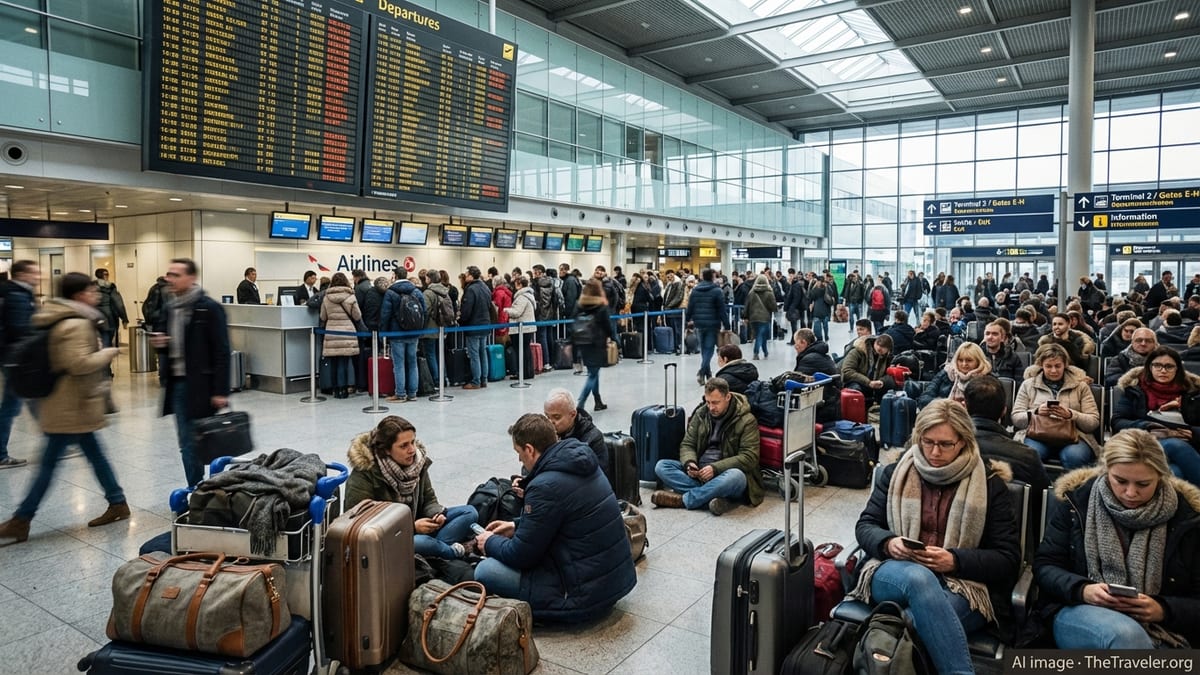
Network Wide Disruptions Hit Key European Hubs
The latest wave of disruption follows weeks of operational strain in Europe’s skies, with flight tracking and passenger rights services reporting persistent delays and cancellations at major airports. Paris Charles de Gaulle and Orly, London Heathrow and Gatwick, Copenhagen, Stockholm Arlanda and Lisbon have all seen rolling knock on effects from weather systems, staffing constraints and tight air traffic control capacity, creating bottlenecks during peak travel periods.
Recent aggregated data from passenger compensation platforms indicates that more than 2,000 flights have been cancelled or delayed on several days this month across core markets such as France, the UK and Sweden, with additional disruption in Germany, Spain and Greece. In this context, a day featuring 43 cancellations and 1,033 delays concentrated in France, the UK, Denmark, Sweden and Portugal represents another acute spike in an already stressed network rather than an isolated event.
Industry analysts say Europe’s aviation system is currently operating with little slack, so even modest weather disturbances or local staffing gaps can cascade across borders. Airlines are juggling aircraft and crews to keep schedules moving, but high load factors in the winter shoulder season, combined with ongoing industrial and infrastructure challenges in several countries, mean there is limited room to absorb fresh shocks.
Airports in Paris and London have again emerged as focal points, with delays spreading outward to secondary hubs. As departures slip behind schedule in one capital, arriving aircraft and onward connections in Copenhagen, Stockholm and Lisbon are pushed back, swelling the number of delayed flights across the continent through the day.
Major Airlines Shoulder the Impact
The disruption is being felt across a broad cross section of European and international airlines. Flag carriers such as Air France, SAS, KLM, Iberia and British Airways have reported waves of delayed departures and arrivals, particularly on short and medium haul routes linking Paris, London, Copenhagen, Stockholm and Lisbon with other European cities. These airlines operate dense hub and spoke networks, which makes them especially vulnerable when a core airport experiences sustained congestion.
Low cost and leisure oriented airlines including Pegasus are also affected, particularly on services linking the UK and France to Scandinavia, southern Europe and Turkey. While many of these carriers use point to point models that can sometimes insulate them from knock on effects, shared runway, terminal and airspace capacity means they are ultimately exposed to the same structural constraints as legacy airlines when traffic surges or weather deteriorates.
Operational data from recent disruption days underscores the breadth of the impact. On one comparable day this month, more than 170 flights were cancelled and over 1,900 delayed across Germany, France, Sweden, the UK and Greece, with Pegasus, British Airways, Air France, KLM and SAS among the most heavily disrupted. Another update highlighted more than 1,300 delays and 50 cancellations focused on hubs including Madrid, Amsterdam, Paris, Copenhagen and London, again singling out Air France, KLM, Iberia, British Airways and SAS among the hardest hit operators.
This pattern, in which the same large carriers repeatedly appear among the most disrupted, reflects their scale and central role in European connectivity. With hundreds of daily flights and complex rotations, even a handful of localised problems at a major hub can ripple through their networks, forcing airlines to trim schedules, consolidate services or reroute passengers at short notice.
Weather Systems and Structural Constraints Combine
Weather remains a key trigger for irregular operations, particularly in February when wintry conditions can quickly degrade visibility and runway performance. Recent travel alerts from several airlines have warned of snow and low temperatures in parts of France and northern Europe, prompting pre emptive schedule adjustments at Paris Charles de Gaulle and Orly and at airports serving Scandinavia and the UK. Airlines increasingly cancel or retime flights in advance to avoid last minute operational breakdowns, concentrating the visible disruption into single intense days.
However, aviation performance data suggest that deeper structural issues are also at play. Reports from European air traffic management bodies in recent seasons have highlighted chronic bottlenecks in several airspace regions, with France repeatedly cited as a source of a large share of flow management delays due to capacity and staffing constraints, compounded at times by industrial action. When traffic demand exceeds what controllers can safely handle, flights are held on the ground or slowed en route, feeding into the kind of widespread delay totals seen this month.
Airports themselves are still working to rebuild resilience after the pandemic period. While traffic has recovered to or exceeded pre 2019 levels on many routes, recruitment and training of ground handlers, security staff and technical personnel has lagged in some markets. This leaves terminals vulnerable during peak departure waves, when minor glitches in baggage systems or de icing operations can disrupt entire banks of flights and quickly push delay counts into the hundreds.
The combination of seasonal weather, constrained airspace capacity and lean airport staffing means that days with a few dozen cancellations and around a thousand delays are no longer rare outliers, but recurring features of the European travel calendar. For passengers, that translates into a growing sense that disruption is part of the landscape rather than a genuine exception.
Airports in Paris, London, Copenhagen, Stockholm and Lisbon Under Strain
On the most recent disruption day, passengers in Paris faced early morning queues as departures from Charles de Gaulle and Orly slipped behind schedule. Even when outright cancellations remained relatively limited, clusters of one or two hour delays forced travelers to sprint between terminals in search of alternative connections, while aircraft waited for available departure slots in crowded airspace. Airlines prioritised long haul operations where possible, trimming or retiming some intra European services to free aircraft and crews.
In London, operational data showed similar patterns at Heathrow and Gatwick, with dense schedules leaving little margin for recovery once the morning peak faltered. Heathrow’s role as a global hub for British Airways and partner airlines means any mismatch between arrival and departure waves can quickly result in missed connections and rebooked itineraries, swelling queues at transfer desks and lengthening hold times for customer service lines.
Copenhagen and Stockholm Arlanda, key bases for SAS and important hubs for northern Europe, also reported elevated disruption. For Scandinavia’s main carriers, delays on services to and from Paris and London often have direct consequences for domestic and regional flights that depend on the same aircraft and crews. When an early rotation from Copenhagen to London runs late, for example, its onward afternoon service to a smaller Nordic city may have to be curtailed or rescheduled, widening the pool of affected passengers well beyond those travelling between major capitals.
Lisbon, an increasingly important gateway for transatlantic and African routes, has likewise struggled to absorb irregular operations, especially when compounded by weather fronts moving in from the Atlantic. TAP Air Portugal and other airlines have had to juggle gate space and turnaround times as delayed inbound flights jostle with on time departures, contributing to the wider European total of over 1,000 delayed services on peak disruption days.
Passengers Face Missed Connections and Overnight Stays
For travellers caught up in the latest episode of disruption, the effects are immediate and often costly. Missed connections are a particular concern on multi leg journeys linking smaller European cities through hubs like Paris, London or Copenhagen. When the first sector is delayed even by an hour, the narrow minimum connection times at busy hubs may no longer be achievable, forcing passengers onto later flights or, in some cases, leaving them overnight in transit hotels.
Families and leisure travellers on fixed holiday schedules are especially vulnerable. With school breaks and winter getaways driving demand, many flights in and out of Lisbon, Stockholm and other leisure heavy gateways are operating close to full. That limits airlines’ ability to re accommodate everyone on later departures, pushing some travellers onto alternative routings through secondary hubs or entirely different departure days.
Business travellers, meanwhile, face lost working time and cascading schedule changes as meetings are missed or shifted. Some companies have responded by factoring greater buffer time into itineraries or choosing early morning departures that offer more fallback options in the event of disruption. Others are reverting to video conferencing for short notice engagements, wary of relying on same day returns when delay statistics remain elevated.
The human toll of repeated disruption can be seen in images from terminals across the continent: passengers sprawled across departure lounge seating, long lines at customer service counters and weary travellers clutching paper boarding passes as they wait for updated gate information. While many eventually reach their destinations within a few hours of the original plan, the cumulative frustration is adding to wider questions about the reliability of European air travel.
Passenger Rights and Compensation Under EU Rules
As disruption becomes more frequent, understanding passenger rights has taken on growing importance. Within the European Union, the core framework is Regulation EC 261, which sets out common rules on compensation and assistance when flights are cancelled, significantly delayed or subject to denied boarding. Depending on route distance and the length of the delay at arrival, passengers may be entitled to financial compensation, typically ranging from 250 to 600 euros.
In addition to potential compensation, the regulation requires airlines to provide care in the form of meals, refreshments and access to communication during extended delays, and hotel accommodation when passengers are forced to stay overnight because of flight disruption. Travellers are generally advised to keep boarding passes, booking confirmations and receipts for any out of pocket expenses, as these documents can be crucial when filing a claim directly with an airline or via a specialist compensation service.
However, eligibility is not automatic. Airlines are not required to pay compensation when the disruption was caused by extraordinary circumstances beyond their control, such as severe weather, certain air traffic control restrictions or security incidents. The challenge for many passengers lies in understanding whether their particular delay falls within or outside these exemptions, especially on days when multiple contributing factors are at play.
Consumer advocates argue that the rising tally of daily delays and cancellations underscores the importance of clear, proactive communication from airlines at the airport and via digital channels. While some carriers have invested heavily in real time notifications and self service rebooking tools, others still rely on crowded service desks and generic announcements, leaving passengers unsure of their options at some of the most stressful moments in their journeys.
How Airlines and Travellers Are Adapting
In response to the continuing operational strain, airlines have begun refining their schedules and contingency plans. Some carriers have slightly trimmed frequencies on marginal routes in order to build more resilience into core networks, while others are increasing scheduled block times on congested sectors to better reflect typical delays. There has also been renewed investment in crew reserve pools and spare aircraft in selected hubs, though high costs and tight labour markets limit how far these buffers can be expanded.
Technology is playing a growing role, with more airlines using predictive analytics based on historical data from services tracking daily disruption trends across Europe. By forecasting where delays are likely to cluster, operations teams can pre position crews and adjust aircraft routings, reducing the risk of last minute cancellations. Yet even sophisticated planning tools cannot fully offset the impact of sudden weather changes or systemic constraints in air traffic control capacity.
Travellers, too, are adjusting their behaviour. Many passengers now consult flight tracking and compensation platforms before booking to gauge typical punctuality on specific routes, and some are increasingly favouring non stop flights to avoid the risk of missed connections at busy hubs. Travel advisers report that more clients are building longer buffers into itineraries involving critical events, such as cruises, conferences or long haul connections, to guard against the possibility of a disruption day with hundreds of delays.
As Europe grapples with the latest tally of 43 cancellations and 1,033 delays concentrated in France, the UK, Denmark, Sweden and Portugal, both airlines and passengers appear resigned to a period in which resilience, flexibility and informed planning matter as much as the headline schedule on the ticket.