

More news on this day
Thousands of travelers have been left stranded in Egypt and the United Arab Emirates as widespread airspace restrictions trigger cascading disruption at Cairo and Dubai international airports, where at least 92 flights were cancelled and 111 delayed, snarling key routes to Jeddah, Doha, Riyadh and beyond.
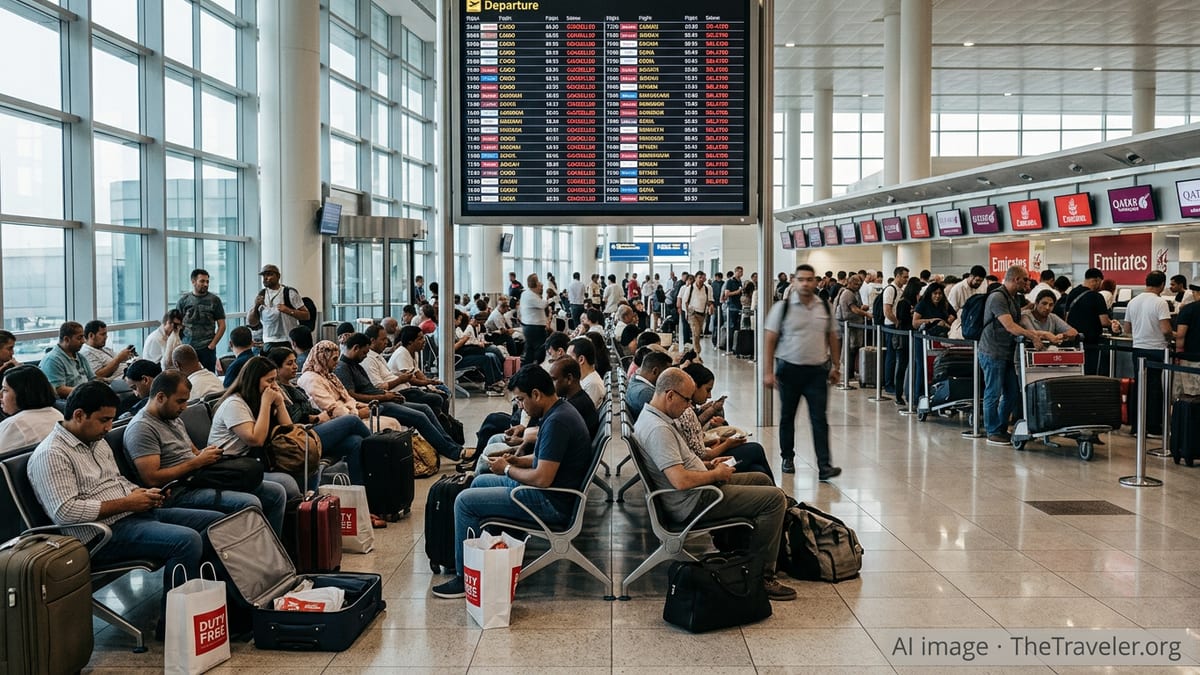
Airspace Turmoil Ripples Through Regional Hubs
The latest figures from regional aviation data providers show Cairo International Airport and Dubai International Airport among the hardest hit as Middle East carriers grapple with fast-changing airspace closures and rerouting. Cancellations and delays mounted through the weekend and into Monday, sharply curtailing movements on some of the busiest corridors linking North Africa and the Gulf.
At the center of the disruption are restrictions on overflight corridors that normally allow airlines to operate dense schedules between Egypt, the Gulf states and onward destinations in Europe, Asia and Africa. With several key airways either shut or heavily constrained, airlines have been forced to trim schedules, add circuitous routings and prioritize repatriation and essential services.
Dubai, normally one of the world’s most connected transit hubs, has seen waves of cancellations in recent days, building on more than 300 flights already axed as carriers including Emirates and flydubai temporarily suspended or thinned operations. Cairo, a critical gateway for EgyptAir and Gulf-based airlines, has also endured scores of cancellations and extended delays as crews and aircraft are repositioned or held on the ground.
While some services have now resumed on limited schedules, operations remain far from normal, with airlines warning that rolling changes are likely as authorities reassess risk and reopen or close specific airspace segments with little notice.
Major Carriers Cut and Rebuild Schedules
Flag carriers Qatar Airways, Emirates, Saudia, flydubai and Royal Jordanian are among the airlines most visibly affected by the latest round of disruption, alongside EgyptAir and several European and Asian operators that rely on Cairo and Dubai for regional connectivity. Many have issued near-daily schedule updates as they cancel, consolidate or reschedule flights in response to the evolving constraints.
Qatar Airways, which was forced to suspend most regular operations when access to its normal corridors tightened, has been gradually reintroducing a limited slate of repatriation and trunk routes, including select flights linking Doha with Cairo, Jeddah and Riyadh. These services are being marketed primarily to passengers whose earlier flights were cancelled, with the airline cautioning that seats for new bookings will be scarce in the short term.
Emirates and flydubai, the dominant operators at Dubai International Airport, initially halted large parts of their networks before resuming under reduced schedules. Emirates has been operating targeted departures to high-demand destinations such as Jeddah and Cairo, while continuing to cancel other services where routings remain unviable or where aircraft and crews are out of position. Flydubai has similarly focused on restoring connectivity across the Gulf and select regional points while warning that further cancellations are possible at short notice.
Saudi Arabia’s Saudia and Jordan’s Royal Jordanian, both heavily reliant on cross-border traffic through Gulf and Levantine airspace, have trimmed frequencies and suspended some city pairs altogether. Flights linking Amman, Riyadh and Jeddah with Cairo and Dubai have been particularly vulnerable, as carriers juggle scarce operating windows and pressure on available fleet.
Routes To Jeddah, Doha And Riyadh Bear The Brunt
Key religious, business and migrant worker corridors from Cairo and Dubai to Jeddah, Doha and Riyadh have been among the most disrupted, amplifying the human impact of the cancellations. These routes typically carry large volumes of travelers heading to Saudi Arabia for Umrah pilgrimages, to Qatar for onward long haul connections, and to Riyadh for corporate and government travel.
Passengers booked on popular combinations such as Cairo to Jeddah, Dubai to Riyadh and Cairo to Doha have reported repeated rebookings and last minute cancellations as airlines adjust to new routing restrictions. Some services that do operate are taking significantly longer than usual as they detour around closed airspace, increasing flight times and complicating crew scheduling.
Airports in Saudi Arabia and Qatar, including King Abdulaziz International Airport in Jeddah, King Khalid International Airport in Riyadh and Hamad International Airport in Doha, are simultaneously dealing with their own schedule upheavals. The knock on effect has been a shortage of available connection options, leaving many travelers in Cairo and Dubai with no immediate way to continue their journeys, even when their local airport is technically open.
Industry analysts note that these specific corridors are crucial for the wider global network because they feed long haul departures to Europe, North America and Asia. When links between Cairo, Dubai and key Saudi and Qatari hubs are disrupted, entire waves of onward flights can launch with large numbers of empty seats or be cancelled outright, intensifying the overall impact.
Stranded Travelers Face Days Of Uncertainty
For passengers caught in the middle of the turmoil, the statistics translate into anxiety filled days and nights in terminals and hotels. With 92 flights cancelled and 111 delayed across Cairo and Dubai in the most recent reporting period, thousands of people have found themselves unexpectedly grounded, often with limited information about when they will be able to depart.
Airport hotels near both hubs are reported to be close to capacity, with airlines racing to secure accommodation for eligible passengers under their care obligations. Others, particularly those on separate tickets or basic economy fares, have resorted to booking their own rooms or spending the night in departure halls as they wait for updates.
Check in areas at both airports have implemented stricter access controls to manage crowds, with authorities in the UAE and Egypt urging people not to come to the terminal unless they have received explicit confirmation that their flight is operating. Ground staff have been tasked with rebooking passengers onto the next available services, but limited capacity means that some travelers are being pushed several days out, especially on peak routes such as Dubai to Jeddah and Doha, or Cairo to Riyadh.
Travel insurance providers are also fielding a spike in claims related to extended delays, additional accommodation costs and missed onward connections. Agents caution that coverage varies widely between policies, and that some travelers may have to rely primarily on airline vouchers or refunds rather than full reimbursement of their out of pocket expenses.
Airlines And Authorities Chart A Slow Path To Normality
Aviation authorities in the region, working closely with air navigation providers, are gradually opening limited corridors that allow airlines to reestablish skeletal networks. However, operators emphasize that even as more flights reappear on departure boards, the process of returning to pre disruption levels will likely take days, if not weeks.
Carriers have begun publishing short term operating plans that prioritize routes with high numbers of stranded passengers, including Cairo to Doha and Dubai to Jeddah and Riyadh. Repatriation style flights, often scheduled outside normal peak banks, are being used to clear backlogs where security and routing constraints permit.
Industry experts note that aircraft and crew rotations have been thrown badly out of sync by the abrupt cancellations, limiting how quickly airlines can scale back up. Many widebody jets are currently positioned away from their home bases, and crew duty time limits restrict how long they can operate complex detour routings. It will take several scheduling cycles before fleets and staff are fully realigned with demand.
In the meantime, both airlines and regulators continue to urge travelers to treat any confirmed booking as provisional until they receive same day operational confirmation. With airspace conditions subject to further change, the only certainty for many passengers flying through Cairo and Dubai is that flexibility and patience will remain essential for some time to come.