

More news on this day
A growing body of data suggests flight delays have become a structural, multibillion-dollar drag on global aviation, with recent estimates indicating disruptions in the United States alone are eroding roughly $34 billion a year in economic value.
Get the latest news straight to your inbox!
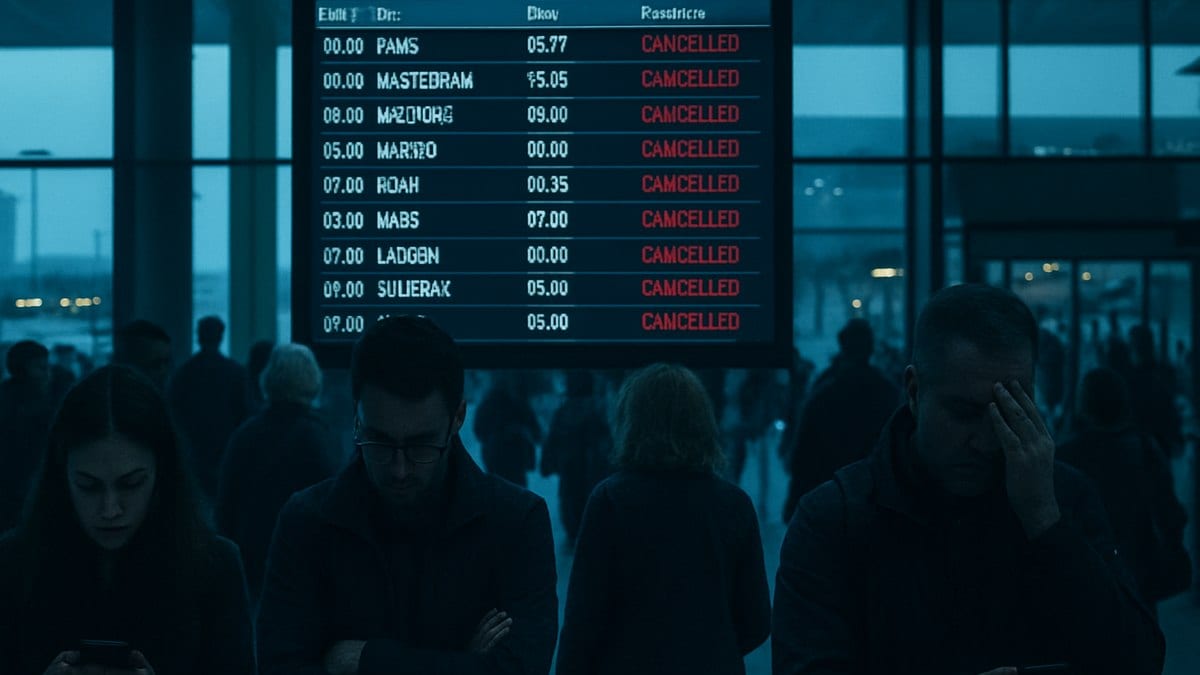
A Structural Cost Hidden in Every Late Departure
Recent research drawing on federal transportation data and industry modeling indicates that delays across the United States now cost the wider economy around $33 to $34 billion annually, once airline operating expenses and lost passenger time are combined. Analysts note that this burden is split between carriers absorbing extra fuel, crew and maintenance costs, and travelers whose productivity and onward plans are disrupted. Earlier academic work placed the U.S. economic hit from delays at roughly $32.9 billion, underscoring how little progress has been made in reducing the overall bill.
Operational studies frequently cite a rule-of-thumb cost of about $100 per minute of delay for airlines, a figure that multiplies quickly across thousands of late departures each day. Publicly available estimates from passenger-rights groups suggest that in 2022 alone, delays in the U.S. market created more than $34 billion in combined airline and passenger losses, and industry observers say the underlying drivers have only intensified through 2024 and into 2026.
What began as a post-pandemic recovery challenge has evolved into what many analysts describe as a structural crisis. Despite traffic volumes stabilizing and airline profitability improving on paper, the system remains highly vulnerable to shocks that cascade into long strings of missed connections, overnight strandings and schedule resets that reverberate for days.
Supply Chain Bottlenecks and Grounded Jets
One of the most visible pressure points is the aircraft supply chain. International Air Transport Association forecasts show airlines contending with record order backlogs running into the tens of thousands of jets, even as delivery schedules slip. A recent joint analysis by IATA and consulting firms warned that slow production and persistent parts shortages could strip more than $11 billion from airline earnings in 2025 alone, largely by forcing carriers to keep older, less fuel-efficient aircraft in service and limiting their ability to rebuild spare capacity into schedules.
The vulnerabilities became starkly apparent during the emergency grounding of thousands of Airbus A320-family aircraft in late 2025 after a global software issue triggered safety concerns. Published coverage described about 6,000 aircraft temporarily removed from service, leading to mass cancellations and delays across Europe, Asia and the Americas over a single weekend. Airlines were left juggling aircraft rotations without sufficient slack, and the resulting disruptions rippled well beyond the immediate recall window.
Separate reporting on Boeing production and safety setbacks highlights similar constraints. Regulators documented how temporary groundings of certain Boeing models and caps on production rates removed hundreds of jets from global schedules and cost manufacturers and carriers billions in direct and indirect losses. For passengers, these supply issues translate into thinner networks, more tightly packed flights and fewer options when irregular operations occur.
Tech Outages and Cyber Risks Amplify Disruption
The modern dependence on complex software and cloud-based tools is adding another layer of fragility. In July 2024, a global information technology outage linked to a faulty security software update triggered widespread failures across airlines and airports. One major U.S. carrier later reported that the resulting cancellations and delays cost it around $550 million in lost revenue and extra expenses, illustrating how a single digital incident can erase months of operational gains.
In September 2025, a cyberattack on a major aviation technology supplier disrupted systems used for check-in and boarding at several of Europe’s busiest hubs, including London Heathrow and Brussels. Airports shifted to manual procedures and warned that delays and cancellations would last hours, if not days. The episode followed earlier warnings from cybersecurity researchers that the aviation ecosystem’s interconnected IT architecture makes it particularly susceptible to cascading outages.
Analysts argue that many of these technology shocks have outsized consequences because airlines are operating with minimal buffer capacity. With fleets stretched and spare crews limited, any prolonged system failure leads quickly to crew out-of-position problems and aircraft stranded in the wrong cities, compounding the cost of the initial incident.
Staffing Strains, Regulation and the Human Cost
Staffing remains another fault line in the delay crisis. Studies of U.S. domestic operations between 2010 and 2024 point to a marked shift in how security checkpoints and crew availability contribute to late departures, with post-pandemic schedules more sensitive to even modest fluctuations in staffing levels. Air traffic control shortfalls in several key regions have prompted flow restrictions that slow departures and arrivals, lengthening block times and eroding on-time performance.
Labor pressures have also surfaced through industrial action and new safety rules. In Canada, recent strike action by cabin crew highlighted longstanding compensation structures in which flight attendants are not paid during many ground delays, deepening tensions over schedule reliability. In India, a 2025 scheduling crisis at one of the country’s largest low-cost carriers was linked partly to new flight duty time limitations for pilots, which increased mandatory rest periods and reduced night-time flying even as the airline expanded its fleet.
Passengers, meanwhile, are directly exposed to the human cost of these strains. Consumer advocacy groups report that tens of millions of travelers each year face significant delays, with a substantial share of the economic loss coming from missed connections, forfeited hotel nights, rebooked trains and lost work hours. Surveys show rising frustration with perceived “unrealistic scheduling” and a growing expectation that regulators will intervene more aggressively when chronic delays persist.
Regulators, AI and the Race to Contain the Damage
Regulatory responses are beginning to reshape incentives. In early 2025, the U.S. Department of Transportation imposed a multimillion-dollar penalty on a major airline over what federal officials described as chronic delays and unrealistic scheduling, a rare case in which systemic tardiness triggered direct financial sanctions. In Europe, expanded enforcement of compensation rules has exposed carriers to several billion euros a year in potential payouts tied to late or canceled flights.
Government reviews of national air traffic control systems have also acknowledged the need for extensive modernization, with cost estimates running into the tens of billions of dollars over coming years. Policy papers emphasize that outdated hardware and software, combined with rising weather volatility, leave networks vulnerable to traffic-management slowdowns that can snarl entire regions for days.
At the same time, airlines and airports are turning to artificial intelligence and real-time data tools in an effort to preempt disruptions and optimize recovery. Industry briefings from analytics providers describe how machine-learning models now ingest live information on weather, crew duty limits, aircraft status and airport congestion to suggest schedule adjustments minutes or hours before a problem becomes visible to passengers. Proponents argue that even small reductions in average delay minutes per flight could claw back billions from the current $34 billion drag.
Yet analysts caution that technology alone will not resolve what has become a systemic imbalance between demand, infrastructure and resilience. With global traffic projected to keep growing, the emerging consensus in research and policy circles is that without renewed investment in capacity, safety oversight and workforce planning, the true cost of flight delays is likely to climb beyond today’s $34 billion estimate in the years ahead.