

More news on this day
A sharp rebound in global air travel is colliding with long-standing operational bottlenecks, as analysts warn that a largely hidden flight delay bill of roughly 18 billion dollars a year risks being amplified by booming 2026 bookings.
Get the latest news straight to your inbox!
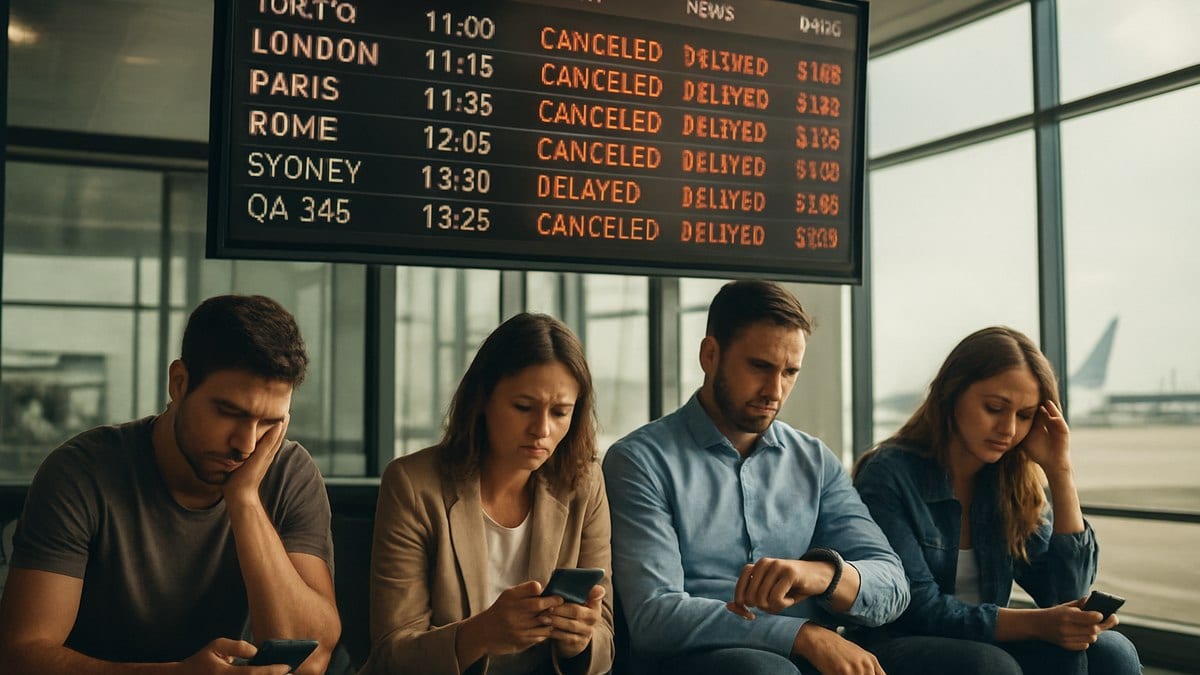
Historic delay costs resurface as a modern warning
Research for the Federal Aviation Administration has previously put the annual economic cost of passenger trip delays in the United States at about 18 billion dollars, tallying lost time, missed connections, extra staffing, fuel and other knock-on effects across the wider economy. More recent academic work and policy reviews suggest that the underlying drivers of those costs, including congested hubs and tight scheduling, remain firmly in place even as airlines modernize fleets and operations.
While the original 18 billion dollar estimate dates back more than a decade, economists note that it captured systemic inefficiencies rather than a one-off crisis year. Publicly available data on on-time performance, cancellations and passenger volumes indicate that similar patterns of congestion and disruption have re-emerged in several peak travel periods since the pandemic recovery, particularly around major holidays and weather events.
Industry analysts say the headline numbers understate the total burden on travelers and businesses. Beyond direct costs to airlines, delays ripple through supply chains, corporate travel budgets and tourism-dependent regions when meetings are missed or itineraries are abandoned. Consumer surveys also point to a softer but significant cost in eroded confidence, with some travelers shortening trips or avoiding certain hubs perceived as unreliable.
2026 demand accelerates despite operational strain
Travel demand entering 2026 is robust. Data released by the International Air Transport Association for January 2026 show global passenger traffic up 3.8 percent year on year, continuing a run of record volumes through late 2025. Separate long-term projections published in February 2026 point to solid growth through the decade, driven by rising middle-class travel in Asia and resilient leisure demand in North America and Europe.
Forward-booking data from travel technology providers indicate especially strong momentum in the first half of 2026. One widely cited analysis of global air bookings shows air visitor reservations for early 2026 running around 20 percent ahead of the same period in 2025, as travelers lock in summer and major event travel earlier than in previous years. Corporate travel forecasts compiled by industry groups also project incremental growth in average ticket prices through 2026, suggesting companies are willing to absorb higher fares to keep employees on the road.
At the same time, IATA’s latest global outlook highlights persistent capacity constraints, with aircraft delivery delays and maintenance bottlenecks limiting how quickly airlines can add seats. Carriers in several regions are operating with tight spare capacity, making them more vulnerable when storms, air traffic control disruptions or technology issues arise. Analysts warn that this leaves little margin for error as airports brace for another record summer.
High-profile disruptions spotlight the risks
Recent disruptions have underscored how quickly delays can translate into major financial and reputational damage. A large-scale technology failure at a major U.S. carrier in 2024 led to the cancellation of thousands of flights over several days and a reported financial hit of more than 500 million dollars, according to regulatory filings and company statements reviewed in public coverage.
In India, an extensive scheduling crisis at the country’s largest airline in late 2025 triggered thousands of cancellations and widespread delays after new flight crew time rules were introduced. Public reports describe several days in early December when close to one in five flights on the carrier’s network failed to operate as scheduled, prompting regulators to temporarily adjust the rules to stabilize operations.
Government actions have also drawn attention to the cost of poor performance. In the United States, a record civil penalty announced in 2023 against a major airline for mass holiday cancellations, and subsequent partial waivers granted in 2025, highlighted the financial stakes tied to consumer protection rules. Separate reporting on the impact of a protracted government shutdown in late 2025 detailed hundreds of millions of dollars in lost revenue for airlines as air traffic control staffing strains forced capacity cuts and extensive delays at key hubs.
Taken together, these episodes illustrate how structural pressure points in the system, from outdated IT to tight labor resources, can quickly convert routine delay minutes into large balance-sheet losses and a renewed regulatory spotlight.
Passenger experience: longer waits and lost time
For travelers, the hidden 18 billion dollar figure is most visible in hours spent waiting at gates, missed connections and disrupted plans. Consumer-focused analyses of U.S. airline performance in the most recent full year show average departure delays approaching 80 minutes at some large carriers, with millions of passengers affected. When multiplied across the industry, one study of domestic operations calculated more than 2 billion minutes of collective delay, equivalent to thousands of years of lost passenger time.
On-time performance varies widely by airport and airline. Rankings of major U.S. hubs for 2026, based on 2025 flight data, show on-time arrival rates at some of the worst-performing large airports hovering near 70 percent. That means roughly three in ten flights arrive late, creating missed connections and crowding at customer service points when irregular operations cascade through the day.
Travelers are responding by building in longer connection times, purchasing flexible fares and, in some cases, shifting to alternate airports perceived as more reliable. Industry consultants note that digital tools allowing passengers to rebook themselves during disruptions are becoming a competitive differentiator, even as they also reveal in real time just how frequently schedules slip.
The frustration is not limited to leisure travelers. Corporate travel managers report increasing pressure to quantify the productivity cost of delays, with some companies tracking lost working hours and rebooking expenses as part of broader sustainability and duty-of-care reporting.
Can technology and policy keep pace with demand?
Airlines and airports are investing in technology to reduce the risk that the 18 billion dollar drag worsens as 2026 bookings surge. Publicly available information from major carriers highlights spending on modern reservation platforms, crew management tools and predictive maintenance systems designed to spot emerging issues before they trigger large-scale delays. Airports are deploying biometrics at security and boarding, along with upgraded baggage systems, to speed passenger flows and reduce choke points.
Air navigation service providers and regulators are moving more slowly. Proposals to modernize air traffic management, expand the use of satellite-based navigation and add staffing in critical control centers have advanced unevenly across regions. Aviation groups argue that without parallel upgrades to airspace infrastructure, gains from airline-side investments could be partially offset by persistent bottlenecks in the sky.
Policy debates are also intensifying over compensation and minimum service standards during disruptions. Some consumer advocates in North America continue to press for rules closer to those in the European Union, where airlines must compensate passengers in many delay and cancellation scenarios. Airline industry representatives counter in public forums that higher mandated payouts could reduce funds available for operational investments.
For now, the data point to a widening gap between the speed of demand growth and the gradual pace of structural reform. With global passenger traffic still climbing and forward bookings for 2026 already elevated, the risk is that an economic cost historically measured at 18 billion dollars a year could climb further, even as much of the impact remains hidden in the fine print of travel itineraries and corporate ledgers.