

More news on this day
Flight disruptions in the United States are quietly draining an estimated $18 billion a year from travelers in 2026, as delays translate into lost time, extra spending and trip plans reshaped around an increasingly unpredictable aviation network.
Get the latest news straight to your inbox!
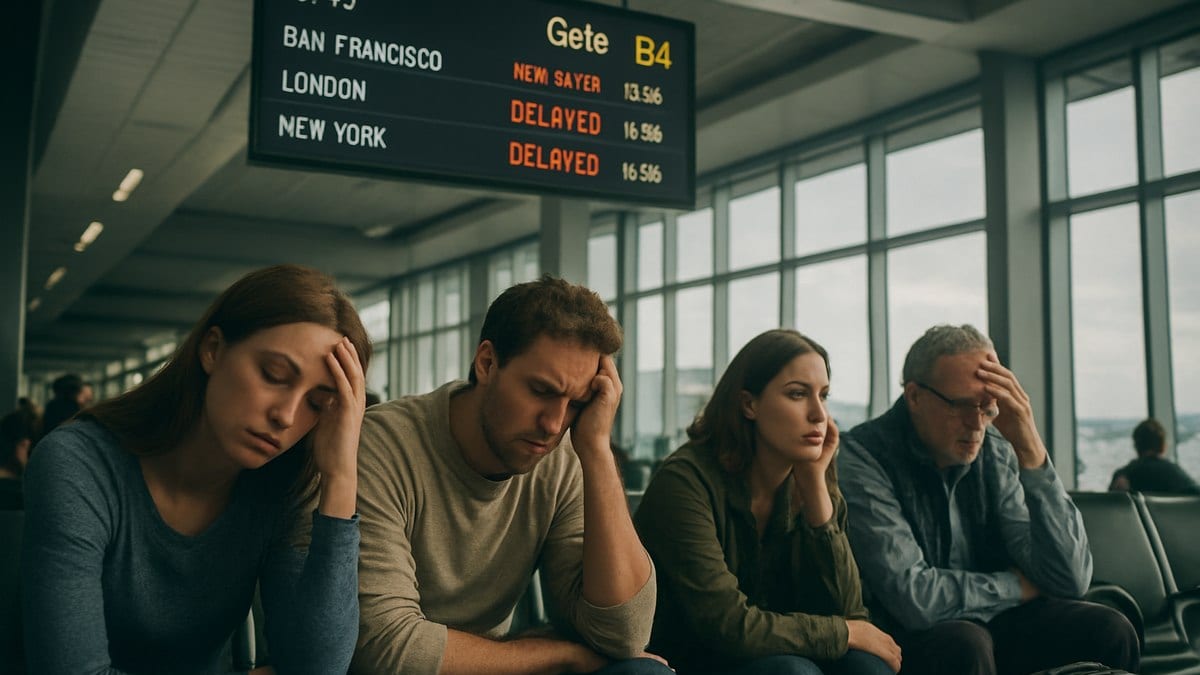
A Growing Hidden Cost Behind Every Delay
Recent assessments of delay-related impacts indicate that U.S. air passengers now shoulder roughly $18 billion annually in costs linked directly to disruption. That figure reflects both the economic value of time lost while waiting for late departures or missed connections and the out-of-pocket expenses that are rarely captured in headline fare comparisons.
Industry and government-linked analyses point out that the total economic impact of delays is even larger once airline operating costs and wider productivity losses across the economy are included. Earlier studies placed overall delay costs in the tens of billions of dollars per year, with passengers bearing a substantial share of the burden. The latest $18 billion estimate highlights how that passenger share has continued to rise as air travel demand rebounds.
Behind the aggregate numbers are millions of individual disruptions. Data compilations for 2023 and 2024 show that U.S. carriers operated with average delays running into the tens of minutes across hundreds of thousands of flights, adding up to hundreds of millions of hours of passenger waiting time. When those hours are valued using standard transportation economics benchmarks for the cost of time, the result is a multibillion-dollar annual hit absorbed largely by consumers.
How Delay Costs Show Up in Travelers’ Wallets
For many travelers, the most visible cost of a delay is the extra money spent once a trip begins to slip off schedule. Travel insurance providers and industry datasets show that claims linked to delays and missed connections routinely involve hotel stays, meals, and alternate ground transport while passengers wait for a replacement flight.
Typical delay claims run into the hundreds of dollars per incident, with travel protection data indicating average payouts in the range of several hundred dollars for missed connections and shorter delays, and somewhat lower amounts for baggage or airline-related issues. Aggregated across millions of disrupted passengers each year, these expenses contribute significantly to the multibillion-dollar total attributed to travelers.
Beyond direct reimbursement, many expenses never show up in insurance statistics. Analysts note that passengers often book last-minute hotel rooms at peak prices, pay change fees or fare differences for rebooked flights, and purchase extra meals and ground transport. In cases where delays are attributed to weather or other factors outside an airline’s control, those costs are frequently borne entirely by the traveler, further reinforcing the notion that much of the financial weight of disruption falls on consumers.
Time itself is another key component. Transportation economists commonly assign an hourly value to passenger time when calculating the cost of delays. When applied to the hundreds of millions of hours of annual delay reported across the U.S. network, that valuation produces figures that align with the latest $18 billion estimate for traveler impacts alone, separate from what airlines and airports incur.
Operational Strains Keep Pressure on On-Time Performance
Operational statistics from federal datasets and market research show that, while average delay durations have fluctuated, the system continues to operate near capacity at many major hubs. Weather, air traffic control constraints, and infrastructure bottlenecks routinely combine to push flights behind schedule, especially during peak travel seasons and holiday periods.
Industry cost analyses suggest that airlines themselves face tens of billions of dollars in added expenses tied to delays, including extra fuel burn, crew time and maintenance. Those operational pressures can indirectly affect passengers through higher fares, tighter scheduling and reduced slack in the system, leaving less room to recover when something goes wrong.
Events over the past several years have highlighted how quickly disruption can cascade. High-profile technology outages and severe weather episodes have, at times, produced days of cancellations and rolling delays, stranding large numbers of passengers and prompting renewed scrutiny of resilience in airline and air traffic operations. Publicly available information from those incidents underscores how concentrated disruption at a few key hubs can ripple across the entire domestic network.
At the same time, research into delay prediction and air traffic modernization shows that even incremental efficiency gains can translate into large savings when applied across millions of flights. Federal programs to modernize airspace management and airline investments in better scheduling tools aim to reduce the frequency and duration of delays, although the benefits can take years to fully materialize.
Why Complaints Are Rising Even as Metrics Improve
Federal complaint data and consumer surveys indicate that airline-related grievances have climbed in recent years, even as some headline measures of on-time performance show gradual improvement compared with the early post-pandemic period. Observers say this reflects a gap between what statistics capture and what passengers experience.
Part of the disconnect stems from the compounding effect of disruptions. A relatively modest initial delay can trigger missed connections, long rebooking lines and lost work or vacation time, turning a short schedule slip into an overnight ordeal. For travelers on tightly timed trips or with limited flexibility, the overall impact is far greater than the delay minutes alone suggest.
Another factor is the shift in expectations as ticket prices and load factors have climbed. With aircraft frequently operating close to full and alternative flights limited, passengers may feel they have fewer options when something goes wrong. Reports of long hold times, crowded customer service desks and difficulty securing compensation or accommodations add to perceptions that the system is not keeping pace with demand.
Consumer advocates have pointed to the growing share of complaints related to cancellations, delays and customer service as evidence that the human impact of disruption is not fully reflected in operational dashboards. For many travelers, the $18 billion in annual delay-related costs is experienced as a series of stressful, costly episodes rather than an abstract national total.
What Travelers and Policymakers Are Watching in 2026
As the 2026 travel season unfolds, analysts are watching several trends that could influence the scale of delay-related costs to passengers. Continued growth in demand, especially on popular leisure and sunbelt routes, is expected to keep pressure on peak periods, while airlines are working to balance aircraft utilization with the need for additional schedule buffer.
Regulatory developments remain a focal point. Discussions around stronger passenger protections, clearer compensation rules and improved transparency on delay causes have intensified amid rising complaints. While current U.S. rules provide specific safeguards in limited situations, comparisons with more expansive compensation regimes abroad are shaping public debate over whether domestic standards should change.
Infrastructure investments at major airports and in air traffic control systems are another key variable. Projects aimed at expanding runway capacity, modernizing terminals and upgrading technology are designed to improve throughput and reduce bottlenecks over time. Publicly available planning documents suggest that some benefits are already being realized, but full impacts will depend on consistent funding and implementation.
For individual travelers, the $18 billion figure underscores the importance of factoring delay risk into trip planning. Industry guidance increasingly emphasizes building longer connection windows, considering travel insurance where appropriate, and paying close attention to seasonal patterns and airport performance records. Even with those precautions, however, the data for 2026 indicates that flight delays remain a costly and persistent feature of U.S. air travel, with passengers continuing to bear a substantial share of the financial and time burden.