

More news on this day
Flight delays are inflicting an estimated $34 billion in economic damage each year, highlighting how chronic disruption has become one of the most expensive pressure points in global air travel.
Get the latest news straight to your inbox!
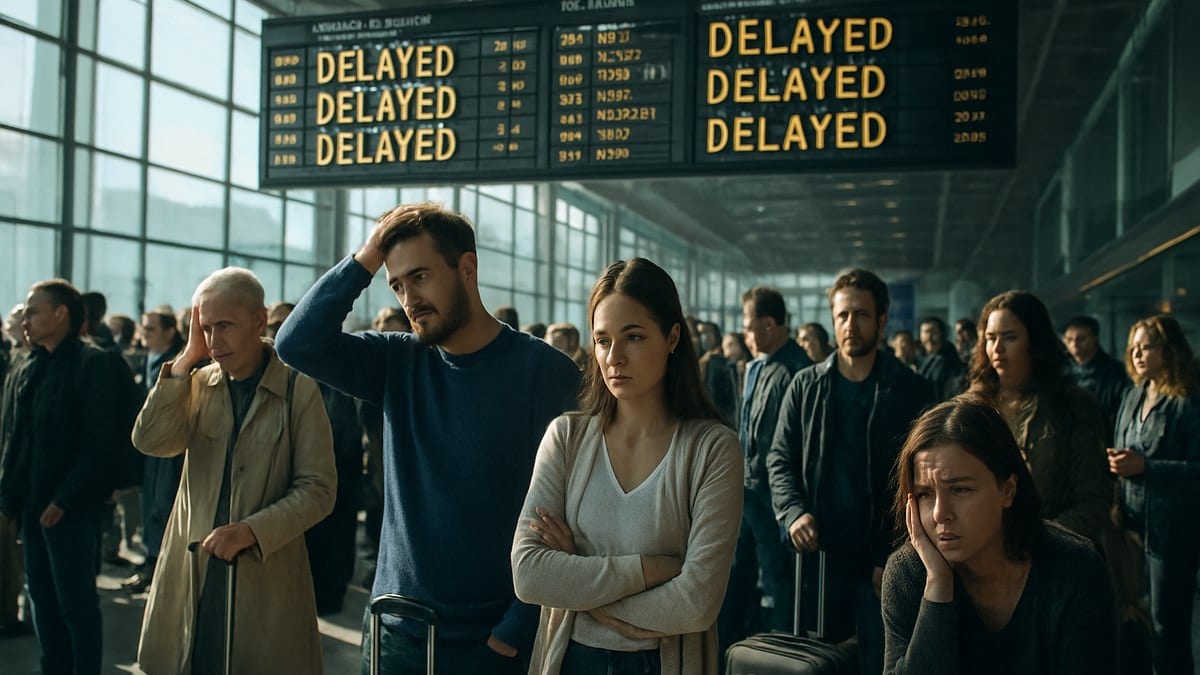
New Estimates Put a Price Tag on Disruption
Recent economic assessments of flight disruption indicate that delays and cancellations are now costing tens of billions of dollars annually worldwide, with several studies converging around a central figure of roughly $34 billion a year. Research drawing on 2022 and 2023 traffic data for major aviation regions, including the United States, Europe and Australia, suggests that the global bill for disruption is not only large but growing faster than passenger volumes.
For the United States alone, publicly available regulatory filings and industry analysis show that delays and cancellations have been generating an annual economic impact in the range of 30 to 34 billion dollars in recent years. When similar methodologies are applied to other mature aviation markets, the implied worldwide total underscores how deeply schedule unreliability is eroding the value created by commercial air transport.
The 34 billion dollar figure typically aggregates several categories of harm: additional costs to airlines, lost time for passengers, knock-on effects on other sectors such as hospitality and retail, and the costs of rebooking, care and compensation. While the precise global total varies depending on assumptions, most recent models point to a structural problem that is no longer confined to isolated bad-weather days or holiday peaks.
Where the Money Goes: Airlines, Travelers and the Wider Economy
Breakdowns of disruption costs show that airlines themselves shoulder only part of the total impact. Studies of recent flight seasons indicate that roughly one third of the burden falls directly on carriers in the form of extra fuel burn, crew overtime, out-of-position aircraft, maintenance knock-ons and the expenses of accommodating stranded passengers. In tight-margin businesses, these unplanned outlays can erase profits on entire routes or days of operation.
A slightly larger share is attributed to the value of time lost by passengers. Economic assessments generally assign a monetary value to each hour of delay based on income levels and government transport-agency benchmarks. When multiplied by millions of delayed travelers and average waits that can stretch well beyond half an hour, the result is a multi-billion dollar annual transfer of productivity and leisure time from travelers to congestion and inefficiency.
Spillover effects make up the rest. Late arrivals and missed connections ripple into hotels, ground transport, meetings and events, tourism activities and even supply chains that rely on air cargo carried in passenger aircraft bellies. Analysts tracking the 2022 and 2023 disruption seasons found that this indirect damage, while harder to quantify, adds significantly to the overall economic footprint of delays and cancellations.
Why Delays Are Getting Worse, Even as Demand Soars
The rising cost of disruption comes at a time when commercial aviation is carrying more passengers than ever. Industry bodies have reported record or near-record global traffic, with around five billion travelers projected in 2024. Yet capacity has not always kept pace, and the system’s fragility has been exposed whenever demand peaks or a single point of failure creates widespread schedule chaos.
Weather remains a major driver of delay minutes, particularly in North America and Europe, but operational and systemic issues are increasingly in focus. Staffing shortages among air traffic controllers, ground handlers and maintenance technicians, together with aircraft delivery delays tied to supply chain problems, have all contributed to tighter operating margins and less slack in daily schedules.
Low-cost carriers and ultra-tight aircraft utilization models also play a role. Networks built on quick turnarounds and high daily aircraft hours can be profitable when everything runs on time, but they leave little resilience when disruptions occur. A single technical issue or crew timing problem early in the day can cascade into hours of downstream delays and missed connections across a network that spans multiple continents.
Regulators, Tech Providers and Airports Race to Contain the Damage
As the price tag of disruption becomes harder to ignore, regulators and industry players are stepping up efforts to contain it. In the United States, transportation regulators have linked chronic delays to unrealistic scheduling and consumer-harm concerns, and have introduced new transparency tools to help passengers understand what airlines will provide in the event of significant delays or cancellations.
In Europe, longstanding compensation rules have already made delays costly for carriers, and recent economic work by regional aviation organizations has quantified multi-billion euro losses tied to air traffic management bottlenecks. These findings are adding momentum to modernization programs aimed at overhauling congested airspace and harmonizing fragmented control systems in order to cut en route delays.
Technology companies and airport operators are meanwhile promoting digital tools as part of the solution. Real-time data platforms, predictive analytics for staffing and gate management, and automated rebooking engines are being deployed to identify bottlenecks earlier and keep aircraft, crew and passengers moving. Baggage-tracking upgrades show how investments in operational technology can meaningfully reduce mishandling costs, and similar approaches are increasingly being applied to delay mitigation.
What It Means for Fares, Climate and Future Travel Plans
For travelers, the 34 billion dollar disruption bill is not an abstract statistic. Industry cost models suggest that persistent delays feed back into ticket pricing as airlines attempt to recover higher operating and contingency costs, especially in an environment of elevated fuel prices and constrained fleet growth. While competition limits how much of the burden can be passed on directly, analysts expect schedule unreliability to remain one of several upward pressures on average airfares.
There are environmental implications as well. Longer taxi times, holding patterns and re-routings associated with congestion increase fuel burn and carbon emissions, blunting the benefits of more efficient aircraft and sustainable aviation fuel. Some economic studies now explicitly account for these climate-related externalities when tallying the full cost of disruption, adding another layer to the argument for more resilient infrastructure and smarter traffic management.
For business travelers and tourism planners, the new cost estimates reinforce a shift in behavior that began after the pandemic. Companies are building more buffer time into itineraries and are scrutinizing connection risks on complex routings, while leisure travelers increasingly consider schedule reliability and historic on-time performance alongside price when choosing airlines and airports. As long as flight delays continue to generate tens of billions of dollars in economic damage each year, reliability is likely to remain one of the most scrutinized metrics in global aviation.