

More news on this day
Flight delays are no longer just an inconvenience for travelers; new analyses indicate they now represent an annual economic drag of roughly 34 billion dollars, exposing deep structural weaknesses in the way global aviation manages capacity, staffing and disruption.
Get the latest news straight to your inbox!
A Mounting Economic Drain on Airlines and Passengers
Recent economic assessments of air travel disruption point to an annual cost in the tens of billions of dollars, with the United States alone accounting for an estimated 30 to 34 billion dollars in 2022 from delayed and cancelled flights. Publicly available summaries of regulatory filings and consultancy work for the U.S. Department of Transportation describe this figure as covering direct airline operating costs, lost passenger time and wider spillover effects on hotels, ground transport and business activity.
Similar calculations across multiple regions indicate that the burden is now global rather than confined to any single market. Industry analyses drawing on International Air Transport Association and Eurocontrol data suggest that delayed flights in Europe and Australia added a further 30 billion dollars or more in 2022, pushing the combined impact of disruption in major aviation markets well beyond the 34 billion dollar headline and into a range that rivals the annual profit of the entire airline sector.
The financial hit is shared unevenly. Airlines absorb higher fuel burn from extended taxi times and reroutes, pay for crew overtime, reposition aircraft and accommodate stranded passengers. At the same time, research highlighted by outlets such as PhocusWire and AirHelp shows that travelers shoulder a substantial share of the total through lost work hours, missed connections and out-of-pocket costs for meals, hotels and alternative transport.
The result is a structural strain that eats into an industry already operating on thin margins. While global airlines are forecast to post profits in 2024 and 2025, IATA’s latest outlook notes that cost pressures from congestion, supply chain constraints and staffing issues are likely to remain elevated, limiting how much of the disruption bill carriers can absorb without passing it on through higher fares and fees.
Where Delays Come From: Capacity, Staffing and Weather
The rising economic cost reflects not only more passengers in the skies but also a network struggling to keep pace. Reports from Eurocontrol’s performance unit show that gate-to-gate air traffic flow management delays in European airspace reached record levels in 2024, with almost 30 million minutes of delay attributed to bottlenecks such as air traffic control staffing, constrained routes and airport capacity.
In the United States, Federal Aviation Administration statistics and academic work from institutions including the University of California, Berkeley have for years underlined how congestion at a relatively small number of major hubs can cascade across the national network. That dynamic has intensified as airlines have rebuilt schedules to, and in some cases beyond, pre‑pandemic levels while contending with shortages of pilots, air traffic controllers and maintenance workers.
Weather remains a consistent trigger. Infographics produced by The Weather Company using IATA and Eurocontrol data estimate that storms, low visibility and other adverse conditions cost airlines hundreds of millions of euros a year in extra fuel and disruptions within European airspace alone. More frequent extreme weather events linked to climate change are adding volatility, particularly in peak summer travel periods when systems are already stretched.
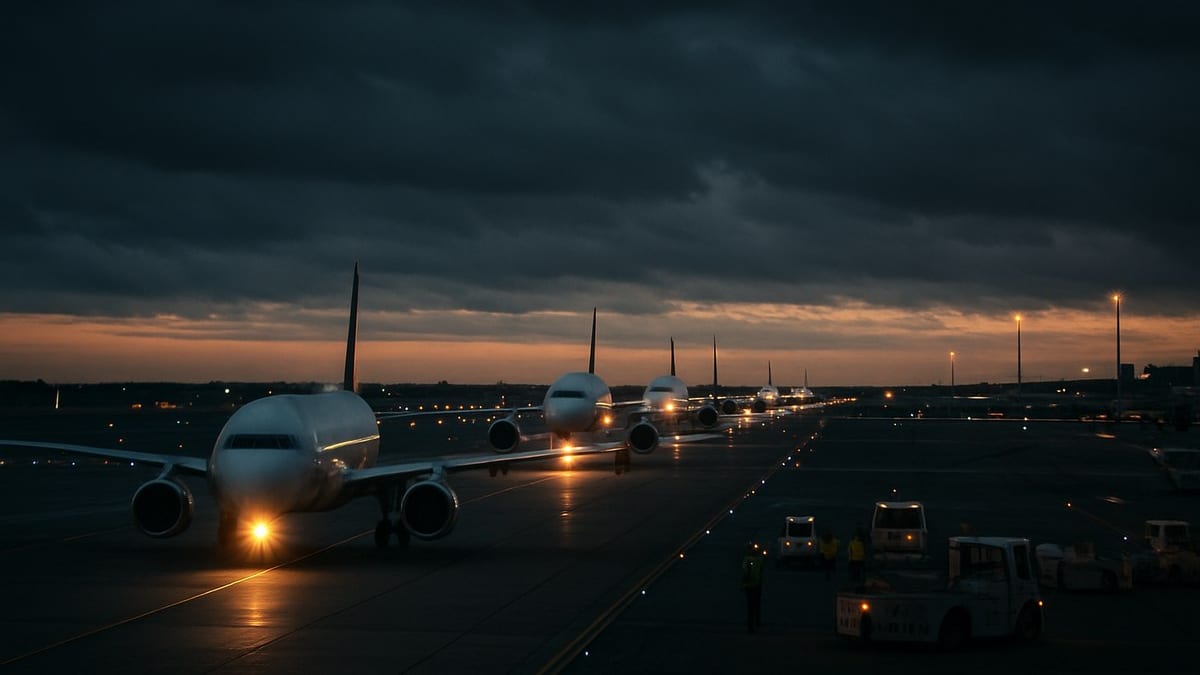
Infrastructure limitations compound these challenges. Many airports operate close to their declared capacity for long stretches of the day, leaving little resilience to absorb unexpected events such as equipment failures, runway closures or security incidents. When such events occur at busy hubs, long departure queues and missed connections can quickly ripple through domestic and international networks, magnifying the final economic impact.
Passengers Pay in Time, Money and Well‑Being
While airline finances draw much of the attention, a significant portion of the 34 billion dollar annual strain is borne directly by passengers. AirHelp’s analysis of disruption in 2022, cited by several travel and business publications, estimated that each affected traveler faced average out‑of‑pocket expenses in the hundreds of dollars once meals, accommodation, rebooking costs and missed activities were taken into account.
Beyond direct spending, the value of lost time is substantial. Economic models used by regulators and researchers assign a monetary value to hours spent waiting in terminals or re‑routing journeys, reflecting lost productivity and the opportunity cost of missed work meetings, family events and onward travel. When multiplied across hundreds of millions of disrupted passengers, these lost hours amount to tens of billions of dollars in implicit costs each year.
There is also a growing recognition of the human toll. Surveys commissioned by consumer advocacy groups and referenced in industry reports link extended delays and cancellations to higher stress levels, sleep disruption and, in some cases, worsened physical health for vulnerable travelers. The frustration is often intensified by poor communication at airports, inconsistent compensation practices and uncertainty over passenger rights, particularly on international journeys involving multiple carriers and jurisdictions.
For leisure travelers, disruption can mean truncated vacations or missed cruise departures. For business travelers, it may translate into cancelled deals or foregone opportunities. In both cases, the economic cost extends beyond the ticket to the broader ecosystem of tourism and trade that relies on predictable air connectivity.
Environmental and Policy Pressures Add to the Bill
Delays also carry an environmental price tag that is beginning to feature more prominently in policy debates. The same regulatory and industry analyses that quantify the financial cost estimate that disrupted flights generated around 9 million tons of additional carbon dioxide emissions in 2022, roughly 1 to 1.5 percent of total airline emissions for the year. Holding aircraft on the ground with engines running, extending flight paths to navigate congestion and repeating takeoff and landing cycles all drive fuel burn higher than necessary.
Governments and regulators are responding with a mix of passenger rights rules and pressure on aviation stakeholders to improve performance. In Europe, discussion around strengthening compensation rules under Regulation 261 has intensified after summers marked by widespread delays. In the United States, the Department of Transportation has increased public reporting and scrutiny of airline customer service commitments, encouraging carriers to standardize vouchers, meals and hotel coverage during severe disruptions.
Industry groups warn that poorly calibrated rules can inadvertently increase costs and reduce flexibility, potentially worsening the very delays policymakers hope to curb. At the same time, environmental organizations argue that pricing the true climate impact of disruption could accelerate investment in more efficient air traffic management technologies and sustainable aviation fuels.
The policy debate reflects a broader question for governments: whether to prioritize consumer protection, environmental performance or operational flexibility when disruptions inevitably occur. The answer will influence how the 34 billion dollar burden is shared among airlines, passengers and taxpayers in the years ahead.
Technology and Operational Reforms Seek to Contain Costs
Faced with mounting disruption costs, airlines, airports and air navigation service providers are turning to technology and process reform in an effort to contain the damage. Aviation business media highlight a growing push for real‑time data integration, predictive analytics and artificial intelligence tools that can anticipate knock‑on effects from weather systems, crew timing constraints or equipment failures before delays cascade.
Projects in both North America and Europe aim to modernize airspace management, allowing for more precise routing, dynamic use of military and civilian airspace and closer coordination between air traffic control centers. Proponents argue that even modest improvements in average delay per flight would translate into billions of dollars in saved time and fuel when scaled across global traffic levels.
On the ground, airports are experimenting with collaborative decision‑making platforms that share operational data among airlines, ground handlers and terminal operators. By aligning schedules, gate assignments and turnaround activities, these systems are designed to reduce idle time and keep aircraft flowing more smoothly through constrained infrastructure.
Yet progress is uneven, and the latest performance data from Europe and the United States suggest that gains from new tools are being offset by continued growth in demand, staffing constraints and more volatile weather. For travelers, that means delays are likely to remain a defining feature of modern air travel, even as the industry and policymakers seek ways to keep the global cost of disruption from climbing far beyond today’s 34 billion dollar strain.