

More news on this day
Travelers moving through Cancun International Airport are facing a fresh wave of disruption, with publicly available data showing 43 delayed flights and nine cancellations affecting services on Spirit Airlines, Avianca, JetBlue and WestJet across Mexico City, Montreal, Toronto and several major U.S. gateways.
Get the latest news straight to your inbox!
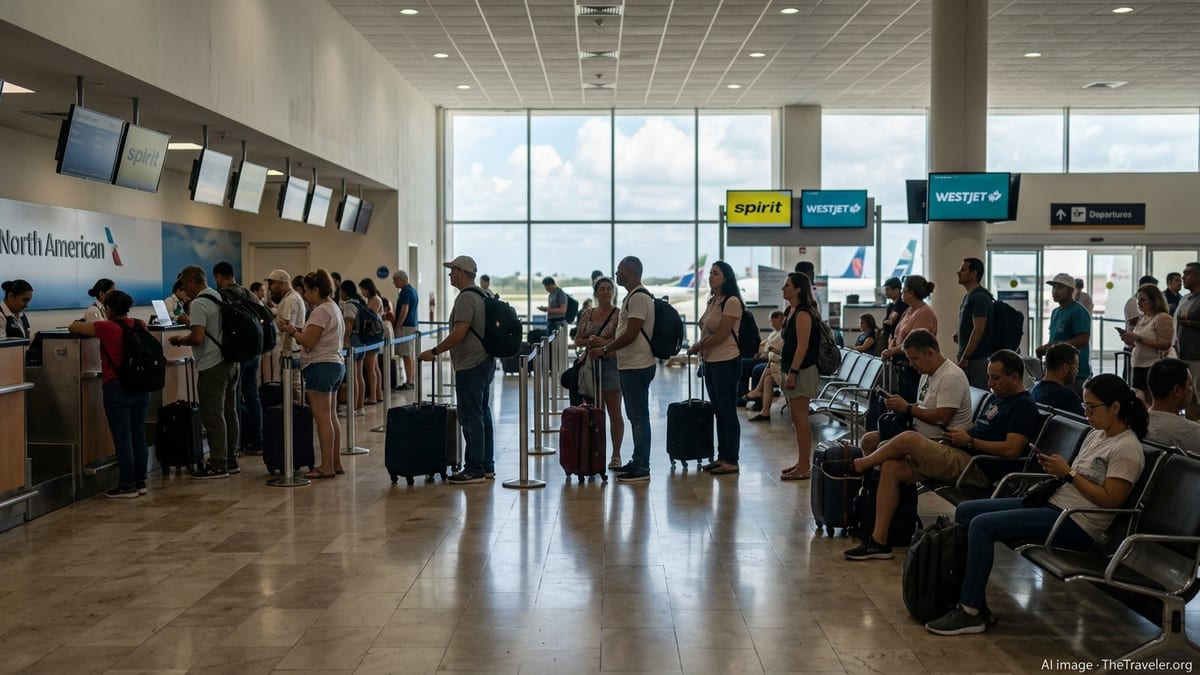
Weather and Network Strains Converge on a Busy Tourism Hub
The latest operational snarl at Cancun International Airport comes at a time when carriers across North America are still contending with tight aircraft utilization and lingering schedule fragility following a series of severe winter systems in late January and February. Industry data and recent coverage of regional storms indicate that heavy snow, ice and strong winds at hubs in the United States and Canada have periodically forced airlines to compress timetables, triggering rolling delays and missed connections that can ripple south toward leisure destinations.
Cancun, one of Latin America’s busiest leisure airports, depends heavily on tightly timed turnarounds for narrowbody jets cycling between Canada, the United States and Mexican cities such as Mexico City. When an aircraft or crew departs late from a northern hub, that delay can cascade into subsequent legs touching Cancun later in the day. According to airline operations summaries examined by travel analysts, this pattern has been evident again as carriers work through weather-related backlogs and constrained crew availability.
Published flight boards for Cancun on the day of the disruption show late departures and arrivals stretching across morning and afternoon banks, with some services pushed back by several hours. A smaller number of flights were removed from the schedule entirely, reflecting what aviation observers describe as a preference by airlines to cancel a subset of flights in order to protect the integrity of the broader network.
The timing has been particularly challenging for leisure travelers leaving resorts at the end of school holidays and winter getaway periods, when load factors are typically high and options to rebook onto alternative departures are limited. Travel forums and social media posts from recent weeks already depict a mix of smooth experiences and extended waits at Cancun, underscoring how quickly the airport’s operations can tip from manageable to strained when multiple flights are disrupted at once.
Spirit, Avianca, JetBlue and WestJet Among Most Affected
The current wave of 43 delays and nine cancellations is hitting a cross-section of carriers that link Cancun with both regional and long-haul markets. Publicly accessible schedules show Spirit Airlines operating dense frequencies between Cancun and U.S. cities including Orlando, Fort Lauderdale, Houston and various Midwest gateways, routes that are particularly exposed when storms slow ground handling and deicing operations at origin airports.
Avianca, which connects Cancun to its broader Latin American network, appears among the affected airlines with delays on flights tied into its Central and South American hubs. While the carrier’s operations are less dependent on winter weather in North America, any disruption to connecting flows or air traffic control programs can still reverberate into departures and arrivals at Cancun, especially during peak hours.
JetBlue, a major player on U.S. East Coast leisure routes, has recently expanded and reshaped its Mexico and Caribbean schedules, and the latest irregular operations in Cancun are impacting those links. Flight trackers show late-running services involving U.S. airports where air traffic flow restrictions and congested arrival banks have been recurring themes in recent seasons.
Canadian carrier WestJet, which markets Cancun heavily to sun-seeking travelers from Calgary, Edmonton, Montreal, Toronto and Vancouver, is also seeing its Cancun rotations disrupted. The airline’s timetable data, along with updates from Canadian airport authorities, indicate that winter weather and broader network pressures have already led to a series of schedule adjustments and cancellations this year, making any additional irregularities at Cancun especially visible for Canadian travelers.
Key Routes Impacted: Mexico City, Montreal, Toronto and U.S. Gateways
Among the most affected markets in the current episode are flights linking Cancun with Mexico City, Montreal and Toronto, along with a swath of U.S. cities on both coasts. Route maps and current-season schedules show that these corridors are central to airline strategies in the region, feeding both point-to-point tourism and connecting traffic onward to other domestic and international destinations.
Mexico City services are particularly important as they anchor domestic connectivity and provide onward links to smaller Mexican cities. When flights between Cancun and the capital run late or are canceled, travelers can miss connections and must be reaccommodated, adding strain to customer service desks and baggage systems both in Cancun and at Mexico City’s already busy terminals.
On the transborder side, WestJet and other Canadian operators run multiple daily flights between Cancun and Montreal or Toronto during the winter and early spring peak. Schedule summaries from Canadian airports highlight Cancun as one of the most popular sun destinations, meaning that even a handful of cancellations or extended delays can affect hundreds of passengers on a single day. Additional U.S. gateways, including major East Coast airports, feed similarly high volumes of leisure travelers who often build resort stays around fixed check-in and check-out windows.
The combination of long-haul inbound flights, tight connection times and busy resort transfer operations means that any delay at Cancun can have knock-on effects beyond the airport itself. Ground transport providers, hotels and tour operators must adjust plans when flights arrive several hours late or are canceled outright, complicating logistics across the broader tourism ecosystem.
Construction, Capacity and Seasonal Peaks Compound Challenges
The disruptions are unfolding as Cancun International Airport works through a multi-year program of terminal remodeling and expansion scheduled to continue into 2026. Publicly available planning documents and recent airport updates describe an effort to add capacity and modernize facilities to match sustained growth in passenger volumes. While much of the construction is being phased to limit operational impact, travelers have reported crowding and shifting layouts as work progresses.
Seasonal peaks add another layer of complexity. Winter and early spring are traditionally high-demand periods for Cancun, with strong inbound flows from Canada and northern U.S. states. Passenger statistics released by airport operators in Mexico show that Cancun consistently ranks among the country’s top airports by international traffic, often operating close to capacity during holiday periods. In those conditions, relatively small disruptions can result in longer lines at check-in, security and immigration when multiple delayed flights converge.
Recent traveler accounts shared on forums and social media point to a wide range of experiences: some passengers report moving through the airport in under an hour, while others describe multi-hour waits for baggage or immigration. Such variability reflects how day-of-operations factors, including the arrival of several late flights in quick succession, can quickly overwhelm available space and staffing.
For airlines, operating through an airport in transition requires careful planning around gate assignments, turnaround times and ground handling resources. When delays hit, the competition for gates and stands can intensify, further complicating efforts to recover normal operations and contributing to the rolling pattern of late departures reflected in today’s figures.
What Travelers Can Expect in the Coming Days
With 43 delays and nine cancellations already recorded around this disruption, analysts expect some residual impact to continue as airlines reposition aircraft and crews. Publicly accessible flight-status tools typically show that most irregular operations at Cancun are resolved within 24 to 48 hours, but the exact pace of recovery depends on weather patterns at origin airports, crew duty-time limitations and available spare aircraft.
Travelers scheduled to pass through Cancun in the near term are likely to see generally normal operations punctuated by localized pockets of crowding during peak departure and arrival waves. Historical patterns at the airport suggest that early-morning and late-afternoon banks are most susceptible to knock-on effects from delayed inbound flights, particularly on busy U.S. and Canadian routes.
Consumer advocates emphasize that passengers facing significant delays or cancellations should be aware that compensation and care standards vary by country and airline, and often depend on the cause of the disruption. Regulatory summaries in Canada, the United States and Mexico outline differing obligations around rebooking, meal vouchers and hotel accommodations, creating a patchwork of rights that can be confusing for international travelers.
Given the combination of seasonal demand, ongoing construction and network fragility across North America, travel specialists expect Cancun International Airport to remain sensitive to external shocks for the remainder of the peak season. While the current figures highlight a challenging day for many passengers, they also underscore the broader pressures on one of the world’s busiest beach gateways as it works to expand and modernize its facilities.