

More news on this day
Travelers moving through some of China’s busiest airports faced mounting disruption today as a wave of delays and cancellations affected China Eastern, Spring Airlines, Urumqi Air and several other carriers, with publicly available tracking data indicating more than 120 delayed flights and over a dozen cancellations across major hubs including Beijing, Shanghai, Hefei and Guangzhou.
Get the latest news straight to your inbox!
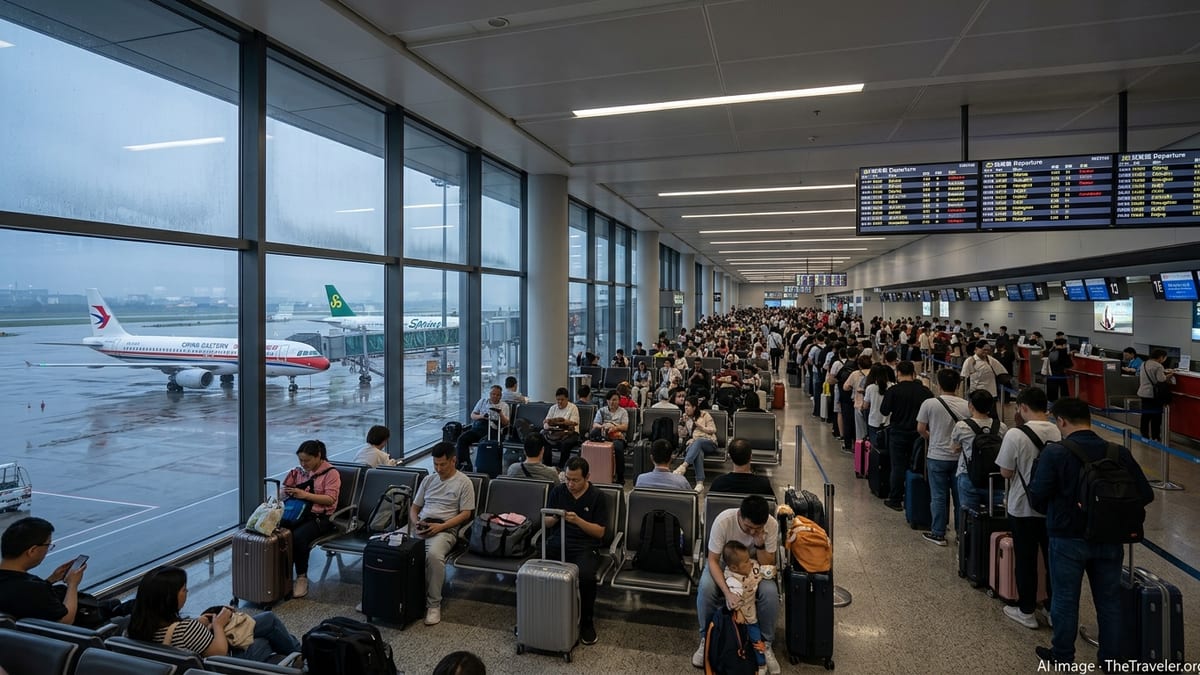
Severe Weather and Congested Skies Slow China’s Air Network
The latest disruption follows a familiar pattern in China’s fast-growing aviation market, where convective storms and tight airspace controls can quickly ripple through the system. Meteorological reports show bands of heavy rain and low cloud affecting parts of eastern and southern China, including the Yangtze River Delta and the Pearl River Delta, where both Shanghai and Guangzhou sit at the heart of dense domestic flight networks.
Operational summaries from flight-tracking platforms indicate at least 124 flights running behind schedule and 15 cancelled across multiple carriers, concentrating around the morning and late-afternoon peaks. When temporary airspace restrictions coincide with poor visibility or thunderstorm activity, departure slots are reduced and incoming flights are held in stacks, stretching delays across entire route banks.
China’s aviation system is particularly sensitive to such bottlenecks because several of its biggest airports already operate near capacity. Once a cluster of delays emerges in Beijing or Shanghai, the knock-on effect can reach inland cities such as Hefei and regional hubs feeding into Guangzhou within hours, affecting passengers who are far from the original weather cells.
Major Hubs From Beijing to Guangzhou Bear the Brunt
Beijing’s two major airports, Capital and Daxing, act as key gateways for domestic and international traffic, so disruptions there are often the first sign of broader turbulence across the network. Reduced departure rates and arrival holds can quickly force airlines to adjust rotations, with aircraft arriving late from one city and departing late to the next.
Shanghai’s dual-airport system, Hongqiao and Pudong, is equally exposed. Both facilities handle dense schedules for China Eastern and Spring Airlines, with Hongqiao in particular serving as a primary hub for high-frequency domestic routes linking coastal and inland business centers. When storm cells track across the Yangtze River Delta, schedules at these airports are among the first to see cascading delays.
Further inland, Hefei connects central provinces with both Beijing and the coastal hubs. Even limited holding or ground stops at the larger airports can leave inbound flights to Hefei short of available slots, prompting airlines either to delay departures from origin cities or, in more severe cases, to cancel low-demand rotations. Guangzhou, a critical southern gateway, then absorbs additional pressure as diverted or re-timed flights seek new routes into the region once conditions improve.
China Eastern, Spring Airlines and Urumqi Air Adjust Operations
China Eastern, based in Shanghai, operates one of the country’s largest domestic networks, with hundreds of daily flights touching Beijing, Guangzhou and numerous secondary cities. When weather reduces throughput at key hubs, its interconnected schedules are among the most affected, frequently forcing a re-sequencing of aircraft, crews and turnarounds throughout the day.
Spring Airlines, a Shanghai-based low-cost carrier, typically runs tight turnaround times and high aircraft utilization. Disruptions at a hub like Hongqiao or Pudong can be particularly challenging for such a model, because even modest delays erode the buffers that protect later flights in the rotation. As a result, low-cost operators often find themselves weighing whether to cancel selected services to restore overall timetable integrity.
Urumqi Air, which connects the far western Xinjiang region with eastern cities including Beijing and Shanghai, is vulnerable to disruptions at destination airports thousands of kilometers away. When arrival slots tighten in the east, departures from Urumqi and other western cities may be held on the ground, turning what appears to be a local weather problem into a nationwide issue for travelers attempting same-day connections.
Other Chinese carriers operating through the same hubs are also indirectly impacted when air traffic management temporarily limits total hourly movements. In such situations, airlines must compete for reduced numbers of slots, and even flights not originally forecast for delay can be pushed back as controllers prioritize long-haul arrivals, international departures or flights that are already significantly late.
Passenger Impact: Missed Connections and Overnight Holds
For travelers, the most immediate consequences are missed connections, extended waits in crowded terminals and uncertainty about onward plans. Domestic passengers with tight layovers in Shanghai or Guangzhou are among the most at risk, particularly when their inbound flight experiences a rolling delay that is updated in small increments rather than all at once.
Passengers on multi-leg itineraries involving Urumqi, Hefei or other secondary cities may find themselves stranded mid-journey when airlines choose to cancel selected flights to reposition aircraft or crews. In some cases, publicly available accounts from previous disruption events show travelers being rebooked on later services or rerouted through alternate hubs, sometimes with overnight hotel stays arranged near the airport.
Disruptions on this scale can also strain airport facilities. Check-in areas and security lanes become congested as delayed passengers remain landside for longer than planned, while airside departure halls fill with travelers waiting out rolling gate changes. Staff must repeatedly adjust boarding times and reassign gates as updated information arrives from operations centers and air traffic control.
International travelers connecting onto or off Chinese domestic flights can be particularly vulnerable. When delays occur on the domestic legs feeding major intercontinental departures, rebooking options may be limited, especially on busy travel days when long-haul flights depart full and spare seats are scarce.
What Travelers Can Do During Ongoing Disruptions
Travel advisories from previous disruption episodes in China highlight several practical steps passengers can take when delays begin to mount. Monitoring flight status through airline apps and airport displays, rather than relying solely on original departure times, allows travelers to react more quickly to rolling schedule changes.
For those holding tightly timed connections in Beijing, Shanghai or Guangzhou, seeking earlier feeder flights where possible can provide a valuable buffer during unsettled weather periods. Travelers already in transit are often encouraged by publicly available guidance to contact airline customer service channels promptly once delays exceed a certain threshold, as rebooking options diminish the longer one waits.
Travel insurance policies that include coverage for delays and missed connections may also prove useful during events like this, particularly for itineraries spanning multiple carriers. Policy terms vary, but documentation such as boarding passes, delay notices and any receipts for meals or hotels typically plays an important role in subsequent claims.
With weather and airspace constraints expected to remain recurring challenges for China’s busy aviation system, today’s disruption serves as another reminder for travelers to build extra time into connections, keep itineraries flexible where possible and stay closely informed whenever storm systems approach the country’s major air corridors.