

More news on this day
Travellers across Canada faced a difficult start to the weekend as publicly available flight-tracking data showed around 40 cancellations and more than 200 delays affecting services operated by Air Canada, Jazz, Porter Airlines, Icelandair, WestJet and other carriers through major hubs in Toronto, Montreal, Vancouver, Ottawa and Calgary.
Get the latest news straight to your inbox!
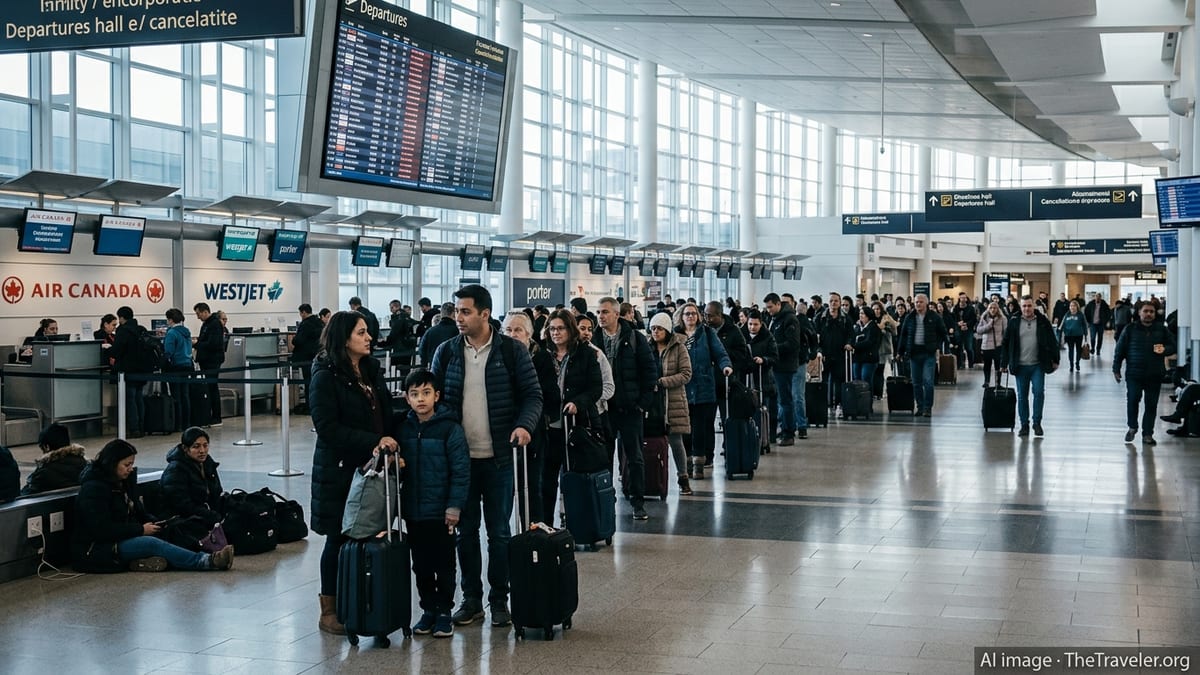
Widespread Disruptions at Major Canadian Hubs
Data compiled from airport status boards and flight-tracking platforms on Saturday indicated a wave of disrupted services across Canada’s largest airports. Toronto Pearson, Montreal Trudeau, Vancouver International, Calgary International and Ottawa International all reported clusters of cancelled and late departures, affecting both domestic and transborder routes.
The pattern of disruption was most evident in Toronto and Montreal, where high passenger volumes meant even a relatively small number of cancellations translated into long queues at check in, security and rebooking counters. Vancouver and Calgary recorded fewer outright cancellations but a higher proportion of delayed departures, creating rolling knock on effects through the day as aircraft and crews fell out of position.
Publicly available information showed that the cancellations were spread across multiple airlines rather than concentrated on a single carrier. Flights operated by Air Canada and its regional partner Jazz, along with WestJet, Porter Airlines and Icelandair, were among those affected, alongside smaller and foreign carriers serving Canadian gateways.
Operational experts note that in such scenarios, the absolute number of impacted flights can understate the human impact. A single cancelled widebody service on a trunk route such as Toronto to Vancouver can affect several hundred passengers, while repeated delays on high frequency corridors like Toronto–Montreal or Calgary–Vancouver can cascade into missed connections throughout the network.
Weather, Congested Skies and Tight Schedules
Although conditions on Saturday did not match the severity of major winter storms earlier in the season, weather continued to play a role. Forecasts in parts of southern Ontario and the Prairies pointed to periods of low visibility, freezing precipitation and gusty winds, which typically trigger precautionary spacing of aircraft, slower ground handling and extended deicing times.
Recent government and media reports on the January 23 to 27, 2026 North American winter storm documented how heavy snowfalls in Toronto and other centres forced hundreds of cancellations and exposed the fragility of tightly wound schedules. Those earlier disruptions left airlines working for days to return fleets and crews to normal rotations, and industry observers suggest that residual imbalances continue to reduce the margin for error when fresh weather challenges emerge.
Air navigation constraints have also been a recurring factor. Travellers posting on social media in recent weeks have described delays linked to air traffic control flow restrictions at congested hubs, particularly Vancouver, as controllers manage runway capacity during periods of poor visibility or runway clearing. When combined with mechanical checks or crew duty time limits, what might otherwise be minor timing adjustments can tip individual flights into lengthy delays or cancellations.
Airlines operating dense domestic networks, such as Air Canada, Jazz and WestJet, are particularly vulnerable when a single hub experiences a slowdown. With aircraft often scheduled to operate multiple legs in a single day, an early delay departing Toronto, Montreal or Calgary can ripple across subsequent services to smaller cities, leaving passengers facing missed connections or overnight stays.
Airlines Balance Proactive Cancellations and Customer Fallout
In recent storms and capacity crunches, Canadian carriers have increasingly turned to proactive cancellations, trimming schedules in advance to reduce the risk of day of operations chaos. Online discussions among travellers this winter have highlighted instances where WestJet and other airlines cancelled flights ahead of forecast storms in Calgary and southern Ontario, allowing ground and airport crews to focus on a smaller, more manageable schedule.
Industry analysts view this strategy as a trade off. Proactively grounding select flights can limit long security lines, tarmac delays and aircraft waiting for gates, but it places a heavier burden on airlines to provide timely rebooking options and clear information. Some passengers posting on public forums in recent weeks have reported long hold times with call centres and difficulty securing alternatives when travel demand is already high.
Regulatory pressure remains another backdrop. The Canadian Transportation Agency has in recent months publicised penalties against airlines, including WestJet, for alleged violations of air passenger protection rules related to previous delays and cancellations, underscoring heightened expectations for communication and care. While current disruptions are still being assessed, consumer advocates argue that consistent enforcement is key to incentivising better operational planning and customer service across the sector.
Carriers have pointed in past public statements to labour shortages, supply chain constraints for spare parts and lingering post pandemic staffing gaps as factors limiting flexibility when irregular operations occur. With fleets and crews stretched, the room to add recovery flights at short notice can be limited, leaving travellers more exposed when disruption hits on busy travel days.
Key Routes and Passenger Experiences
The latest round of disruptions has been most visible along Canada’s busiest corridors. High demand routes linking Toronto with Vancouver, Calgary and Montreal saw multiple delayed departures, while regional spokes to cities such as Ottawa and Halifax experienced schedule knock ons as arriving aircraft turned late for onward sectors.
Porter Airlines, which has been expanding from Toronto Pearson and Ottawa in addition to its original Billy Bishop base, saw select departures flagged as delayed, particularly on east coast runs where weather has been changeable. Jazz operated services under the Air Canada Express banner were impacted on shorter hops into and out of major hubs, where even short ground holds can cause tight connection windows to evaporate.
Icelandair’s transatlantic services into Canadian gateways have occasionally been caught in the crossfire of wider network disruptions, especially when connecting traffic from domestic feeders arrives late. Aviation observers note that long haul carriers often face difficult decisions when inbound aircraft miss curfew windows or when onward connections in Europe and beyond would be severely disrupted by late departures from Canada.
Across social media platforms, travellers shared images of crowded gate areas, long lines at customer service desks and departure boards heavy with yellow and red status indicators. Some described relatively smooth rebookings using airline apps, while others reported multi hour waits for alternative itineraries or hotel vouchers, illustrating the uneven experience passengers can face during widespread irregular operations.
What Travellers Can Expect in the Coming Days
With the spring travel period ramping up, aviation specialists anticipate that Canadian carriers will focus on stabilising schedules and restoring aircraft and crew rotations to normal patterns. Historical data from previous winters suggest that once a cycle of weather and operational disruptions sets in, several days of relatively calm conditions are often needed before on time performance significantly improves.
Publicly available guidance from airlines and airports continues to emphasise preparation by travellers. Recommendations include allowing extra time at the airport, monitoring flight status frequently, and using mobile apps or online tools for rebooking when disruptions do occur. Passengers connecting through major hubs such as Toronto, Montreal, Vancouver, Ottawa and Calgary are being encouraged to build in longer layovers where possible to reduce the risk of missed onward flights.
Consumer advocates advise that travellers keep careful records of boarding passes, delay notifications and any out of pocket expenses in case they wish to pursue compensation under Canada’s air passenger protection regulations. Past rulings have drawn important distinctions between delays caused by uncontrollable weather and those linked to airline controllable factors such as crew scheduling or maintenance planning.
While the latest round of cancellations and delays falls short of the full scale shutdowns seen during the most severe winter storms, it serves as another reminder of the sensitivity of Canada’s air transport system to even moderate operational pressures. For now, passengers planning trips in the coming days are watching forecasts and airport status boards closely, hoping for a period of calmer skies and more predictable departures.