

More news on this day
Flight delays and cancellations in the United States are extracting a steep economic toll, with recent analyses indicating disruptions are draining as much as 34 billion dollars from the U.S. economy every year.
Get the latest news straight to your inbox!
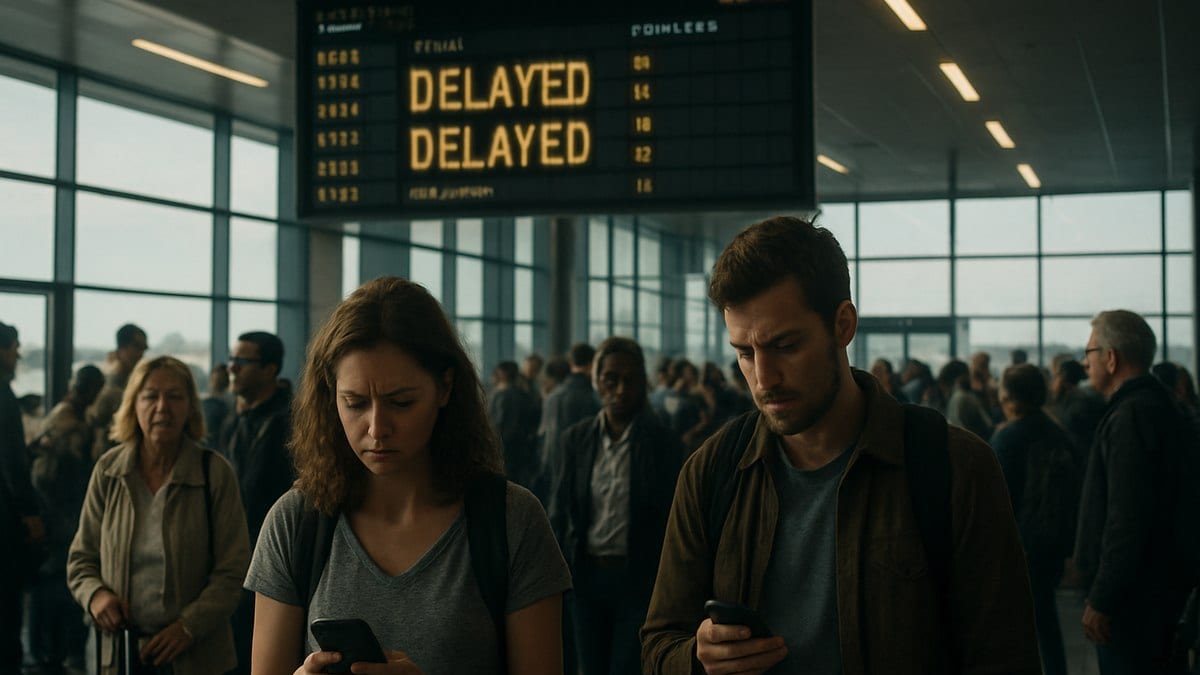
A Growing Price Tag for an Overstretched System
Recent economic assessments drawing on aviation data for 2022 estimate that flight disruptions generated an impact of 30 to 34 billion dollars in the United States alone. Publicly available analyses of disruption patterns indicate that more than 200 million passengers were affected by delays and cancellations that year, highlighting how routine the problem has become in the nation’s skies.
The headline figure reflects more than the visible chaos at departure boards. Aviation research and industry submissions to federal regulators describe a layered cost structure that includes airline operating expenses, the value of passengers’ lost time and a wide range of spillover effects on other sectors. The result is an economy where congestion and schedule instability in the air transport system quietly chip away at productivity and consumer spending.
The 30 to 34 billion dollar estimate represents a marked escalation from earlier government-linked studies that placed the cost of flight delays in the tens of billions annually. Analysts note that the rebound in air travel demand after the pandemic, combined with persistent staffing and infrastructure constraints, has pushed disruption costs sharply higher even as airlines promote improvements in on-time performance.
While the exact figure fluctuates year to year with weather, demand, and operational challenges, the available data suggest that the upper end of the current range, roughly 34 billion dollars, has become a realistic measure of the annual drag that flight disruptions impose on the wider U.S. economy.
Where the 34 Billion Dollars Really Goes
Breakdowns of disruption costs indicate that airlines absorb only a portion of the overall burden. Industry and research reports describe how incremental operating time for airlines, including extra fuel burn, crew expenses and aircraft repositioning, accounts for roughly one third of the total. Those direct costs contribute to higher operating budgets that can ultimately flow through to fares and ancillary fees.
A larger share of the economic impact is tied to the value of time lost by passengers. Analysts typically assign a monetary value to hours spent waiting in terminals, sitting on taxiways or rebooking missed connections. For business travelers, those hours can translate directly into lost output, delayed deals and rescheduled meetings. For leisure travelers, they represent foregone vacation time, missed events and the intangible stress that can influence future trip decisions.
Spillover effects on other sectors add another significant layer. When travelers arrive late or abandon trips altogether, hotels lose room nights, restaurants see fewer diners, ride-hailing services and car rental companies miss out on rides and bookings, and attractions see lower foot traffic. Economic modeling submitted to federal rulemaking dockets notes that disruptions ripple well beyond the airport perimeter, depressing activity in tourism-dependent communities and business hubs alike.
There are also accommodation and care costs directly linked to severe disruptions. Airlines frequently provide hotel rooms, meal vouchers and ground transportation when cancellations strand passengers overnight, particularly during large-scale weather or technology events. While those expenses formally sit on carrier balance sheets, they are part of the broader 34 billion dollar impact that ultimately touches investors, employees and travelers.
Travelers Shoulder Rising Hidden Expenses
Passenger-focused surveys and consumer studies show that travelers are increasingly bearing substantial out-of-pocket costs when flights do not operate as planned. Recent coverage of disruption trends cites analyses that put the average financial hit per affected passenger in the hundreds of dollars once meals, emergency hotel stays, last-minute rebookings and other incidental expenses are included.
Many of these costs never appear in official fare comparisons. Travelers who build extra nights into itineraries to hedge against missed connections, or who opt for more expensive nonstop routes to avoid fragile hubs, are effectively paying a private insurance premium against disruption. Those choices can be rational at the individual level but raise the aggregate cost of air travel throughout the economy.
Missed events magnify the stakes. Accounts compiled in public filings describe small business owners who lose revenue when client visits are canceled, families who forfeit nonrefundable deposits on vacations, and workers who must take additional unpaid time off after being stranded. When multiplied across tens of millions of disrupted journeys each year, these micro-level losses help explain how delays and cancellations collectively reach the 34 billion dollar mark.
Consumer advocates point out that U.S. passenger rights remain comparatively limited. Unlike in Europe, where standardized compensation rules apply to many long delays and cancellations, U.S. travelers typically depend on airline-specific policies and goodwill. This framework can leave households absorbing a disproportionate share of disruption costs, especially in peak travel periods when alternative flights are scarce.
Operational Strains, Infrastructure Gaps and Weather Shocks
The economic toll of disruptions reflects a system grappling with multiple structural pressures at once. Airlines have rebuilt schedules to capture resurgent demand, often with thinner staffing margins in both flight crews and ground operations. At the same time, air traffic control facilities and training pipelines have faced persistent staffing challenges, limiting capacity on some of the nation’s busiest routes and adding vulnerability during peak periods.
Weather remains a dominant driver of day-to-day delays and cancellations, from intense summer thunderstorms to winter storms that close runways and disrupt crew rotations. Analysts note that as severe weather events become more frequent and volatile, disruption patterns have become harder to manage, with small disturbances in one region propagating across the national network.
Technology dependence creates another source of risk. The past several years have seen high-profile outages involving airline scheduling platforms and third-party software providers, temporarily grounding flights nationwide and generating cascading disruptions. Publicly available case studies of these incidents highlight how a single failure in a complex digital ecosystem can produce thousands of cancellations and add hundreds of millions of dollars to the annual disruption bill.
Infrastructure capacity is also a factor. While the U.S. has invested in modernizing its air traffic management system, major hubs continue to operate near their physical and procedural limits during peak hours. In that environment, even modest schedule padding or small operational setbacks can quickly translate into long lines on taxiways and missed slots, imposing costs that ultimately show up in the 34 billion dollar estimate.
Policy Debates and Industry Efforts to Contain the Damage
The scale of the economic losses has energized debate in Washington and across the aviation sector about how to reduce disruption costs. Recent policy discussions have explored measures ranging from tougher service standards and clearer passenger compensation rules to increased funding for air traffic control staffing and modernization projects.
Public filings from airlines and industry groups highlight investments in new technology to improve crew scheduling, predictive maintenance and real-time rerouting. Carriers argue that better data tools can help them anticipate bottlenecks and recover more quickly when storms or outages strike, limiting the downstream economic harm. They also point to fleet renewal programs that introduce more efficient aircraft, which can be easier to reposition and schedule during irregular operations.
Airport operators, for their part, have sought support for terminal expansions, additional gates and improved ramp infrastructure to reduce ground congestion. Some hubs are experimenting with redesigned gate assignment systems and collaborative decision-making platforms that share operational data among airlines, airports and air traffic controllers, aiming to streamline recovery when disruptions occur.
Consumer groups and some lawmakers have pressed for stronger protections that would shift more of the financial burden back onto airlines when delays and cancellations are within carrier control. Proposals have included mandatory cash compensation for significant delays and automatic reimbursement of certain expenses. While the future of such measures remains uncertain, the ongoing 34 billion dollar annual drain has ensured that the economic impact of flight disruptions will remain a focal point in both policy and industry strategy discussions.