

More news on this day
Flight delays and cancellations in the United States are inflicting an estimated 30 to 34 billion dollars in annual losses on airlines, travelers and the broader economy, highlighting how routine disruption has become a structural cost for the aviation system.
Get the latest news straight to your inbox!
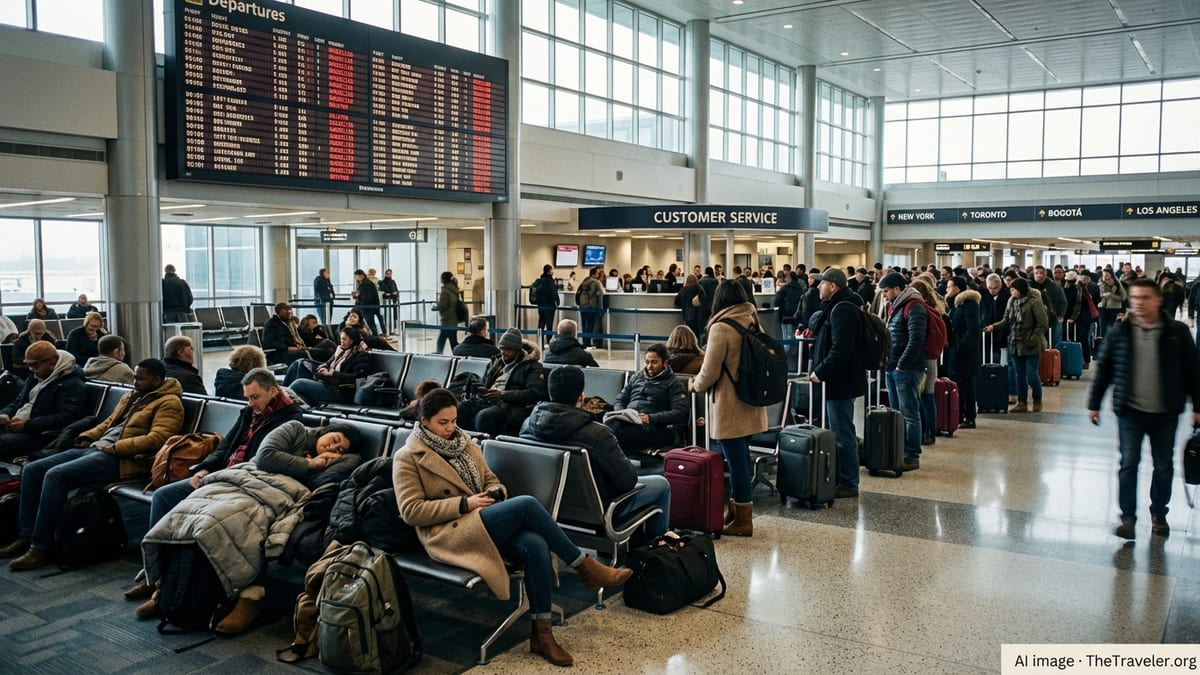
A Multibillion-Dollar Drag on the U.S. Air Travel System
The latest impact estimates, drawn from industry submissions to federal rulemaking proceedings and independent disruption-analytics reports, indicate that U.S. flight disruptions generated between 30 and 34 billion dollars in economic costs in a single recent year. Publicly available material submitted to the U.S. Department of Transportation describes how that burden spans airline operations, passenger time, and knock-on effects for sectors ranging from hotels to retail.
The figures build on earlier work by the Federal Aviation Administration and airline trade groups that put the cost of delays to airlines alone in the tens of billions of dollars. The newer estimates broaden the lens to capture the value of lost time for passengers, additional out-of-pocket expenses, and the wider economic activity that never materializes when trips are abandoned or curtailed.
Disruption volumes have been significant. Analysis cited in recent reports points to more than one million disrupted flights in the United States within a year, affecting at least 200 million passengers. Each delayed or canceled flight compounds across the network, turning operational missteps, severe weather or technology failures into nationwide snarls that reach well beyond a single travel day.
For the aviation industry, the 30 to 34 billion dollar range is more than a headline number. It represents a persistent drag on profitability in a sector that only recently clawed back into the black after the pandemic downturn, and it underscores the financial stakes behind ongoing debates over consumer protections, infrastructure investment and operational resilience.
Where the Money Goes: Airlines, Travelers and the Wider Economy
Breakdowns of the disruption bill show that no single party absorbs all of the pain. According to summaries of the most recent impact studies, incremental airline operating costs account for roughly one-third of the total, including extra fuel burned while aircraft wait in queues, crew and maintenance time, and the logistical burden of repositioning aircraft after cascading delays.
Passengers shoulder an even larger share once the value of lost time is factored in. Analyses referenced by travel and consumer publications describe how disrupted travelers lose hours to airport waits, missed connections, and rebooked itineraries. One widely cited data set from AirHelp and subsequent coverage in U.S. travel media estimate that flight disruptions in 2025 cost U.S. passengers nearly 500 dollars each on average when time, missed work and out-of-pocket spending are combined.
Spillover effects ripple outward into the broader economy. When flights fail to operate as planned, hotel nights may go unused at the destination even as unplanned stays pile up near hub airports. Tours, conferences, cruise departures and business meetings are missed entirely, cutting into revenue for local tourism operators and corporate event planners. Some impact studies attribute about one-sixth of total disruption costs to these indirect effects on sectors that rely on predictable air connectivity.
There is also an environmental price tag. Research highlighted in disruption-impact reports finds that the additional holding patterns, diversions and recovery flying associated with delays and cancellations generate several million extra tons of carbon dioxide annually, equivalent to the yearly emissions of millions of passenger cars. That added footprint sits uneasily alongside commitments by U.S. carriers and airports to decarbonize aviation.
Major Meltdowns Reveal the Scale of Single-Event Losses
While most disruption costs accumulate in small increments every day, high-profile breakdowns over the past few years illustrate how quickly losses can surge. Public filings and post-incident briefings show that the 2022 Southwest Airlines holiday scheduling crisis produced more than one billion dollars in direct financial damage for the carrier, on top of hundreds of millions of dollars in passenger reimbursements and compensation.
Similarly, the July 2024 technology outage linked to third-party software at Delta Air Lines forced the cancellation of more than 7,000 flights over five days. Company disclosures and subsequent reporting put the financial impact for Delta at roughly 500 to 550 million dollars once lost revenue and recovery expenses were added together. Those numbers capture only airline costs and do not reflect the value of time lost by more than a million affected passengers.
System shocks originating outside airlines have also been costly. A nationwide ground stop in early 2023 after an outage in a critical Federal Aviation Administration system led to thousands of delays and cancellations in a single day, disrupting travel plans for well over 7,000 flights. More recently, federal government shutdowns have prompted traffic-reduction orders that forced carriers to cancel flights proactively, with industry analyses warning that each week of reduced air traffic can erase billions of dollars from the wider U.S. economy.
These headline incidents are outliers in scale but not in type. They highlight the vulnerability of the U.S. air travel system to concentrated failures in scheduling software, third-party IT providers, government funding cycles and safety-critical infrastructure. The 30 to 34 billion dollar annual cost estimate effectively treats them as extreme examples layered onto an already fragile baseline.
Policy Shifts, Passenger Rights and Industry Pushback
The growing price tag of disruption is feeding into a policy debate over who should pay when flights do not operate as promised. Since late 2024, new rules issued by the U.S. Department of Transportation have strengthened automatic cash refund requirements for cancellations and significant schedule changes. Advocacy groups argue that robust refund standards are necessary to rebalance the costs of disruption, while airlines warn that aggressive mandates can raise operating expenses and ticket prices.
In parallel, the department has promoted an online dashboard comparing what major U.S. carriers voluntarily offer stranded passengers in terms of meal vouchers, hotel accommodations and rebooking assistance. Consumer advocates and some lawmakers have pushed for a European-style compensation regime that would pay fixed cash amounts to passengers affected by controllable delays and cancellations. U.S. carriers have resisted that approach, contending in public comments that it would add billions of dollars to annual costs without addressing the root causes of disruption.
Airline trade groups have instead pressed for investments in air traffic control modernization, expanded staffing for controllers and Transportation Security Administration officers, and more resilient airport infrastructure to cope with extreme weather. Industry submissions to Congress and regulators argue that underinvestment in the national airspace system, combined with capacity constraints at crowded hubs, has made the system less able to absorb shocks and more prone to multi-day snarls.
Passenger-rights organizations counter that opaque scheduling practices, lean staffing, and aggressive utilization of aircraft and crews are major contributors to disruption, especially when combined with tight turnaround times. They point to recent meltdowns and the billions in associated losses as evidence that current business models underprice the risk of failure and externalize too much of the cost onto travelers and destination communities.
Resilience Efforts and What Comes Next for U.S. Aviation
In response to the rising financial toll, airlines, airports and technology providers are experimenting with new tools intended to predict and contain disruption. Academic and industry research presented in 2025 aviation forums describes efforts to model how severe-weather events, flooding and other shocks might force airport shutdowns and to quantify the resulting economic losses across airlines and regional economies.
Carriers have been investing in more sophisticated crew-management and aircraft-tracking systems designed to reassign resources more quickly when schedules begin to unravel. Some are adding spare aircraft capacity or building “buffer” into their timetables during peak travel periods, especially around holidays when earlier meltdowns proved most damaging. Airport operators, for their part, are reevaluating ramp layouts, deicing capacity and gate-allocation strategies to minimize choke points.
Yet the underlying pressures on the system remain intense. Travel demand has rebounded strongly, while aircraft production and deliveries continue to lag, limiting the ability of airlines to add slack. Ongoing labor pressures in critical roles, from pilots to mechanics and air traffic controllers, leave less margin for sickness or unexpected absences. Climate change is amplifying weather volatility, from severe storms to extreme heat, that can force ground stops and extended flow-control measures.
For now, the 30 to 34 billion dollar annual disruption cost serves as both a warning and a benchmark. As regulators refine passenger protections and industry leaders weigh investments in resilience, that figure offers a way to gauge whether new policies and technologies are closing the gap between rising demand for air travel and the system’s ability to deliver passengers to their destinations on time.