

More news on this day
Chronic flight disruptions in the United States are quietly stripping an estimated $30 billion to $34 billion from the economy every year, as late and canceled departures ripple far beyond airport terminals into lost productivity, higher business costs and weakened consumer spending.
Get the latest news straight to your inbox!
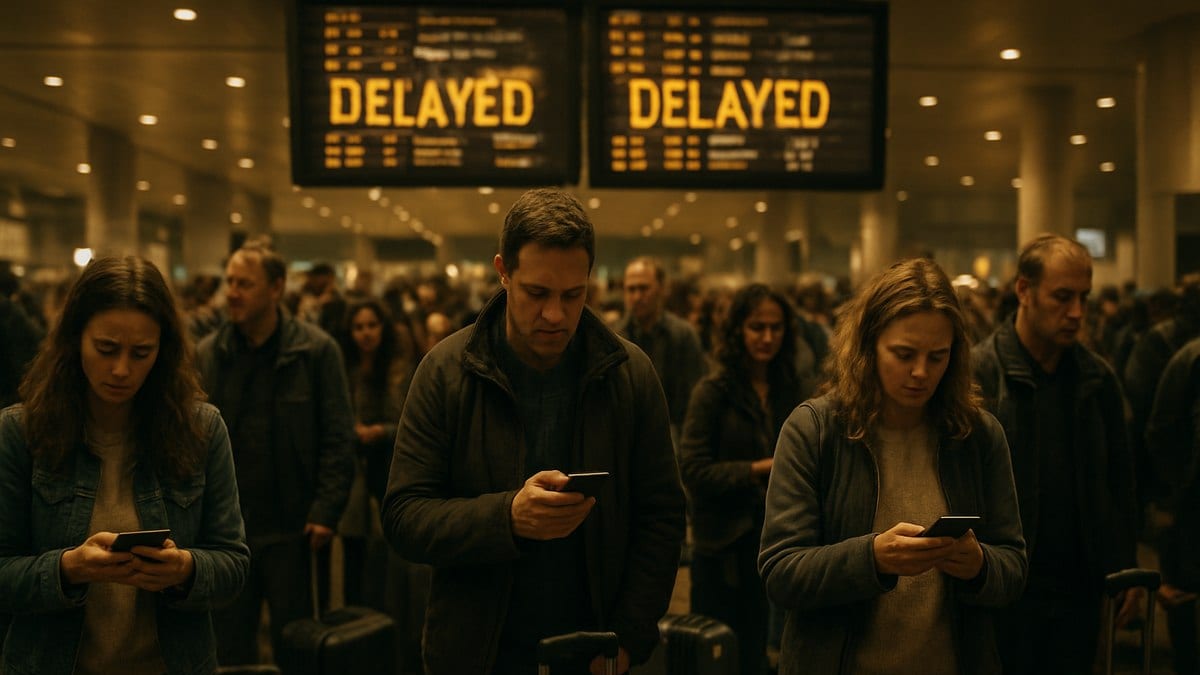
New Estimates Put National Cost Above $30 Billion
Recent research and industry analyses suggest the full economic toll of U.S. flight disruptions has climbed into a $30 billion to $34 billion annual range. A synthesis of publicly available studies indicates that the figure captures not only direct airline operating expenses, but also the value of passenger time, missed connections, additional staffing, fuel burn and the knock-on effects for tourism and trade-dependent sectors.
A 2022 assessment cited in aviation resilience research placed total U.S. disruption costs above $30 billion to $34 billion in a single year, based on an estimated 1.2 million to 1.5 million affected flights. That work translated the operational chaos into a per-flight economic impact in the tens of thousands of dollars, once aircraft, crew, passenger delay and missed-spending effects were combined.
Airline trade groups and federal analyses have separately pegged annual delay costs in a similar band. An Airlines for America summary of Federal Aviation Administration and Nextor modeling reported total delay costs of roughly $33 billion in the final pre-pandemic year, a benchmark that more recent private-sector data platforms and academic papers suggest has remained broadly comparable in the current era of record travel demand.
While methodologies differ, the convergence of estimates near the $30 billion to $34 billion mark underscores how disruptions have become a structural drag on U.S. economic performance rather than an occasional inconvenience limited to peak holiday weekends or severe weather events.
Passengers Shoulder Billions in Lost Time and Extra Expenses
Behind the headline economic numbers is a mounting burden on individual travelers. Industry data compiled by travel and aviation analysts indicate that passengers alone now absorb tens of billions of dollars in disruption-related costs each year, a large share of which never appears in ticket prices or official inflation gauges.
Recent reporting by travel trade publications, drawing on Bureau of Transportation Statistics data and private claims firms, found that U.S. travelers lost well over a million hours to delays in the first three quarters of 2025 alone. When those waiting times are valued at typical hourly wage or productivity rates, passenger time losses nationally reach into the tens of billions every year.
Separate analyses of consumer spending patterns suggest that U.S. passengers personally shoulder around $18 billion annually in out-of-pocket disruption costs, including unexpected meals, hotels, ground transport and rebooking fees. Those consumer costs represent only a portion of the overall $30 billion to $34 billion economic hit, but they highlight how the burden is distributed across millions of individual trips rather than confined to airline income statements.
Travel management platforms that focus on business itineraries have documented similar patterns. One recent corporate travel disruption report estimated that U.S. companies spend more than $17 billion each year mitigating the fallout from trips that do not go to plan, from replacement flights to overtime and lost working hours. When combined with leisure travel, these figures point to a system where delays and cancellations function as a persistent hidden tax on mobility.
Airlines, Infrastructure and Policy Under Strain
The economic drag from disruptions reflects stress across the aviation ecosystem. Airlines face direct costs in the form of crew overtime, fuel for holding patterns, maintenance, repositioning of aircraft and customer care, particularly when problems cascade across hubs during storms, system outages or staffing shortages.
Data compilations published in 2026 by multiple aviation statistics providers indicate that U.S. carriers are facing tens of billions of dollars in delay-related operating costs each year. Estimates for recent years show airline-side delay costs alone exceeding $30 billion globally, with U.S. operations accounting for a substantial share given the size of the domestic market and the prevalence of high-frequency short-haul routes that are vulnerable to congestion.
Infrastructure constraints add another layer of vulnerability. Analyses by the Department of Transportation and independent research organizations have highlighted how air traffic control staffing gaps, aging technology and runway congestion contribute to what are labeled National Aviation System delays. In several recent years, such system-related factors have accounted for around one fifth of all delay minutes in the United States, with weather, airline operations and late-arriving aircraft making up the remainder.
Policy turbulence has compounded these structural issues. The extended federal government shutdown in late 2025 and early 2026 triggered cutbacks in air traffic capacity at dozens of major airports, prompting thousands of cancellations and lengthening queues. Economic briefs from the Federal Reserve system and contemporary press coverage indicated that the shutdown-related disruptions alone generated hundreds of millions of dollars in additional delay costs, on top of the recurring annual burden.
Knock-On Effects for Tourism, Trade and Regional Economies
Although the immediate consequences of a delayed flight are felt by passengers and airlines, the wider economy increasingly bears the long-term costs. Tourism boards, convention organizers and regional economic agencies have warned that persistent reliability issues can weaken the appeal of certain destinations, particularly for high-spending international visitors and time-sensitive business travelers.
Studies by academic researchers and transportation policy institutes have linked prolonged or repeated disruptions to reduced visitor spending, missed events and lower hotel occupancy in affected markets. When major hubs experience multi-day episodes of cancellations, such as during severe winter storms or large-scale technology failures, the resulting drop in arrivals can erase tens or hundreds of millions of dollars in anticipated local spending on lodging, dining, entertainment and retail.
Freight and supply chains are also exposed. While passenger statistics draw the most attention, the same congested runways and airspace serve high-value cargo operations. Logistics analysts note that delays can force shippers to pay for premium routing, extra warehousing and expedited ground transport, with costs ultimately passed along through higher prices. For time-sensitive sectors such as pharmaceuticals, electronics and perishables, even modest disruptions can translate into significant write-offs.
Regional economies that depend heavily on a single large hub are particularly vulnerable. Research into past disruption events, including aircraft groundings and major carrier outages, shows measurable impacts on local employment in tourism-adjacent industries and on tax collections when flight schedules are severely curtailed for extended periods.
Search for Solutions: Technology, Staffing and Accountability
The mounting price tag for flight disruptions has intensified debate over how to stabilize the system. Aviation industry associations, technology providers and policy researchers are advancing a range of proposals focused on modernizing infrastructure, improving staffing and clarifying passenger protections.
Airlines and airport operators have promoted investments in next-generation air traffic management tools, expanded use of data-driven scheduling and collaborative decision-making platforms that allow carriers and controllers to better anticipate bottlenecks. Some industry case studies suggest that advanced rebooking systems and automated disruption management tools have already trimmed recovery times and reduced certain categories of delay costs for airlines by double-digit percentages.
At the policy level, recent years have seen shifting approaches to passenger compensation and service commitments during disruptions. The U.S. Department of Transportation has periodically updated guidance on when airlines are expected to provide vouchers, meals or hotel rooms, while proposed rulemakings on mandatory compensation for controllable delays have sparked intense debate over potential costs and benefits. Consumer advocates argue that stronger financial incentives would encourage airlines to invest more aggressively in reliability, while carriers caution that blanket obligations could raise fares.
Transportation economists note that, given the estimated $30 billion to $34 billion annual drag on the U.S. economy, even modest efficiency gains could yield large payoffs. Reducing average delay minutes across the system, improving air traffic control staffing resilience and clarifying responsibility for disruption-related costs are increasingly seen as not just customer-service improvements, but macroeconomic priorities as well.