

More news on this day
Passengers traveling through Amsterdam Schiphol Airport in the Netherlands today faced a fresh wave of disruption, as at least seven flights were cancelled and 98 services were delayed, affecting operations on key routes to and from Barcelona, Lisbon, Berlin, Geneva, Madrid, and other European destinations.
Get the latest news straight to your inbox!
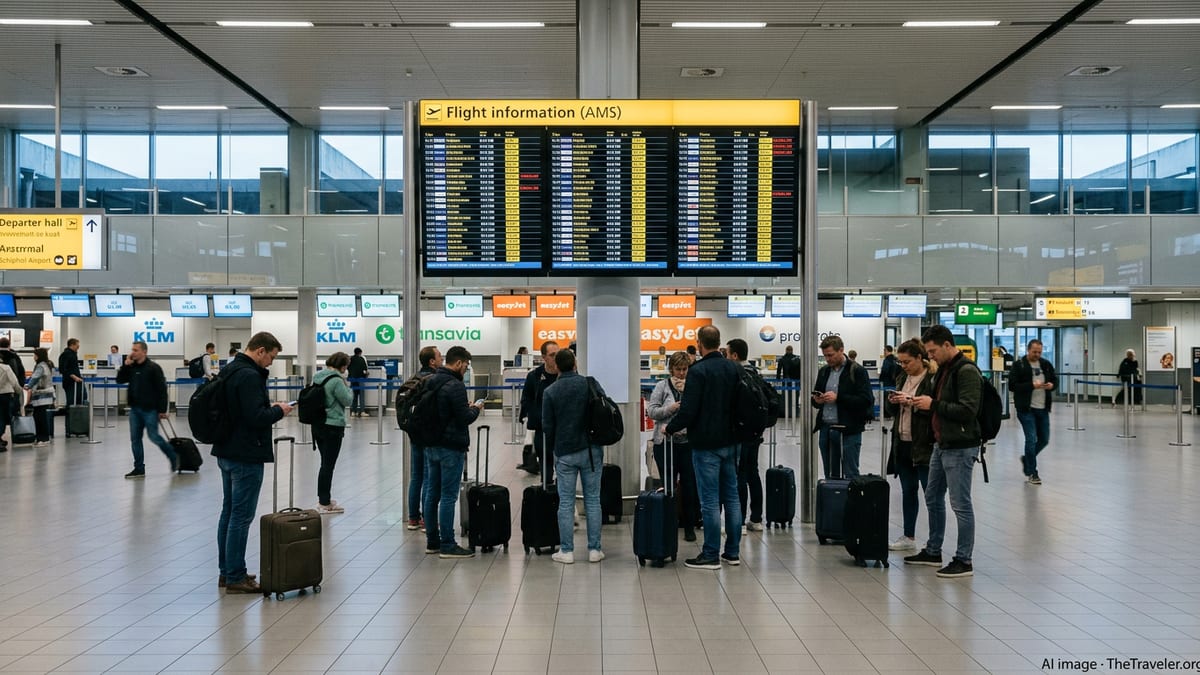
Delays Ripple Across Major European Routes
According to live operational data and airport tracking platforms, the disruption at Amsterdam Schiphol concentrated heavily on short and medium haul services across Europe. Flights linking the Dutch hub with Barcelona, Lisbon, Berlin, Geneva, Madrid, and several other cities saw schedule changes ranging from minor delays of under an hour to extensive hold-ups stretching well beyond two hours.
The imbalance between seven outright cancellations and almost one hundred delayed flights reflects a familiar pattern at large hubs, where operators often attempt to preserve much of the schedule by pushing back departure and arrival times instead of cancelling large numbers of services. The result for travelers, however, was a full day of uncertainty, missed connections, and revised itineraries.
Publicly available information shows that both departures and arrivals were affected, creating a two-way ripple effect across airline networks. Aircraft arriving late into Schiphol were turned around behind schedule, while some onward legs were rescheduled to later in the day to ease pressure on ground and airside operations.
For many passengers, the impact was felt well beyond Amsterdam. Connections via the Dutch hub are a mainstay for travel between secondary European cities and for long haul journeys, meaning delays on feeder flights to and from southern and central Europe quickly translated into missed onward departures.
Multiple Airlines Caught in Operational Snarl
The disruption hit a broad mix of carriers, with KLM, Qatar Airways, Transavia Airlines, and easyJet among the airlines whose schedules were affected. Live tracking and timetable data indicated that KLM, as Schiphol’s largest operator, bore a significant share of today’s delays, particularly on intra-European routes and feeder services into long haul banks.
Transavia Airlines, which runs an extensive leisure and city-break network from Amsterdam to southern Europe, also experienced knock-on disruption, notably on services connecting to Spanish and Portuguese destinations such as Barcelona, Lisbon, and Madrid. These markets are popular with both Dutch travelers and transfer passengers, intensifying the impact of any schedule irregularities.
Low cost carrier easyJet, which operates point-to-point services linking Amsterdam with cities including Berlin, Geneva, and other European capitals, saw several of its flights subject to altered departure times. For travelers relying on tight same-day plans, even relatively modest delays at a major hub can lead to missed rail connections, hotel rebookings, or truncated business itineraries.
Qatar Airways, operating long haul services that depend on precise connection windows at Amsterdam, also needed to adjust operations as inbound aircraft and connecting passengers navigated the day’s irregular schedule. Even when long haul sectors depart broadly on time, delays on feeder flights into the hub can force rebooking and accommodation for affected travelers.
Passengers Face Missed Connections and Long Queues
Reports from travelers and recent publicly available accounts of similar disruption at Schiphol highlight the difficulties passengers encounter when irregular operations unfold at scale. When multiple flights are delayed rather than cancelled, terminals remain busy throughout the day, with longer queues at security, transfer desks, and customer service points.
Many travelers with connections through Amsterdam were forced to rework itineraries at short notice. Missed onward flights to southern and central Europe meant that some passengers had to accept later same-day alternatives, overnight stays, or rerouting via other hubs in order to reach final destinations.
Published coverage of recent disruption events at Schiphol suggests that digital self-service tools have become increasingly important when flight schedules unravel. Airline apps and booking platforms often provide options to change itineraries without additional fees, but high demand can slow systems and limit the availability of alternative flights during peak disruption.
For those already at the airport, the combination of delayed departures and full flights can result in crowded gate areas and limited seating, particularly during late afternoon and evening waves when rescheduled services overlap with regularly timed departures.
Operational Pressures Behind Today’s Irregularities
While the precise mix of factors driving today’s seven cancellations and 98 delays has yet to be fully detailed in official post-operation reports, recent patterns at Amsterdam Schiphol highlight several recurring pressure points. Weather conditions in the wider region, air traffic flow restrictions, and staffing constraints in ground handling and air traffic control can all combine to reduce an airport’s effective capacity.
Industry analyses describe a strategy commonly used in Europe’s busiest hubs, sometimes referred to as “flight thinning,” where selected flights are delayed or spread out across a longer time period to avoid more extensive cancellations. This approach can protect key trunk routes and long haul operations, but it also increases the likelihood of late arrivals, missed connections, and aircraft being out of position.
Published operational statistics from European regulators and airports show that even modest changes in runway acceptance rates or air traffic flow into a major hub can translate quickly into dozens of delayed flights. Once punctuality deteriorates beyond a certain point, recovery within the same operating day becomes challenging, particularly for airlines with complex wave-based connection structures like those at Amsterdam.
In this context, today’s pattern of limited cancellations and widespread delays suggests an attempt to maintain much of the schedule while managing constraints in airspace and on the ground. For passengers, however, the distinction between a delayed and a cancelled service can blur when onward journeys are disrupted.
What Travelers Through Schiphol Should Expect Next
Based on recent episodes of disruption at the Dutch hub, residual delays can persist into subsequent operating days as airlines reposition aircraft, reallocate crews, and accommodate passengers who missed earlier connections. Travelers scheduled to pass through Amsterdam in the coming 24 hours are likely to face busier-than-normal flights and potentially tighter seats on popular European routes.
Public guidance from airlines in similar situations advises passengers to monitor flight status closely via official apps or airline websites before leaving for the airport. Same-day schedule adjustments are common when operations are heavily disrupted, and proactive checks can reduce the risk of unnecessary waiting time at the terminal.
Travelers with critical connections or onward rail and hotel bookings from cities such as Barcelona, Lisbon, Berlin, Geneva, and Madrid may wish to allow extra time or build more flexibility into their plans. A pattern of concentrated delays, as seen today, can echo across Europe’s interconnected flight network for several rotations.
While Amsterdam Schiphol remains one of Europe’s key aviation gateways, today’s seven cancellations and 98 delays underline how quickly even a well-established hub can experience widespread disruption. For passengers, preparation, flexibility, and close attention to real-time information remain essential when traveling through one of the continent’s busiest airports.