

More news on this day
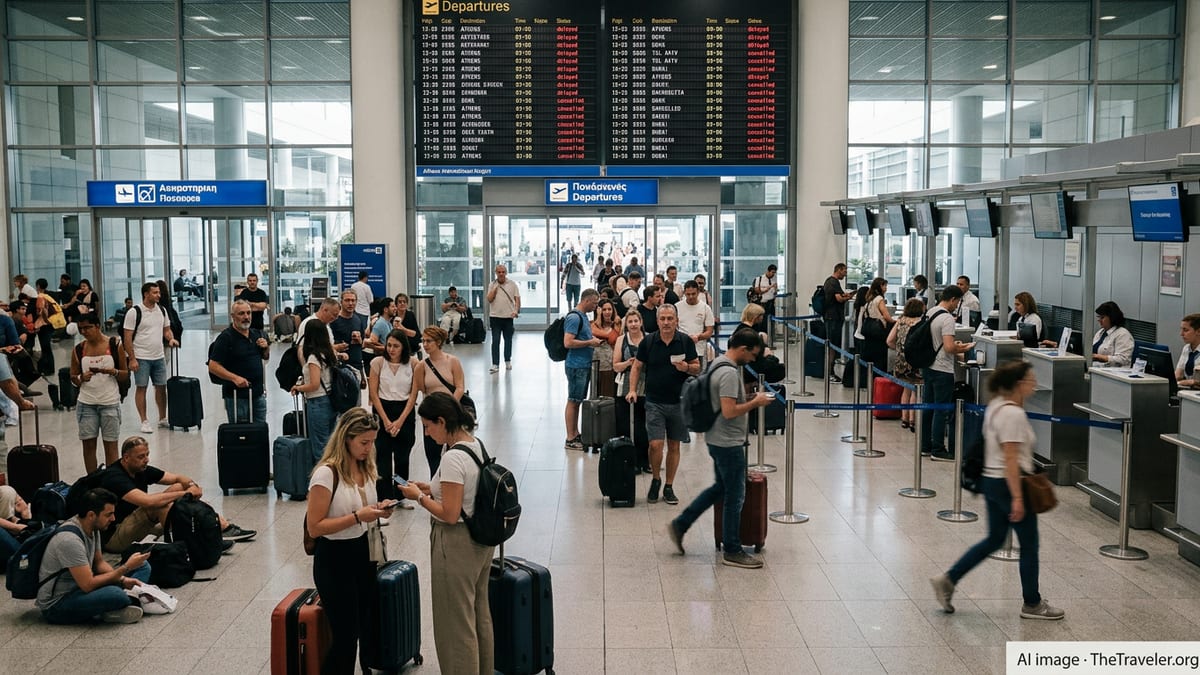
Dozens of passengers at Athens International Airport were left facing long queues, missed connections, and rapidly changing itineraries on March 10 as at least 20 delays and 19 cancellations affected flights operated by Aegean Airlines, Qatar Airways, and Emirates on key routes linking Athens with Doha, Tel Aviv, and Dubai.
Regional Turmoil Ripples Into Athens Flight Schedule
The disruption in Athens comes amid a broader air travel crisis across the Eastern Mediterranean and Gulf region, triggered by ongoing conflict in Iran and resulting airspace restrictions that have forced airlines to reroute or suspend services. European monitoring data for March 9 already showed hundreds of cancellations and thousands of delays across the continent, with knock-on effects now clearly visible in Greece as operations adjust day by day.
Aegean Airlines, Greece’s flag carrier, has been progressively trimming its Middle East network, announcing successive waves of cancellations to and from Tel Aviv, Dubai, Riyadh, Erbil, Baghdad, and Beirut for safety and operational reasons. The airline confirmed on March 10 that additional suspensions would extend into the second half of the month, with passengers offered free rebooking or travel credit in lieu of cash refunds in many cases.
Qatar Airways and Emirates, both heavily reliant on complex hub-and-spoke networks through Doha and Dubai, are also operating on reduced schedules while regional air corridors remain constrained. Qatar Airways has introduced a limited timetable from Doha, prioritizing repatriation and essential travel, while Emirates is gradually rebuilding frequencies but remains short of normal capacity, particularly on links touching Israel and parts of the Gulf.
Although Athens has not experienced the kind of technical meltdown seen in February, when a system fault briefly disrupted departures, the current situation is more complex. Airlines are often making late operational calls as overflight permissions change, leaving airport staff struggling to keep departure boards and gate announcements aligned with rapidly evolving flight plans.
Passengers Face Missed Connections and Overnight Stays
For travelers passing through Athens, the combination of rolling delays and sudden cancellations has translated into missed onward connections, overnight stays, and a rush on the remaining available seats. Passengers originating in Athens and bound for Doha, Tel Aviv, or Dubai reported being rebooked through alternative hubs such as Istanbul, Cairo, or major Western European airports when nonstop services were pulled from the schedule at short notice.
Those arriving from the Middle East have not been spared either. With Qatar Airways and Emirates scaling back operations at their hubs, inbound flights into Athens are often retimed or consolidated, arriving several hours behind schedule. This has had a particular impact on long-haul travelers using Athens as a stepping-stone between Europe, Asia, and Australia, where even a modest delay can unravel multiple segments in a single itinerary.
Families and business travelers alike described crowded check-in halls on Tuesday morning, as airline staff attempted to process rebookings while also preparing flights still scheduled to operate. Lines at ticket desks were reported to stretch across sections of the departures level, with many passengers waiting more than an hour to speak with an agent about alternative options or compensation rights under European Union regulations.
Hotel desks and ground transport operators around the airport also experienced an uptick in demand. With some passengers advised not to travel to the airport unless they held confirmed seats on operating flights, those already on site and facing extended waits sought short-notice accommodation near the terminals, further straining local capacity during an otherwise shoulder-season period for tourism.
Aegean, Qatar Airways, and Emirates Outline Temporary Policies
Aegean Airlines has attempted to provide some certainty by publishing updated lists of affected routes from Athens, including suspensions to Tel Aviv and Dubai stretching over several days in March. The carrier has offered free date changes for tickets to and from certain Middle Eastern destinations until the end of April, as well as credit vouchers for future travel for passengers choosing to cancel, in an effort to reduce immediate pressure on call centers and airport desks.
Qatar Airways, which continues to face tight operational constraints at Hamad International Airport, has focused on maintaining a skeleton schedule geared toward repatriation and essential travel. The airline has urged passengers to monitor their bookings closely and emphasized that flights may operate with adjusted times or routings as additional airspace corridors are opened or reclosed, underscoring the fluid nature of the crisis.
Emirates, a key player on the Athens to Dubai route, has signaled that it expects to restore near-normal operations in the coming days as more regional airspace becomes accessible. In line with its broader crisis policy, the airline is allowing many passengers booked on affected services in March to request refunds or rebook on alternative dates, though availability on popular long-haul connections remains tight as travelers scramble for remaining seats.
Across all three carriers, the message to customers is consistent: do not assume that a previously confirmed flight will operate on time, or at all, until it is reconfirmed within a short window before departure. Travel agents and airline websites are being updated frequently, but lags between operational decisions and public information have contributed to confusion at the airport.
Broader Impact on Greek Tourism and Regional Connectivity
The timing of the disruption is particularly sensitive for Greece, as the country gears up for the start of the spring and summer tourism season. While March is not yet peak time for arrivals, Athens International Airport serves as a critical gateway for visitors transiting to the islands and mainland destinations. Persistent uncertainty on links to the Middle East risks discouraging travelers from booking itineraries that rely on multiple connections.
Tourism and hospitality operators have so far reported limited cancellations on hotel and package bookings, but there is growing concern that extended instability in regional air traffic could undermine confidence ahead of the lucrative Easter and early summer period. Travel agencies are already fielding questions from clients about the reliability of itineraries involving Doha and Dubai, both of which normally offer extensive onward options to Asia, Africa, and Oceania.
At the same time, Athens remains relatively well connected to Western and Central Europe, where most carriers are operating on near-normal schedules despite elevated levels of delay. For many travelers, rerouting through alternative hubs such as Frankfurt, Paris, or London remains feasible, even if it means longer travel times and additional layovers compared with the once seamless connections offered via the Gulf.
Greek aviation analysts note that the situation in Athens illustrates how quickly regional crises can ripple through seemingly distant markets. A closure or restriction of key air corridors in the Middle East does not just affect direct flights to conflict-adjacent countries; it also cascades across global networks, reducing flexibility, driving up fares on remaining routes, and complicating recovery planning for airlines and airports alike.
What Travelers Through Athens Should Do Now
For passengers due to travel through Athens International Airport in the coming days, industry experts stress preparation and flexibility. Travelers on Aegean, Qatar Airways, and Emirates are advised to check their flights frequently and make use of mobile apps and email alerts, as schedule changes are often communicated digitally before they appear on airport displays.
Given the volume of calls and in-person queries, passengers holding non-urgent bookings are encouraged to manage changes online wherever possible. Many airlines have activated self-service options for rebooking within a limited date range, which can be faster than queuing at service desks. Those with complex itineraries involving multiple carriers may still need to speak directly with agents, especially where ticketing rules or alliance agreements govern what changes can be made without extra cost.
Travelers are also being urged to allow more buffer time for connections, both within Europe and on onward long-haul flights. Even when a departure from Athens is confirmed, moderate delays have become common enough that tight same-day connections in other hubs may no longer be realistic. Building in an extra hour or two, or even planning overnight layovers in some cases, can help reduce the risk of further disruption.
While the current wave of travel chaos at Athens International Airport is closely tied to exceptional geopolitical circumstances, airlines and regulators are already reviewing crisis communication and contingency planning. For passengers caught in the middle, the hope is that clarity on airspace access and carrier schedules in the coming days will restore a measure of predictability to journeys linking Athens with Doha, Tel Aviv, Dubai, and beyond.