

More news on this day
Passengers traveling through Beirut–Rafic Hariri International Airport faced another day of disruption today, as publicly available flight-tracking data indicated at least 12 delayed and 4 canceled departures and arrivals, affecting services operated by Middle East Airlines (MEA), Turkish Airlines, EgyptAir and other regional and international carriers.
Get the latest news straight to your inbox!
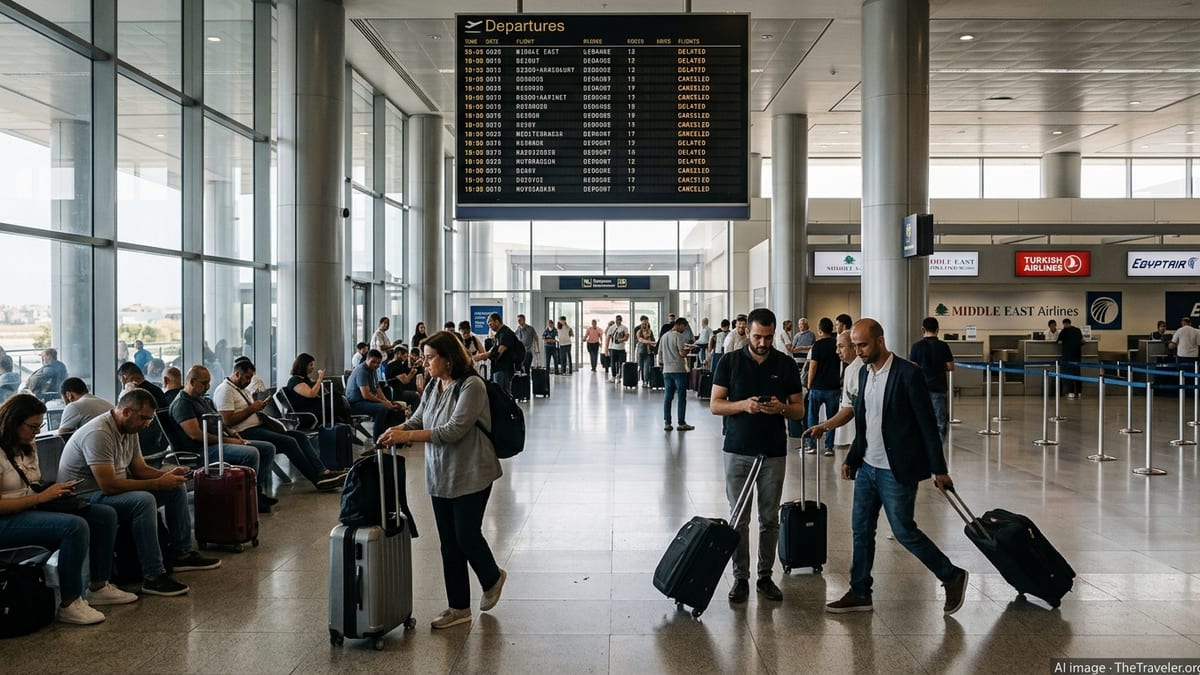
Operational Strain at Lebanon’s Main Gateway
The latest wave of delays and cancellations at Beirut–Rafic Hariri International Airport underscores the vulnerability of Lebanon’s sole commercial gateway to wider regional turbulence. While the airport remains officially open, schedules again proved fluid today, leaving many travelers navigating last-minute changes to itineraries and extended waiting times in the terminal.
Publicly available airport boards and third-party tracking services showed a cluster of delayed departures and arrivals across regional routes, particularly those connecting Beirut with key hubs in the Gulf, Turkey and Egypt. Although the total number of disrupted flights remains modest relative to the day’s overall schedule, the concentration of delays and cancellations on heavily used routes has amplified the impact for both outbound and connecting passengers.
The irregular operations come against the backdrop of a broader pattern of cautious capacity adjustments by regional and European airlines serving Beirut. Over recent months, several foreign carriers have periodically reduced or suspended Beirut services in response to shifting risk assessments, before gradually restoring limited frequencies when conditions allow.
Middle East Airlines Adjusts Amid Regional Airspace Volatility
As Lebanon’s flag carrier and dominant operator at Beirut–Rafic Hariri International Airport, MEA once again found itself at the center of today’s disruption. Schedule data indicated that a portion of the delayed flights involved MEA-operated services on high-demand regional sectors, including routes linking Beirut with major Gulf and Iraqi cities.
According to recent published statements from the airline in similar situations, MEA’s typical response to regional airspace constraints has been to retime departures, consolidate services or, in some cases, temporarily cancel rotations while offering free rebooking or refunds within defined periods. Today’s pattern of delays and a small number of cancellations appears consistent with that broader strategy of tactical adjustments rather than a complete suspension of operations.
Travel-industry commentary and previous MEA advisories have highlighted how the carrier must frequently navigate sudden changes in overflight permissions and temporary shutdowns of neighboring airspace. Even when Beirut’s own airspace remains open, rerouting and extended flight paths can disrupt tightly timed schedules and aircraft rotations, leading to knock-on delays throughout the day.
Impact on Turkish Airlines, EgyptAir and Other Regional Carriers
The effects of today’s disruption extended beyond Lebanon’s national carrier. Flight-monitoring platforms and recent regional coverage suggest that Turkish Airlines and EgyptAir, both important connectors between Beirut and larger international networks, were among the airlines with at least one delayed or canceled flight in and out of the Lebanese capital.
In past episodes of heightened regional tension, carriers such as Turkish Airlines, EgyptAir, Emirates, Lufthansa and others have adjusted Beirut services in parallel with broader cuts across the Middle East, often citing airspace closures or operational risk assessments. Today’s smaller-scale pattern of irregular operations appears to fit within that continuing environment of caution, with some flights operating on time while others are delayed or withdrawn at short notice.
For passengers, this translates into uncertainty around onward connections via Istanbul, Cairo and other regional hubs. Travelers facing a canceled leg from Beirut can quickly lose access to long-haul flights to Europe, North America, Africa or Asia, forcing them to seek alternative routings, overnight stays or refunds. Travel agents and online booking platforms have been advising customers to monitor reservations frequently and allow additional buffer time when planning complex itineraries that rely on Beirut as a starting point.
Travelers Confront Long Waits, Rebooking Challenges and Confusion
For those already at the airport, today’s mixture of delays and cancellations meant long waits in departure halls and repeated visits to service desks. Reports shared on social platforms and in recent traveler forums describing similar days at Beirut–Rafic Hariri International Airport point to confusion about whether flights will operate, particularly when airline websites, airport displays and third-party apps show differing information.
In this environment, passengers often face difficulty reaching airline call centers or securing timely rebooking options, especially when disruptions are concentrated across multiple carriers at once. Some travelers with flexible tickets may be able to shift travel dates without penalty, but others on restricted fares or those relying on tight connections can find that feasible alternatives sell out quickly.
Consumer-rights frameworks for flight disruptions differ depending on the airline’s country of registration and point of origin, meaning that passengers on the same route may have varying entitlements to compensation or hotel accommodation. Travel specialists frequently recommend that passengers keep boarding passes, booking confirmations and any written notices of delay or cancellation, as these can be important for later claims.
Ongoing Uncertainty Clouds Near-Term Travel Plans
Today’s disruptions at Beirut–Rafic Hariri International Airport add to a longer-running sense of uncertainty surrounding air travel to and from Lebanon. While the airport has remained operational and MEA continues to serve many of its core routes, intermittent cancellations by foreign airlines and sudden changes to regional airspace have made forward planning more complicated for residents, expatriates and visitors alike.
Travel-industry analysis suggests that airlines will likely continue to review Beirut schedules on a rolling basis, sometimes adjusting capacity only days or hours before departure in response to evolving risk assessments. This reactive approach can help carriers maintain a presence in the market, but it also leaves passengers exposed to abrupt last-minute changes.
For now, publicly available information indicates that today’s 12 delayed and 4 canceled flights at Beirut–Rafic Hariri International Airport represent a disruption rather than a full-scale shutdown. Travelers with upcoming itineraries through Beirut are being widely encouraged, through airline notices and travel advisories, to check flight status frequently, maintain up-to-date contact details with carriers and consider travel insurance that includes robust coverage for delays and cancellations.