

More news on this day
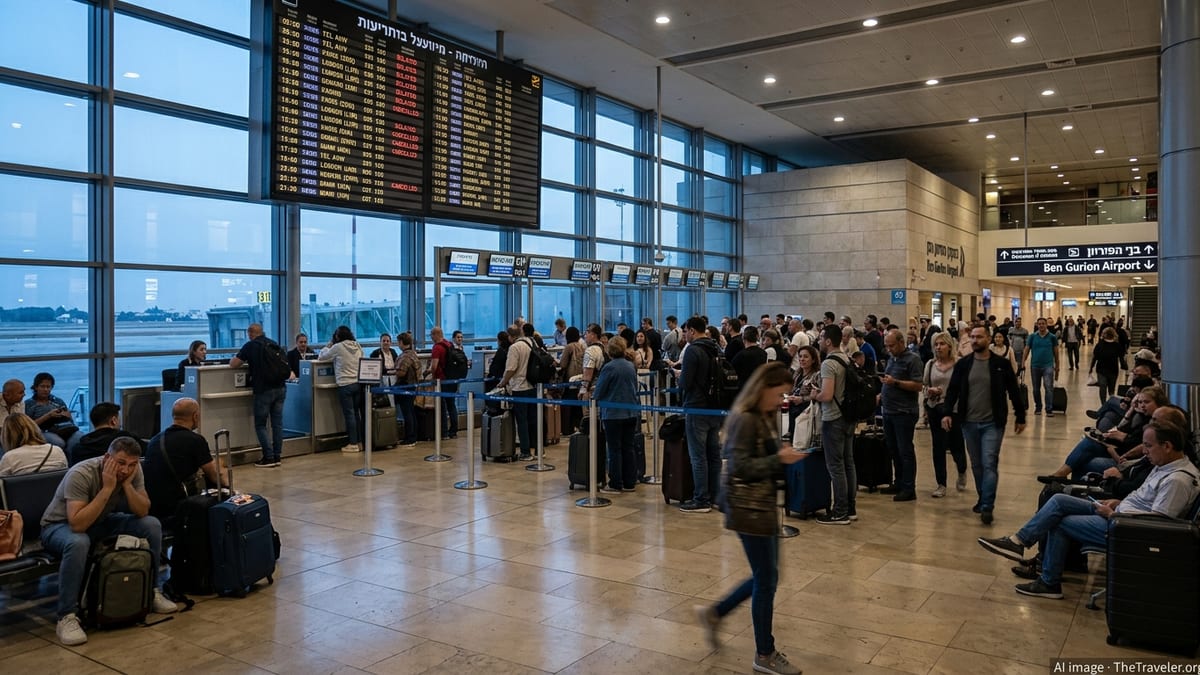
Travelers passing through Israel’s Ben Gurion International Airport are facing a fresh wave of disruption as a series of cancellations and delays involving Air France and El Al have affected at least four flights and multiple long-haul routes connecting Tel Aviv with Paris, Newark, London, Miami and additional global hubs.
Get the latest news straight to your inbox!
Targeted Cancellations Add Strain to Ben Gurion Operations
Recent schedule changes by Air France and El Al have added pressure on Ben Gurion International Airport, already operating under tightened capacity controls following months of regional security tensions. Publicly available flight information and published coverage indicate that several departures and arrivals on core routes have been suspended or heavily delayed, including services linking Tel Aviv with Paris Charles de Gaulle, Newark Liberty, London and Miami.
The latest disruption centers on at least four flights removed from the schedule or held back for extended periods, creating knock-on delays across the day. While full daily operations at Ben Gurion have formally resumed, ongoing constraints on passenger numbers for some long-haul services, especially to North America and parts of Europe, mean that even a small cluster of cancellations can quickly ripple through the network.
For travelers, the impact is being felt most directly on high-demand transatlantic and European routes, where seats are already limited and alternative options remain narrower than before the region’s recent period of instability. Many passengers are being shifted to later departures or routed through third-country hubs, extending journey times and complicating connections.
Paris and Tel Aviv Link Faces Renewed Volatility
The Paris to Tel Aviv corridor, historically a key route for both business and leisure traffic, has once again emerged as a pressure point. Reports on Air France’s current network show that the carrier has periodically adjusted its services to Israel in response to changing security and operational conditions, including earlier suspensions following missile activity and temporary closures of Israeli airspace.
Although Air France has recently been rebuilding its long-haul and European schedules after winter weather disruptions in North America and Europe, the connection to Tel Aviv remains sensitive. When a single rotation on the Paris route is suspended, the effect can cascade, as aircraft and crews are repositioned and onward connections through Charles de Gaulle are reshuffled.
Passengers relying on Paris as a transfer point to onward destinations in Europe, Africa and the Americas may face missed connections and forced overnight stays when Tel Aviv flights are delayed or canceled. Travel specialists monitoring the route note that demand remains strong, but scheduling remains more volatile than on comparable European city pairs.
El Al Long-Haul Network to Newark and Miami Under Pressure
El Al’s long-haul services from Ben Gurion to the United States are also experiencing renewed strain. According to recent aviation coverage, outbound departures from Israel to American gateways have been operating under tightened passenger caps after Iranian missile strikes damaged several private aircraft parked at Ben Gurion in March 2026, prompting authorities to limit loads on some long-haul flights.
Newark and Miami are among the most important North American routes from Tel Aviv, serving both point-to-point travelers and those connecting deeper into the United States. When an El Al flight on one of these routes is suspended or incurs a lengthy delay, rebooking options are limited because other carriers have not fully restored their pre-crisis capacity into Israel.
Operational challenges have added to the pressure. Recent months have seen isolated high-profile delays on El Al flights due to stringent security procedures, including an incident in February 2026 in which a Los Angeles to Tel Aviv departure was significantly delayed for additional baggage checks. These kinds of events have reinforced the airline’s cautious stance while also highlighting how easily long-haul operations can be knocked off schedule.
London and Other European Hubs Experience Knock-On Effects
London-bound traffic is feeling secondary impacts from the disruptions at Ben Gurion, even when flights are not directly canceled. British and European aviation coverage in recent weeks has documented a series of Tel Aviv service adjustments by multiple carriers, reflecting continued wariness around regional security developments and the operational challenges of restarting full schedules.
When departures from Tel Aviv to London and other European hubs are delayed, aircraft can miss tightly allocated slots at congested airports, especially during peak morning and evening waves. This can force crew rescheduling and on-the-day retiming that then affects flights onward to North America and other regions. Travelers heading from Israel to cities beyond London often discover that a relatively short delay leaving Ben Gurion results in a full-day itinerary change once connections are recalculated.
Similar patterns are playing out on other key European routes, including services to major airports that feed traffic to the Americas and Asia. With airlines still fine-tuning restored schedules into Israel after earlier suspensions, there is less redundancy in the system, leaving little room to absorb unexpected cancellations.
What Travelers Through Tel Aviv Should Expect Now
The latest round of disruptions underscores how fragile the recovery of international air travel to and from Israel remains, even as official notices describe Ben Gurion as fully operational again. Capacity limits on certain outbound services, heightened security procedures on the ground and lingering caution among some foreign carriers mean that the system can be quickly stressed when a handful of flights are suspended.
Travelers routed through Tel Aviv, particularly those booked on Air France and El Al services to Paris, Newark, London and Miami, are likely to encounter tighter connections, occasional last-minute schedule changes and heavier-than-usual loads on remaining flights. Overnight stays, unplanned rerouting via alternative European or Middle Eastern hubs and extended layovers remain realistic scenarios when a cancellation occurs.
Publicly available flight data suggests that airlines are continuing to adjust their Israel schedules on a short lead time as they respond to operational, security and demand trends. Industry observers note that while traffic volumes at Ben Gurion have steadily risen since earlier closures, the airport’s role as a regional hub remains more vulnerable than before, and passengers traveling through it should build in extra flexibility for the foreseeable future.