

More news on this day
France is grappling with another setback to its already fragile winter travel season as SAS and Air France ground three key services and impose rolling delays at Paris’s main airports, adding fresh disruption for passengers connecting between France, Scandinavia and the rest of Europe.
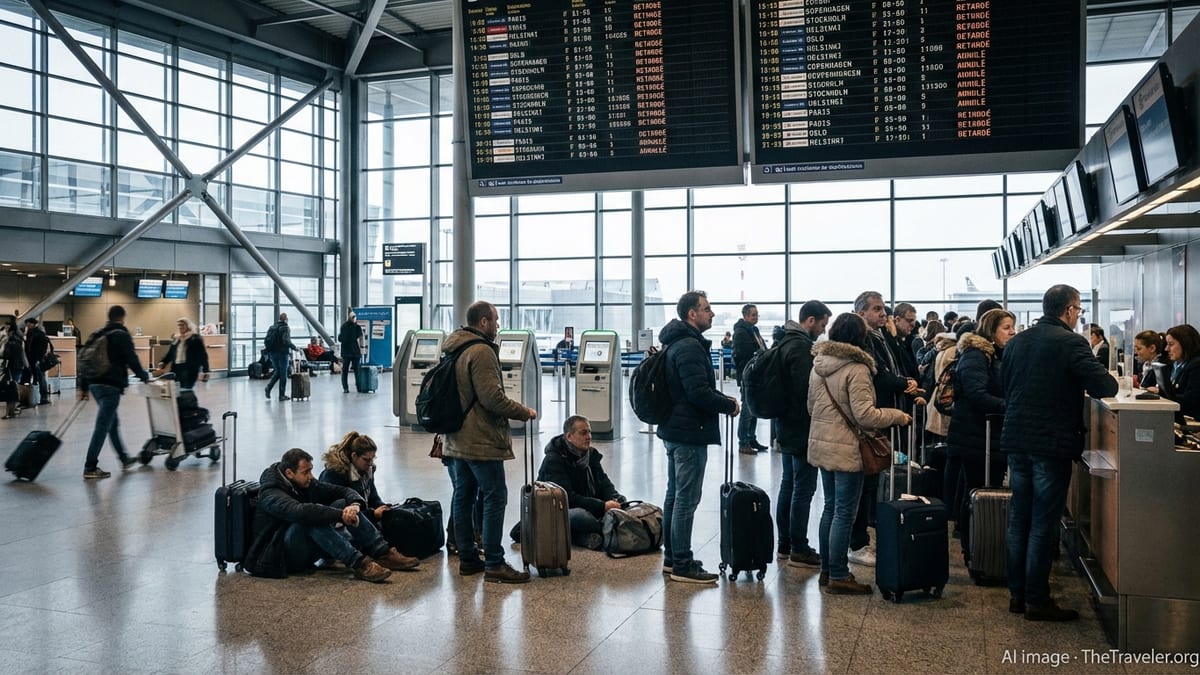
Grounded Flights Add Fresh Strain to Paris Hubs
The latest disruptions center on services linking Paris Charles de Gaulle with major Scandinavian gateways, where SAS and Air France jointly operate several daily rotations under extensive codeshare agreements. On Saturday, three of these services were grounded while others departed late, according to live schedule data and airport status boards, creating knock-on delays for passengers traveling onward to cities across northern Europe.
The affected flights include a mix of SAS-operated and Air France-operated services that also carry codes for partners such as Delta and other SkyTeam airlines. With aircraft and crew tightly scheduled at the tail end of the winter timetable, the removal of even a handful of rotations quickly reverberated through the system, leading to missed connections and rebookings at both Paris Charles de Gaulle and Paris Orly.
Air France has already spent much of February managing elevated levels of disruption triggered by severe weather across Europe, new industrial actions and operational strains in its short and medium haul network. SAS, which has been rebuilding capacity on its Paris routes, has likewise been vulnerable to bottlenecks in shared airspace and airport handling that leave little margin for recovery when delays mount.
While the number of flights grounded on Saturday is modest in isolation, the cancellations come on the heels of a succession of difficult travel days in France and elsewhere in Europe, intensifying frustration among travelers who have faced repeated schedule changes over the past fortnight.
Ripples Across a Europe Already on Edge
The latest problems in Paris land in a wider European context marked by waves of cancellations and delays. Storm systems and heavy winter weather earlier in the week disrupted operations at airports in the Netherlands, the United Kingdom, Germany and the Nordic countries, forcing airlines from KLM and Lufthansa to SAS and Air France to thin schedules or hold aircraft on the ground while conditions improved.
In France, air traffic control constraints and staffing issues at key hubs further complicated efforts to keep flights moving. Paris Charles de Gaulle, already one of Europe’s most complex hubs, has seen departure and arrival banks compressed or reshuffled at short notice, placing pressure on connection windows for long haul travelers bound for North America, Africa and Asia via Paris.
For SAS and Air France, both of which rely heavily on feeding passengers into large hub structures, the current pattern of disruptions poses particular challenges. A single delayed Paris to Oslo or Copenhagen flight can ripple onward to affect departures to destinations as far afield as northern Norway, the Baltic states or domestic French routes, forcing airlines to juggle aircraft assignments and crew rosters late into the day.
Smaller regional airports have also felt the impact. Delays and groundings out of Paris have translated into late arrivals at cities such as Lyon and Marseille, as well as Scandinavian airports that depend on tight turnarounds. The result for passengers has been a sense of instability that goes beyond the immediate day’s schedule, with many travelers nervous about whether upcoming trips will proceed as booked.
Passengers at Charles de Gaulle and Orly Face Long Queues
At Paris Charles de Gaulle, one of Europe’s busiest international gateways, the day’s disruptions were most visible in growing crowds around transfer desks and airline customer service counters. Screens showing late departures to Scandinavian and European destinations sent passengers into long queues in search of rerouting, meal vouchers or hotel accommodation when onward journeys became impossible.
Travelers at Orly, Paris’s secondary airport with a strong focus on domestic and medium haul routes, reported similar scenes as delays spread to connecting services operated by Air France and its partners. While the carrier has been gradually winding down much of its Orly operation in favor of concentrating at Charles de Gaulle, the airport remains a critical node for many French and regional routes. Any disturbance in Paris therefore quickly cascades to airports such as Nice, Marseille and other Mediterranean gateways.
Information flow emerged as a familiar pain point. Some passengers reported receiving text messages and app notifications warning of delays only minutes before boarding time, while others said they learned of cancellations only upon reaching the gate. In an environment where aircraft can quickly be reassigned, airlines are wary of formally cancelling services too early, yet that caution often leaves travelers with little time to adjust ground transport or accommodation plans.
Inside the terminals, airport staff and airline ground agents attempted to prioritize travelers with tight long haul connections, especially those headed to North America and Asia later in the day. Yet even for those rebooked successfully, baggage handling backlogs and tight turnaround times left many uncertain whether their luggage would make it onto the new flights.
Operational Headwinds: Weather, Staffing and Tight Schedules
The circumstances behind Saturday’s grounded flights illustrate how quickly a mix of operational headwinds can converge. Winter weather systems lingering over parts of Europe, including heavy rain and flooding in some French regions earlier in the week, forced airlines to build additional buffers into their schedules. At the same time, chronic staffing pressures in air traffic control and ground handling, coupled with aircraft undergoing scheduled maintenance, have reduced the margin for error.
For SAS, which relies on moving aircraft efficiently between its Scandinavian hubs and major European cities like Paris, even modest air traffic restrictions can upend carefully constructed rotations. A late inbound sector from Oslo or Copenhagen leaves crews approaching duty time limits and can prompt decisions to cancel or consolidate flights to maintain safety and regulatory compliance.
Air France is grappling with similar constraints, particularly on intra-European routes that feed its long haul network at Charles de Gaulle. Earlier in February, industrial actions by air traffic controllers and airport employees forced the carrier to proactively cut frequencies on selected days to avoid mass last minute cancellations. Those capacity reductions, while helping to stabilize operations, have left fewer options to re-accommodate passengers when fresh disruptions occur.
Industry analysts note that the post-pandemic rebound in demand has outpaced the recovery of aviation infrastructure and staffing across Europe. With aircraft flying fuller and schedules rebuilt to near pre-crisis levels, airlines such as SAS and Air France find themselves attempting to deliver high reliability in an ecosystem that remains prone to sudden bottlenecks.
Regulatory and Compensation Landscape Tightens in France
The current wave of disruptions arrives just as France implements tighter rules governing compensation for delayed and cancelled flights. A new decree that took effect this month refines the procedures through which passengers can seek reimbursement or damages from airlines, including those headquartered outside France but operating in French territory.
Under the revised framework, travelers experiencing significant delays or cancellations can expect a more structured process that emphasizes mediation and clearer documentation of claims. While existing European regulations on passenger rights remain the foundation, the French changes aim to close gaps that have allowed some disputes to linger unresolved for months or even years.
For airlines such as SAS and Air France, that means a sharper focus on both communication and record keeping. Carriers must be ready to demonstrate whether a disruption was caused by extraordinary circumstances beyond their control, such as extreme weather or air traffic control strikes, or by issues within their own operations, such as crew shortages or technical problems. The distinction is critical in determining the level of compensation owed.
Consumer advocates have welcomed the new measures but caution that enforcement will be key. As passengers in Paris and across France navigate Saturday’s disruptions, many may be unaware of their rights or how to initiate claims. Travel agents and online booking platforms are therefore likely to play an increasing role in guiding affected customers through the complaint process.
Scandinavian Connections at the Heart of the Disruption
The grounded flights and delays involving SAS and Air France have highlighted the importance of Paris as a connecting gateway for Scandinavian travelers. Routes linking Charles de Gaulle with Oslo, Copenhagen and Stockholm are linchpins for both business and leisure traffic, often carrying a high proportion of connecting passengers who join long haul services to Africa, Asia and the Americas.
In recent seasons, SAS has used its Paris services not only to serve point to point demand but also to connect Nordic travelers into partner networks, particularly through codeshares on Air France and other SkyTeam carriers. Grounded rotations on this corridor therefore have an outsized effect, disconnecting passengers from a web of onward flights that may operate only once per day or a few times per week.
Air France, for its part, has marketed Paris as a convenient alternative hub for Scandinavian passengers heading to southern Europe or long haul leisure destinations. Disruptions on Nordic routes can therefore spill into holiday traffic to destinations in Spain, Italy, Greece and beyond, as rebooked passengers occupy seats that might otherwise have been available for local origin and destination travelers.
Saturday’s events also underscore the growing interdependence of Europe’s major carriers. With alliances and codeshares spreading passengers across multiple brands on a single itinerary, disruptions affecting SAS-operated legs can instantly become problems for Air France, and vice versa, complicating questions of responsibility and compensation when flights go awry.
Travelers Adjust Plans and Seek Workarounds
Amid the uncertainty, many travelers affected by the latest disruptions have resorted to creative rerouting and flexible planning. Some passengers abandoned same day connections via Paris in favor of overnight stays and alternative routes through other European hubs, including Amsterdam, Frankfurt and London, where airlines offered spare seats on later departures.
Others turned to rail, particularly on dense corridors between Paris and major European cities that are well served by high speed trains. For travelers whose final destinations lay within France or neighboring countries, shifting to rail has increasingly become a practical fallback when aviation struggles to recover from weather or operational shocks.
Social media reports from passengers in Paris highlighted both frustrations and moments of successful improvisation. A number of travelers described securing seats on last minute flights to secondary airports in Scandinavia or northern Germany and completing their journeys by regional train or domestic flight. While these detours often added hours to travel times, they provided a measure of certainty in a day marked by frequent schedule changes.
For airlines, such self-directed rerouting is a mixed blessing. While it can ease immediate pressure on customer service desks, it also creates complex after-the-fact reimbursement claims, especially when travelers purchase their own replacement tickets and later seek compensation for disrupted original itineraries.
Outlook: A Fragile System Heading Toward Spring
With the European winter season now in its later stages, aviation planners had hoped for a smoother glide path into the typically busy spring travel period. Instead, February has delivered a string of shocks, from adverse weather to industrial action, that have tested the resilience of airlines and airports alike. The latest grounded flights by SAS and Air France in Paris are emblematic of a system that continues to operate with limited slack.
Looking ahead, both carriers are expected to review their operational resilience on key routes, including the Paris connections at the center of Saturday’s events. That may include building in slightly longer ground times, adjusting crew rotations or trimming marginal frequencies on days when traffic or weather risks are particularly high.
Travel experts advise passengers planning trips through Paris over the coming weeks to allow generous connection times, monitor flight status closely via airline apps and consider travel insurance that specifically covers missed connections and extended delays. For those reliant on tight links between Paris and Scandinavian cities, a cautious approach may be especially prudent until weather stabilizes and operational pressures ease.
For now, the scene at Paris’s airports captures the tension of a continent eager to travel yet still wrestling with the realities of a complex, interconnected aviation system. As SAS and Air France work to restore normal operations, thousands of passengers are once again reminded of how quickly even a small number of grounded flights can throw carefully laid plans into disarray.