

More news on this day
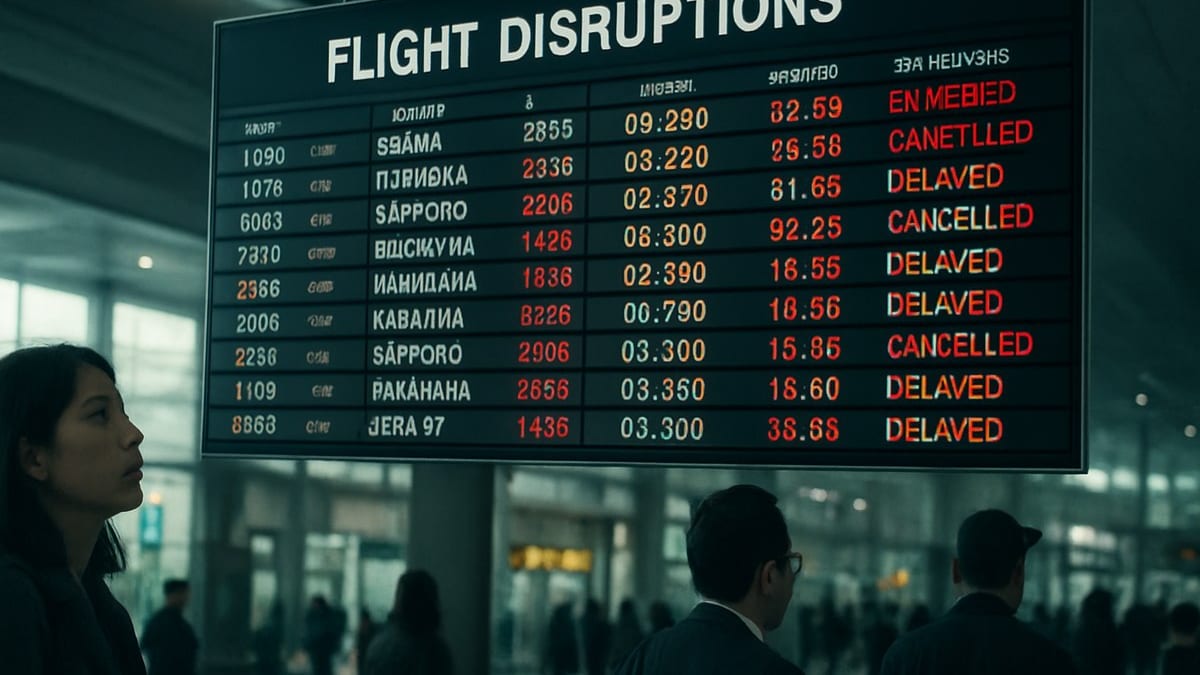
Japan’s aviation network experienced another difficult travel day as publicly available flight-tracking data showed more than 200 delays and 27 cancellations affecting airports from Tokyo to Kagoshima, disrupting plans for thousands of domestic and regional travelers.
Get the latest news straight to your inbox!
Network Strain Across Key Japanese Hubs
Recent operational data compiled by aviation trackers and industry-focused outlets indicates that the latest disruption wave hit a broad swath of Japan’s air transport system, including major hubs such as Tokyo’s Haneda and Narita airports, Sapporo’s New Chitose, Naha in Okinawa, Sendai, Kagoshima and several secondary regional fields. The tally of more than 200 delayed flights alongside 27 cancellations points to a day marked by stretched schedules and reduced punctuality.
Reports from travel industry publications describe how the disruption has been distributed unevenly across carriers. All Nippon Airways and its regional arm ANA Wings, Japan Airlines affiliates, low cost operators such as Jetstar Japan, and niche domestic players including Solaseed and Ibex all recorded affected services. While some airlines managed to limit outright cancellations, many saw a spike in late departures and arrivals that rippled through tightly timed domestic rotations.
Publicly accessible data snapshots suggest that the pattern fits into a broader run of difficult days for Japan’s air network during early April. On certain days this week, aggregated figures have shown nationwide delays reaching into the high hundreds, and in some instances above one thousand, with a smaller but still significant number of flights scrubbed entirely. The latest count of more than 200 delays and 27 cancellations sits within that wider context of elevated operational stress.
Industry observers note that Japan’s dense domestic network, characterized by frequent short hops between metropolitan and regional centers, is particularly vulnerable to compounding effects when schedules begin to slip. A single delayed aircraft can quickly affect multiple subsequent sectors, pushing what might begin as modest congestion at a hub airport into a nationwide pattern of late operations.
Weather, Congestion and Operational Constraints
Publicly available information points to a mix of contributing factors behind the latest disruptions, with unsettled early spring weather and airspace congestion frequently cited in recent coverage of Japan’s aviation performance. Rain bands, shifting wind patterns and low cloud can all trim usable runway capacity, necessitating wider spacing between takeoffs and landings and forcing airlines to slow their tightly sequenced operations.
In several recent Japanese disruption episodes, travel news outlets have highlighted how strong crosswinds and reduced visibility around central and western Japan have triggered minor ground holds and required runway configuration changes at major airports. When those measures coincide with peak travel periods, especially morning and evening banked departures, delays can accumulate rapidly as aircraft wait for slots to depart or arrive.
Operational constraints within airline networks also play a role. Maintenance requirements, crew duty-time limits and aircraft rotations leave limited room to absorb shocks once schedules begin to fray. Publicly available punctuality statistics and monthly operational summaries for major Japanese carriers over recent seasons show that even small variations in weather or traffic volume can result in measurable swings in on-time performance.
Analysts tracking Asia Pacific aviation trends emphasize that these Japanese disruptions are unfolding against a regional backdrop of frequent delay spikes and cancellations in neighboring markets. Recent reports documenting several thousand delays and hundreds of cancellations across hubs in China, Southeast Asia and South Korea suggest that the wider region is juggling capacity constraints, variable weather and still-recovering operational resilience as demand remains robust.
Impact on Passengers and Domestic Travel
For travelers on the ground, the most visible effects of more than 200 delays and 27 cancellations in Japan are longer queues at check in counters, crowded security lanes and departure halls, and busier-than-usual airline service desks. Publicly available images and eyewitness descriptions from prior disruption days this week have shown lines building as passengers seek rebooking options or clarification on evolving departure times.
Domestic business travelers, commuters and leisure passengers alike are particularly exposed when shorter intra-Japan sectors are disrupted. With typical flight times of one to two hours between many city pairs, even modest delays can wipe out the time advantage over high speed rail, while cancellations on thinner regional routes may leave only a handful of later services with spare seats.
Travel industry briefings and consumer guidance articles recommend that affected passengers in Japan monitor departure boards and airline mobile applications closely on the day of travel, as rolling delays and gate changes are common during such events. Many carriers in Japan allow same day standby or no fee rebooking during severe disruption periods, subject to seat availability, although specific conditions vary by airline and fare type.
For travelers with onward international connections, the disruption poses added complexity. Missed connections can force overnight stays or rerouting via alternative hubs in Asia, and some itineraries involving separate tickets may not be protected. Travel advisors frequently caution that during volatile periods in the regional aviation network, itineraries booked on a single ticket and through one carrier or alliance tend to offer more reliable protection options if things go wrong.
How Today’s Turbulence Fits a Broader Asia Pacific Pattern
The latest Japanese figures of more than 200 delays and 27 cancellations are part of a wider pattern of Asia Pacific aviation instability reported in recent days. Travel and aviation outlets documenting regional performance this week have pointed to multi country totals reaching into the thousands of delayed flights and several hundred cancellations across a single 24 hour window, spanning major hubs from Jakarta and Bangkok to Beijing, Seoul and Tokyo.
These cross border disruptions are often linked through aircraft and crew rotations that span several countries, meaning a delay or cancellation in one market can reverberate through another hours later. Publicly available analyses from specialist aviation data firms describe how this interconnectedness can transform a localized weather or congestion episode into a broader regional issue, especially during holiday or peak travel periods.
Japan’s role as both a major origin and destination market and as a connecting point for some Northeast Asia and trans Pacific itineraries ensures that turbulence in its domestic network rarely remains isolated. When operations slow at Haneda, Narita or key regional airports, knock on effects can appear in long haul schedules, cargo operations and neighboring countries’ hub performance.
With further busy travel days expected across Asia in the coming weeks, observers suggest that Japan’s latest tally of more than 200 delays and 27 cancellations underlines the importance for travelers of building flexibility into their plans. Longer connection windows, fully refundable or changeable tickets where possible, and careful monitoring of airline communications are recurring themes in publicly available travel advisories.
What Travelers Can Do As Disruptions Continue
For those scheduled to fly within or via Japan in the near term, practical steps can help reduce the impact of further disruptions if they occur. Consumer guidance from aviation and travel platforms consistently encourages travelers to verify their flight status repeatedly in the 24 hours before departure, using both airline applications and airport information displays, and to enable notifications for real time updates.
Passengers are also urged by publicly available advice columns to arrive at airports earlier than usual on days when disruption risk is heightened. Longer processing times at check in and security are common when many flights are off schedule, and early arrival provides more options if rebooking becomes necessary. Carry on essentials such as medications, chargers and a change of clothes are frequently cited as useful if delays extend into lengthy waits.
Travel insurance that includes coverage for delays and cancellations can provide some financial protection for hotels, meals and missed connections, although policies differ significantly in their wording and trigger conditions. Analysts covering Asia Pacific aviation note that the cumulative pattern of recent disruptions is prompting more travelers to review policy details closely and to consider higher coverage limits when booking complex itineraries.
Ultimately, the picture emerging from Japan’s latest count of more than 200 delays and 27 cancellations is one of a resilient but stressed aviation system operating in a challenging regional environment. While most flights are still operating, albeit not always on time, the current phase serves as a reminder that flexibility, preparation and close attention to real time information remain central to navigating air travel across Japan and the wider Asia Pacific region this season.