

More news on this day
Passengers travelling through Kelowna International Airport in British Columbia are once again facing cancellations and delays, as a fresh wave of winter weather and nationwide operational pressures disrupt schedules for airlines including WestJet, Jazz Aviation and Pacific Coastal Airlines.
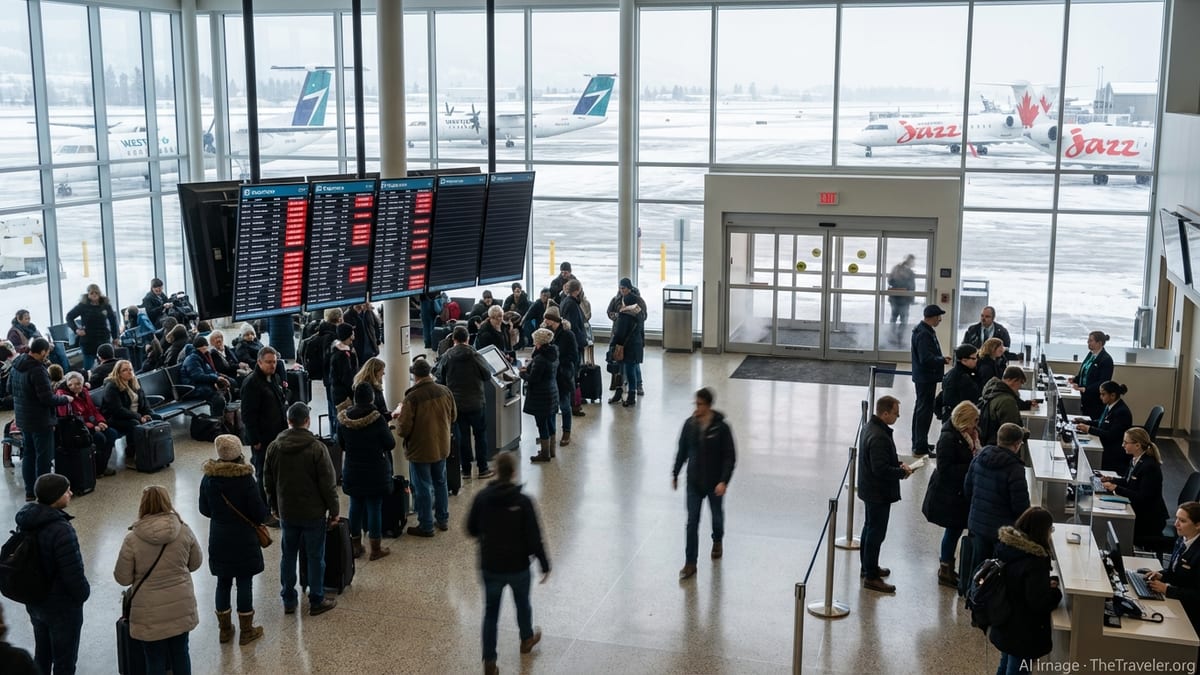
Over a Dozen Flights Affected at Busy Regional Hub
Kelowna International Airport, known by its code YLW, reported more than a dozen flights disrupted on February 17 as carriers struggled with deteriorating winter conditions on key routes and lingering knock-on effects from storms across Western Canada. The interruptions included a mix of outright cancellations and multi-hour delays on both arrivals and departures, affecting travellers headed to and from major connecting hubs such as Vancouver, Calgary and smaller regional points in British Columbia.
The latest issues come on the heels of a record-breaking year for the airport. Kelowna International handled over 2.3 million passengers in 2025, its busiest year on record, with December alone setting a new monthly high. That growth has left airlines and airport operators managing fuller flight loads and tighter schedules, making the system more vulnerable when weather or operational challenges arise.
While YLW itself remained open and operational, airline schedules showed repeated adjustments through the morning and early afternoon. Several passengers reported receiving late-night or early-morning notifications of cancellations, while others arrived at the terminal to find departure times slipping further as aircraft and crews struggled to reposition within carrier networks already strained by winter storms on the Prairies.
Airport officials emphasized that safety remains the overriding priority, particularly where de-icing and approach visibility are concerned. Even minor deterioration in conditions at destination or connecting airports can quickly cascade into delays at a regional hub like Kelowna, which relies heavily on on-time arrivals from larger centers to keep its schedule flowing.
WestJet, Jazz Aviation and Pacific Coastal Among Most Impacted
The latest disruptions have primarily affected regional and domestic services operated by WestJet and its affiliate WestJet Encore, Jazz Aviation on behalf of Air Canada, and Pacific Coastal Airlines. These carriers form the backbone of Kelowna’s connectivity, offering frequent links to Vancouver, Calgary, Victoria, Prince George and other communities across Western Canada.
According to airline status boards on Tuesday, multiple WestJet and WestJet Encore services between Kelowna and Vancouver, as well as Kelowna and Calgary, were operating behind schedule or marked as cancelled. Some flights saw departure times pushed back by more than an hour due to aircraft arriving late from weather-hit airports on the Prairies and in central Canada, where a winter storm system has triggered travel advisories.
Jazz Aviation, which operates feeder services under the Air Canada Express banner, also recorded delays on flights connecting Kelowna with Vancouver and other hubs. Pacific Coastal Airlines, which serves smaller communities and resource regions across British Columbia, reported schedule adjustments as crews and aircraft contended with changing conditions along coastal and interior routes.
While some international flights operated by other carriers continued largely on time, the regional network around Kelowna proved more fragile. With most passengers at YLW connecting onward through larger hubs, even modest schedule changes on relatively short segments can result in missed connections and onward disruptions for travellers bound for eastern Canada, the United States and overseas destinations.
Winter Weather and Network Knock-On Effects Drive Disruptions
The immediate catalyst for the latest round of interruptions is a broad winter weather system moving across the Prairies, prompting travel advisories from carriers such as WestJet for cities including Regina and Saskatoon. While those airports are hundreds of kilometres from Kelowna, the tightly interlinked nature of airline networks means a delayed or cancelled flight in Saskatchewan can ripple through aircraft rotations and crew schedules that touch British Columbia later in the day.
In recent weeks, Canada’s airlines have repeatedly grappled with storms that brought heavy snow, freezing rain and frigid temperatures to major hubs including Toronto, Montreal, Vancouver and Calgary. Each event forced carriers to slow operations to maintain safety margins, triggering hundreds of delays and dozens of cancellations nationwide. Kelowna, which depends on those hubs for the majority of its connections, has felt the impact each time.
Apart from weather, carriers have also been juggling lingering operational pressures related to aircraft availability, staffing and maintenance. When winter conditions compress already tight schedules, there is often little spare capacity to recover quickly from disruptions. That reality is especially visible at mid-sized regional airports like YLW, where aircraft may cycle through multiple Canadian cities in a single day before returning.
Airport officials noted that even when skies over the Okanagan remain relatively clear, storms in Vancouver or Calgary can force flights from Kelowna to hold or delay departure. Air traffic flow-management measures, which limit the rate at which aircraft can arrive at busy hubs during peak disruption, can require regional airports to keep planes on the ground longer than planned, further aggravating backlogs.
Passengers Confront Long Lines, Rebookings and Overnight Stays
For passengers, Tuesday’s disruptions translated into familiar scenes at Kelowna International: lines at check-in counters and customer-service desks, busy seating areas near departure gates, and travellers scanning their phones for updated departure times. Some families and business travellers chose to rebook for later in the week, while others scrambled to adjust hotel reservations and ground transport at their destinations.
Travellers reported a mix of experiences with rebooking options. Those whose flights were cancelled outright could often be moved to later departures on the same day or the following day, although popular routes to Vancouver and Calgary quickly filled up as airlines consolidated capacity. In some cases, passengers opted to route through different hubs, such as connecting via Edmonton or even through U.S. gateways, to reach their final destinations.
The timing of the disruptions has been particularly challenging given Kelowna’s rising popularity as both a leisure and business destination. With more than 2.3 million passengers moving through YLW last year, even a relatively small percentage of disrupted travellers can translate into hundreds of people seeking assistance in a single day. For those without travel insurance or flexible tickets, options can be more limited and out-of-pocket costs higher.
Airport staff and airline agents worked to manage expectations, encouraging passengers to remain in close contact with their carriers via apps and text alerts. Many travellers, however, still rely on airport departure boards and announcements, leading to pockets of confusion as revised departure times shifted multiple times over the course of the morning.
Airlines Activate Flexible Policies and Travel Advisories
In response to the broader winter weather system, WestJet maintained a series of travel advisories for impacted regions, offering fee waivers for one-time changes and, in some cases, flexible cancellation options. While the advisories were focused on cities directly under storm warnings, the measures also benefited some Kelowna passengers on itineraries touching those hubs, enabling them to adjust plans before disruptions peaked.
Under many airline policies, customers whose flights are cancelled by the carrier are entitled to rebooking on the next available flight at no additional cost. Some airlines also provide meal vouchers or hotel accommodations in specific circumstances, though policies vary depending on whether the disruption is classified as weather-related or within the airline’s control. Passengers at YLW on Tuesday were urged to review their fare rules and contact their airlines’ customer-service channels directly.
Jazz Aviation and Pacific Coastal Airlines, both heavily invested in regional connectivity, similarly encouraged travellers to check flight status early and often, particularly for early-morning and late-evening departures when weather conditions and flow-control measures can change rapidly. In many cases, proactive rebooking by passengers helped reduce crowding at airport counters later in the day.
Consumer advocates continue to call for clearer communication around travel rights and compensation for Canadian air passengers. While federal regulations outline certain obligations for airlines, weather-related disruptions often limit the extent of mandatory compensation. For travellers in Kelowna and across the country, understanding the distinction between weather and operational causes can be key to knowing which remedies may be available.
Record Passenger Growth Heightens Sensitivity to Disruption
The latest wave of cancellations and delays comes at a time when Kelowna International Airport is experiencing unprecedented growth. With more than 2.3 million passengers in 2025 and consecutive monthly records in the second half of the year, YLW has firmly established itself as one of Canada’s busiest regional gateways, serving the Okanagan Valley’s tourism, wine and technology sectors.
Airport leadership has pointed to expanded air service, increased flight frequency and the use of larger aircraft as drivers of that growth. New and enhanced routes to major hubs and seasonal leisure destinations have broadened options for both local residents and inbound visitors. However, that same expansion has left the system more complex, with tighter aircraft turnarounds and busier peak periods that leave less room for error when disruption hits.
For airlines, fuller planes can mean fewer spare seats to accommodate disrupted passengers, especially on short-notice rebookings. For the airport, managing passenger flows through security, baggage claim and ground transportation becomes more challenging when multiple delayed flights arrive or depart in quick succession. Tuesday’s issues again highlighted the pressure points in YLW’s operations during irregular operations.
Local tourism and business groups are watching the situation closely. Reliable air connectivity is widely seen as essential to maintaining Kelowna’s competitiveness as a meeting, convention and year-round leisure destination. While occasional winter disruptions are an accepted part of Canadian travel, repeated or prolonged issues risk undermining traveller confidence if not managed transparently and efficiently.
Preparing for Ongoing Winter Risks and Summer Pressure
Looking ahead, both airlines and Kelowna airport officials acknowledge that winter-related disruptions are likely to continue in the coming weeks, given Canada’s typical late-season storm patterns. Passengers are being urged to build additional buffer time into their itineraries, especially when making tight connections through Toronto, Montreal, Vancouver or Calgary.
Operational planners are also turning their attention to the summer travel season, when Kelowna is expected to remain busy and may face knock-on delays related to major events elsewhere. Vancouver’s role as a host city for FIFA World Cup matches in June and July is expected to trigger stricter air-traffic flow-control at that hub, which could in turn lead to departure holds and minor delays on flights from Kelowna to Vancouver even in clear weather.
To mitigate the impact, carriers are reviewing schedules, aircraft assignments and crew planning to add resilience where possible. However, industry analysts note that after several years of recovery from the pandemic and ongoing fleet modernization programmes, many airlines still operate with limited spare capacity. That constraint means regional airports such as YLW will likely continue to feel the effects whenever Canada’s largest hubs are forced to slow operations.
Kelowna airport management has signalled that continued investment in infrastructure and technology, from de-icing capacity to digital passenger communications, will be crucial to keeping operations as smooth as possible during irregular events. In the meantime, travellers flying through YLW are being advised to remain flexible, stay informed and consider contingency plans when booking critical journeys in the heart of winter.
What Travellers Through Kelowna Should Do Now
With more disruptions possible throughout the day, passengers scheduled to travel through Kelowna International are being strongly encouraged to check their flight status before leaving for the airport. Airline apps and text alerts generally provide the earliest notice of time changes, gate shifts or cancellations, often well before information is reflected on departure boards.
For those already holding tickets on affected services, immediate steps include confirming whether a flight is cancelled or simply delayed, reviewing available alternative flights and contacting the airline through digital channels where possible to avoid long queues at the airport. Travellers with tight connections in larger hubs may wish to proactively request rebooking onto earlier departures or alternative routings.
Travel experts also recommend packing essential medications, chargers and a change of clothes in carry-on baggage when flying in winter, in case delays stretch into unexpected overnight stays. For visitors bound for ski resorts and other Okanagan attractions, arrangements with ground-transport providers and accommodation may need to be flexible, particularly when late-night arrivals become early-morning landings.
As Tuesday’s events show, Kelowna International Airport’s growing role in Canada’s aviation network brings with it both opportunity and vulnerability. Strong demand has made YLW a vital hub for the region, but it has also tied the airport’s fortunes ever more closely to the complex web of weather, traffic management and airline operations across the country. For now, passengers, airlines and airport staff alike are working to navigate another turbulent winter day in Canadian air travel.