

More news on this day
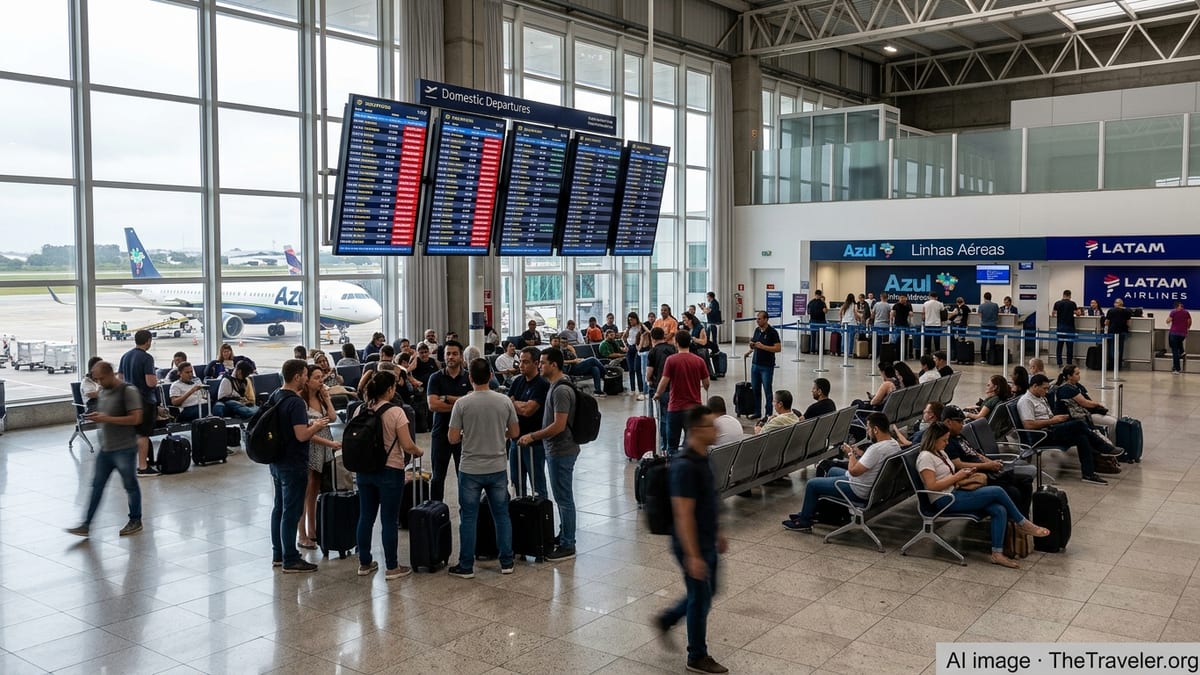
Air travelers in Brazil are facing a new wave of disruption as airports in Campinas, São Paulo, Porto Alegre and Araraquara report more than a dozen cancellations and numerous delays affecting services operated by Azul Brazilian Airlines, LATAM Brasil and other carriers, according to live airport dashboards and local media coverage.
Get the latest news straight to your inbox!
Operational Strain Across Major and Regional Hubs
Publicly available flight information for mid-March indicates that Brazil’s air network is under fresh strain, with clusters of cancellations and late departures at Viracopos International Airport in Campinas, the São Paulo metropolitan airports, Porto Alegre’s regional facilities and Araraquara’s municipal airport. While the total number of affected flights remains modest compared with peak holiday periods, the disruption is concentrated on key domestic routes that connect major business and leisure markets.
In Campinas, a principal hub for Azul, monitoring boards show multiple cancelled departures and arrivals across the day, alongside a series of services leaving significantly behind schedule. São Paulo’s Congonhas and Guarulhos airports, important bases for both LATAM Brasil and Azul, are also registering delayed rotations, particularly on short-haul domestic links. Porto Alegre and Araraquara, which depend heavily on a handful of daily services, are seeing individual cancellations translate into outsized local impact.
The pattern reflects how even a relatively small number of schedule changes can quickly ripple through Brazil’s dense but highly interconnected domestic network. When aircraft and crew are held at one airport, knock-on effects appear at downstream destinations, leaving travelers facing missed connections, rebookings and longer waiting times in terminals.
Azul and LATAM Adjust Schedules Amid Network Pressures
Azul and LATAM Brasil, two of the country’s largest carriers, appear prominently in the latest lists of affected flights. Public airport data suggests that Azul, which relies heavily on Viracopos as a central hub, has pulled several rotations there while also posting extended delays on remaining services. LATAM Brasil, with a strong presence at both Guarulhos and Congonhas, is likewise associated with late departures to and from São Paulo and other cities in the South and Southeast.
Industry analysts note that Brazil’s airlines are still fine-tuning networks that were heavily reconfigured in recent years, with capacity increases on some popular routes and more tentative frequencies on thinner regional links. In this context, adverse operational conditions on a single day can prompt carriers to consolidate flights, cancel lower-demand legs or retime services to restore overall punctuality.
Brazilian aviation has also been coping with elevated cost pressures, including fuel, maintenance and currency volatility, which can limit the availability of reserve aircraft and crews. When disruptions arise, this can reduce flexibility to absorb delays without cutting flights, particularly on routes serving smaller cities such as Araraquara that are typically scheduled with narrow operational margins.
Weather, Congestion and Infrastructure Among Contributing Factors
While no single cause is being cited publicly as responsible for all of the cancellations and delays, recent operations across Brazil’s Southeast and South regions have been influenced by a familiar mix of challenges. Seasonal weather patterns, including heavy rain and low cloud, can disrupt arrivals and departures, particularly at congested airports such as São Paulo’s Congonhas and Guarulhos, where runway and airspace capacity are tightly managed during peak hours.
Congestion in and around major metropolitan airports can also slow ground handling, boarding and pushback, increasing the risk that minor delays early in the day cascade into more significant schedule disruptions. In Campinas, where Viracopos has grown into a busy domestic and cargo hub, aircraft and passenger flows are often concentrated into banks of departures and arrivals, amplifying the impact when one or more flights fail to operate on time.
Infrastructure constraints remain another background factor. Although Brazil has invested in airport modernization in recent years, several secondary and regional facilities still operate with limited stands, ground equipment or terminal capacity. In such environments, a single aircraft rotation arriving late or a sudden maintenance issue can force rapid adjustments, including cancellations, to keep the rest of the day’s operations moving.
Travelers Urged to Monitor Flights and Allow Extra Time
With delays and cancellations scattered across multiple airports and airlines, travel specialists recommend that passengers flying through Campinas, São Paulo, Porto Alegre and Araraquara closely track their bookings on the day of departure. Airline apps, airport displays and notification services can provide early warning of schedule changes, giving travelers more options to rebook or adjust ground connections when necessary.
For those connecting between different airports in the São Paulo region or relying on tight domestic-to-international connections, recent disruption underscores the importance of allowing generous transfer times. Traffic congestion between city airports and shifting departure slots can make short connections particularly vulnerable if an inbound leg is delayed.
Passengers affected by cancellations and significant delays are generally entitled to assistance and, in some cases, compensation under Brazil’s passenger protection rules. Consumer groups in the country routinely advise travelers to retain boarding passes, booking confirmations and any written notices of irregular operations to support later claims, especially in situations where alternative transport or accommodation becomes necessary.
Outlook for the Coming Days
Looking ahead, aviation observers will be watching whether the latest operational difficulties remain localized to a short period or continue to surface across the network in the coming days. Airlines often respond to such episodes by making tactical adjustments, including swapping aircraft types, reorganizing crew rotations or trimming marginal frequencies to restore reliability.
For travelers, the near-term outlook suggests a continued need for flexibility, particularly when itineraries involve multiple segments or smaller regional airports. As carriers such as Azul and LATAM Brasil balance demand, costs and operational resilience, day-to-day punctuality may fluctuate, even outside traditional peak seasons.
The situation underscores the broader challenge of maintaining reliable air service in a large and geographically diverse country where many communities depend on a limited number of daily flights. Any sustained pattern of cancellations at hubs like Campinas and São Paulo, or at secondary cities such as Porto Alegre and Araraquara, is likely to draw close scrutiny from consumer advocates and industry analysts focused on the stability of Brazil’s domestic air network.