

More news on this day
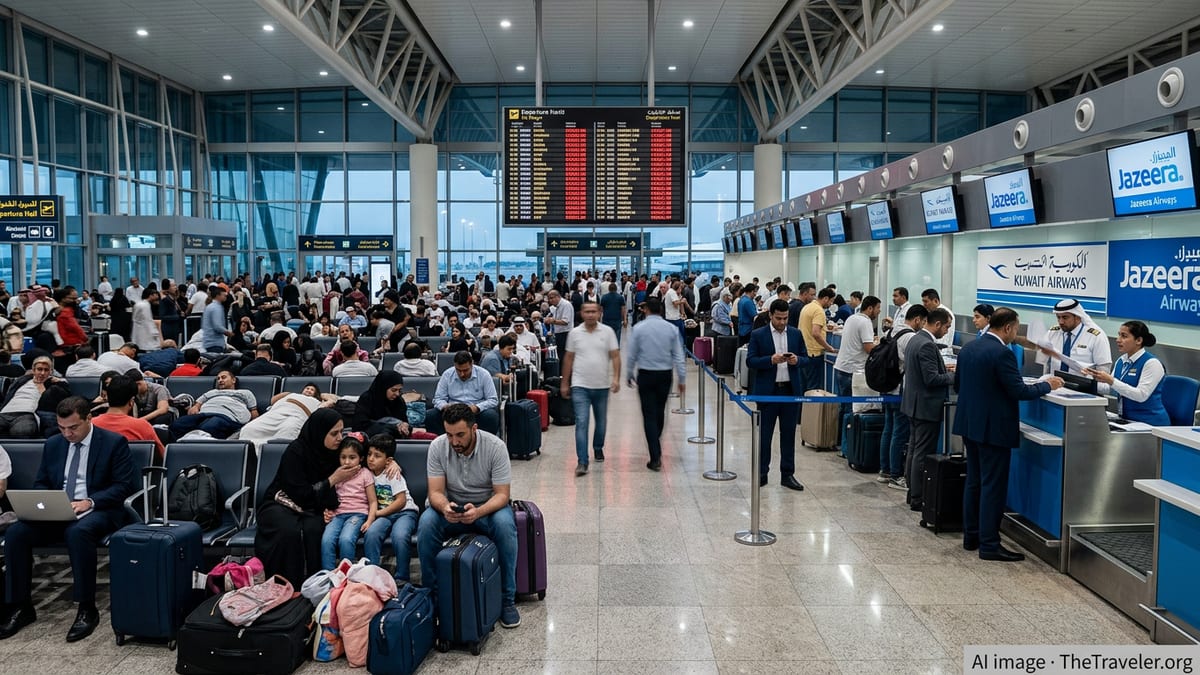
Hundreds of travelers at Kuwait International Airport faced extensive disruption after 19 flights were canceled on short notice, affecting services operated by Kuwait Airways, Emirates, British Airways and Egypt Air on key routes to Dubai, London, New York and Cairo.
Get the latest news straight to your inbox!
Wave of Cancellations Strands Passengers
Published coverage and flight-tracking data indicate that Kuwait International Airport experienced a concentrated wave of cancellations, with 19 flights withdrawn from the schedule in a matter of hours. The affected services included regional and long-haul departures and arrivals, leaving passengers scrambling for alternatives at one of the Gulf’s important connecting hubs.
The disruptions involved multiple major carriers serving Kuwait, including national flag carrier Kuwait Airways alongside Emirates, British Airways and Egypt Air. Key trunk routes linking Kuwait City with Dubai, London, New York and Cairo were among those hit, sharply reducing connectivity to some of the region’s most heavily used destinations.
Reports from passengers on social platforms describe crowded terminals, long lines at airline counters and uncertainty over rebooking options, particularly for those with onward connections. Travelers heading for long-haul flights to Europe and North America appeared especially affected as missed connections in Dubai or London risked cascading delays to final destinations such as New York.
Publicly available information suggests that some flights were canceled outright while others were removed from booking systems and airport boards shortly before scheduled departure, adding to confusion for passengers who had already arrived at the airport.
Operational Pressures on Kuwait Airways and Partner Carriers
Kuwait Airways, which uses Kuwait International Airport as its main hub, appeared to shoulder a significant share of the disruption as it adjusted operations on regional and long-haul sectors. According to timetable data and publicly accessible aviation reports, several Kuwait Airways services to nearby Gulf cities as well as onward connections via partner hubs were either delayed or canceled as the situation unfolded.
Emirates, which links Kuwait to Dubai for connections across its global network, also saw its Kuwait–Dubai services affected. Given Dubai’s role as a major transit point for flights to London and New York, cancellations on the Kuwait–Dubai leg left many travelers uncertain about their ability to reach later long-haul departures, even when those onward flights remained scheduled.
British Airways and Egypt Air appeared to face knock-on operational pressures as well. Disruptions on Kuwait–London services constrained access to one of Europe’s busiest hubs, while adjustments on Kuwait–Cairo flights reduced capacity on a heavily traveled regional corridor that also feeds onward routes into Africa and the wider Middle East.
Industry observers note that the combination of schedule changes, crew and aircraft positioning challenges and airspace constraints across parts of the region have made it harder for airlines to recover quickly once a cluster of cancellations occurs, especially at airports that function both as origin markets and feeder points into larger hubs.
Regional Airspace Constraints and Wider Gulf Network Impact
Recent reporting on Gulf aviation indicates that Kuwait’s disruption is part of a broader period of instability for air travel across the region. Ongoing security concerns and temporary airspace restrictions affecting several Gulf states have forced airlines to reroute or suspend certain services, increasing block times and tightening aircraft availability.
Analysts tracking the situation point to a pattern in which hubs such as Dubai, Doha, Kuwait City and other regional airports experience simultaneous schedule changes when airspace limitations, operational safety considerations or shifting demand patterns intersect. In this context, a cluster of 19 cancellations at Kuwait International Airport is seen as one visible manifestation of wider pressures on the Gulf network.
Publicly available data from flight-tracking platforms shows that on days with more extensive airspace constraints, departures from Kuwait to key hubs like Dubai and Cairo may be reduced or reshuffled, while long-haul sectors to destinations such as London and New York face tighter operating windows. This environment leaves airlines with limited flexibility to recover disrupted rotations and can quickly translate into crowding and delays for passengers.
Travel commentators suggest that even when total passenger numbers remain robust, the concentration of demand on fewer operating flights magnifies the impact of each cancellation, particularly on high-profile routes that connect Gulf cities with major Western gateways.
Traveler Experiences and Passenger Rights
As news of the Kuwait cancellations spread, travelers turned to social media and online forums to share experiences and seek guidance. Several accounts describe passengers waiting for hours at gates or check-in areas before receiving confirmation that their flights would not operate, with many then directed to ticketing counters to explore rebooking or refund options.
Consumer advocacy resources note that passenger protections vary depending on the airline, the jurisdiction of the ticket purchase and the origin or destination of the flight. Travelers on flights touching the European Union or United Kingdom, such as those on British Airways services to and from London, may be covered by specific compensation and assistance regulations, while passengers on other carriers and routes may fall under different contractual and regulatory frameworks.
Guides on air passenger rights advise affected travelers to keep detailed records of boarding passes, booking confirmations and any written communication about cancellations, as these documents may be required to support refund claims, rebooking requests or applications for out-of-pocket expense reimbursements. Travelers are also encouraged to monitor airline apps and official channels closely, as schedule changes can occur rapidly during periods of operational strain.
Reports from recent disruption events elsewhere in the Gulf suggest that proactive communication, timely notification of cancellations and clear instructions for rebooking can significantly reduce passenger frustration. In the Kuwait case, however, several travelers have reported limited visibility into options until they reached airport counters, adding to the sense of uncertainty.
What Passengers Can Do When Flights Are Canceled
Travel experts recommend that passengers caught up in cancellations at Kuwait International Airport take a methodical approach to minimizing disruption. Checking live flight status across both airline and airport channels, along with independent tracking platforms, can help confirm whether an alternative departure is likely to operate before travelers commit to new arrangements.
Those with urgent travel needs are often advised to explore rerouting options through nearby hubs, including alternative Gulf or regional airports, where capacity may still be available. However, any change should be coordinated with the original airline or booking agent to avoid forfeiting entitlements under the original ticket conditions.
For future trips, industry commentators highlight the value of booking longer connection windows on itineraries that rely on Gulf hubs, especially during periods of heightened regional tension. Flexible tickets, comprehensive travel insurance and the use of credit cards that include travel disruption benefits can also help protect travelers against the financial impact of sudden cancellations.
While Kuwait International Airport and the affected airlines work to stabilize operations and restore full schedules, observers expect intermittent disruptions to remain possible as regional airspace and security conditions evolve. Passengers planning to travel through Kuwait in the coming days are widely advised, through publicly available travel advisories, to stay alert to schedule changes and allow additional time for their journeys.