

Passengers traveling between London and North America woke on February 17 to a fresh wave of disruption, as American Airlines, Iberia and British Airways reported a cluster of cancellations and a string of rolling delays across Heathrow and other London airports, complicating journeys at the start of a busy late-winter travel period.
Four Cancellations Spark a Day of Turmoil
Operational data and live flight tracking on February 17 indicate that services operated or marketed by American Airlines, Iberia and British Airways suffered four outright cancellations on routes touching London, alongside numerous departures running significantly behind schedule. While modest in absolute numbers, the cancellations were concentrated on transatlantic and key European links, amplifying the knock-on effect for connecting passengers across both sides of the Atlantic.
Industry analysts note that even a handful of cancellations at hub airports such as Heathrow can quickly ripple through tightly timed networks. Aircraft and crews scheduled to operate onward legs are left out of position, while passengers miss connections and require rebooking, accommodation and re-routing. For large alliance carriers like American Airlines, Iberia and British Airways, which share extensive codeshare arrangements, a disruption to one brand can quickly cascade across the joint network.
Travel data from recent weeks shows that London’s hubs have already been under pressure from winter weather, heavy inbound traffic and residual staffing constraints. Earlier this month, European airports including Heathrow recorded dozens of cancellations and hundreds of delays in a single day as winter weather slowed operations, leaving little slack in the system when further disruption emerged.
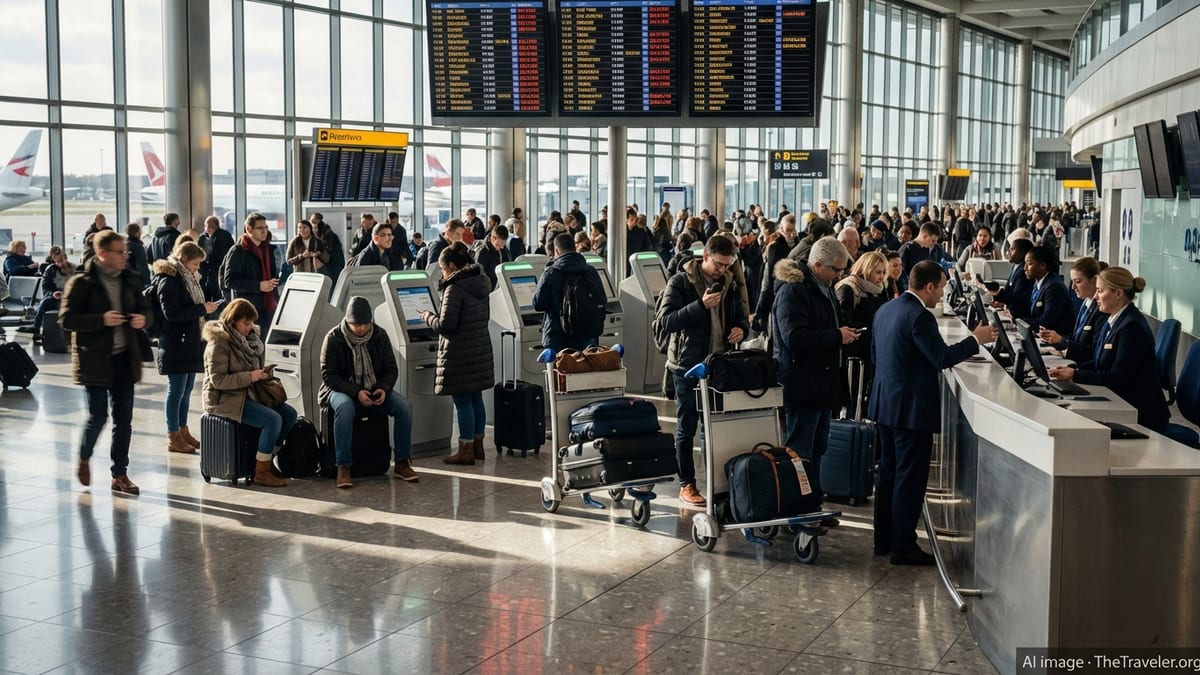
By mid-afternoon on Tuesday, the four cancellations tied to the three carriers had triggered a series of missed onward flights for passengers heading to North America, Spain and secondary European cities, with customer-service desks at Heathrow Terminals 3 and 5 reporting heavy queues as travelers sought alternative options.
Major London Hubs Bear the Brunt
Heathrow once again sat at the center of the disruption, reflecting its role as British Airways’ primary hub and a key gateway for American Airlines and Iberia services. Flight-tracking data on February 17 showed multiple services arriving and departing later than scheduled, with some long-haul flights from the United States reaching London several hours behind their planned arrival times.
One recent American Airlines service from Dallas–Fort Worth to Heathrow, operating earlier in the week, landed more than three hours late, underscoring just how stretched transatlantic operations have become during this period. When such flights operate behind schedule, they compress ground times, challenge crew duty limits and increase the likelihood that later rotations will also slip, building pressure on subsequent days.
British Airways and Iberia, working in close partnership between London and Madrid, also reported schedule strain. While some jointly marketed services ran close to time on Tuesday, others across the broader network have faced recurrent delays this month, complicating connections for travelers heading to Latin America, the Canary Islands and business destinations across continental Europe.
Although London Gatwick and London City saw comparatively fewer cancellations linked to the three carriers on this particular day, they were not immune to delays. Tight airspace capacity over southeast England, combined with congestion at Heathrow, can prompt air-traffic control restrictions that slow arrivals and departures across the region, even when the most visible problems originate at a single hub.
Weather, Staffing and Tight Rotations Combine
Behind the latest disruption lies a familiar mix of contributing factors: adverse winter conditions across parts of Europe and North America, ongoing staffing constraints in ground handling and air-traffic services, and very tight aircraft rotations that leave minimal room for recovery when flights run late. In recent weeks, storms and low-visibility conditions have repeatedly forced airports in the UK and on the continent to trim schedules and extend spacing between takeoffs and landings.
Earlier this month, data compiled across several northern European hubs showed dozens of cancellations and hundreds of delays in a single day as fog, low cloud and icy conditions slowed ground operations. London Heathrow featured prominently in those statistics, illustrating how vulnerable the UK’s primary international gateway remains to weather and operational shocks during the winter season.
Airlines serving London have responded by selectively cancelling a small number of flights to try to stabilize the wider network, a strategy evident again on February 17 with the four cancellations shared among American Airlines, Iberia and British Airways. By grounding a limited set of rotations, carriers aim to protect long-haul operations, preserve strategic routes and avoid a full-day spiral of short, incremental delays that erode punctuality across dozens of flights.
However, this tactic inevitably concentrates the impact on those unlucky enough to be booked on the cancelled services. For those travelers, especially those at the start of complex itineraries involving multiple connections, the decision to cancel rather than operate late can mean missed holidays, lost business meetings and an unplanned night in an airport hotel.
Passengers Face Missed Connections and Mounting Stress
For passengers, the practical consequences of Tuesday’s disruptions were immediately visible in longer queues at check-in, crowded departure lounges and busy transfer desks. Travelers connecting through Heathrow on joint itineraries marketed by American Airlines, Iberia and British Airways reported difficulty securing same-day alternatives, particularly on transatlantic flights where most services during this season are already operating with high load factors.
Those whose flights were cancelled outright faced the most acute uncertainty. Many were offered rebooking on later departures or rerouting via partner hubs such as Madrid, Dublin or Paris, but options were constrained by the limited spare capacity in peak morning and evening banks. Families traveling together sometimes found that only scattered seats remained, forcing them to split across different flights or, in some cases, different travel days.
Even for passengers whose flights departed, extended delays created downstream issues with hotel reservations, ground transfers and pre-booked activities. A delay of several hours on an overnight transatlantic service can easily push an arrival beyond check-in windows and tour start times, especially for travelers headed onward to regional UK cities from London.
Travel counselors at UK and US agencies say they have fielded a steady stream of calls since early morning from clients caught up in the disruption. Many have sought documentation to support insurance claims, guidance on rerouting and clarification on their rights under UK and EU regulations for compensation and care when flights are significantly delayed or cancelled.
Airlines Respond with Rebooking and Vouchers
American Airlines, Iberia and British Airways moved throughout the day to dampen the impact of the disruptions, leaning on alliance partnerships and flexible rebooking policies. At Heathrow, staff were deployed to assist with transferring passengers onto alternative flights, including services operated by oneworld partners, where seats were available.
In line with prevailing UK and European passenger-protection rules, travelers affected by cancellations were offered the choice of rerouting at the earliest opportunity or traveling at a later date, subject to seat availability. In cases where delays stretched into multiple hours and overnight stays became unavoidable, airlines arranged hotel accommodation and meal vouchers for eligible customers, according to passengers and travel agents who spoke to The Traveler.
Some carriers also encouraged customers holding tickets for affected flights to move their journeys to less busy days or times, waiving change fees in specific instances. While such voluntary rebooking options can ease the load on peak services, they require rapid communication through apps, e-mail alerts and text messages to be effective, and not all travelers reported receiving timely notifications.
Across social media, passengers shared images of crowded departure halls and long waits at customer-service desks. Others, however, noted that once rebooked, their journeys proceeded smoothly, praising frontline staff who worked under pressure to resolve complex itineraries and secure last-minute seats on alternative flights.
Regulators and Airports Monitor Resilience
The latest bout of disruption is likely to attract renewed scrutiny from UK aviation regulators and airport operators, who have spent the past several years urging airlines to build more resilience into their schedules. Winter weather and occasional air-traffic control constraints are predictable seasonal risks, officials argue, and networks must be robust enough to absorb them without spiraling into day-long breakdowns.
Heathrow’s management has previously called on airlines to maintain realistic turnaround times, ensure adequate staffing and invest in standby aircraft and crews during peak periods. While carriers insist that they have strengthened their operations since the worst disruptions seen during the post-pandemic recovery, the disruption on February 17 will add fuel to questions about whether current contingency plans are sufficient.
Consumer advocates also continue to press for clearer communication when things go wrong. Passengers often report receiving conflicting or incomplete information about the reasons for a delay or cancellation, the expected length of the disruption and the remedies available to them. This confusion can heighten stress for travelers already grappling with missed connections or time-sensitive commitments at their destination.
Airport authorities in London and elsewhere are investing in improved passenger-information systems and better real-time coordination between airlines, ground handlers and air-traffic control. The goal is to reduce the time it takes to make and communicate key decisions on cancellations and rebookings, especially when multiple carriers are affected by the same underlying conditions.
What Travelers Can Do Now
For travelers planning journeys to or from London in the coming days, the events of February 17 serve as a reminder to build flexibility into itineraries. Travel advisors recommend allowing wider connection windows when transiting through congested hubs such as Heathrow, especially when linking long-haul and short-haul flights on separate tickets.
Checking flight status frequently through airline apps and airport information feeds remains essential, particularly in the 24 hours before departure. When disruptions begin to emerge, passengers who move early to rebook often secure the best remaining options, whether that is an earlier departure ahead of incoming weather or a later flight once operations stabilize.
Travel insurance that covers delays, missed connections and additional accommodation can also cushion the financial blow of cancellations. Policies vary, but many will reimburse for extra hotel nights, meals and local transportation when flights are severely delayed for reasons outside the traveler’s control, provided documentation is kept and claims are filed promptly.
Finally, experts encourage passengers to familiarize themselves with their rights under UK and EU regulations. Depending on the cause of the disruption and the length of the delay, travelers may be entitled to cash compensation, refunds or care such as meals and accommodation. Understanding those entitlements in advance can help travelers advocate for themselves more effectively when they find their plans upended at the airport.
Broader Questions for Transatlantic Travel
While Tuesday’s four cancellations and associated delays represent a modest numerical setback within a vast global schedule, the concentration of problems among American Airlines, Iberia and British Airways at London’s key hubs raises broader questions about the resilience of transatlantic travel this winter. With demand remaining robust and aircraft utilization running high, there is limited margin for error when weather or operational issues strike.
Transatlantic routes are among the most lucrative in commercial aviation, and the joint business arrangement linking these three carriers has been a central pillar of capacity between the UK, continental Europe and North America. Maintaining reliability on these services is therefore both a commercial imperative and a matter of national connectivity for the UK and Spain, where tourism and business links depend heavily on predictable air service.
As airlines finalize schedules for the spring and summer seasons, analysts will be watching closely to see whether carriers introduce additional slack, adjust frequencies or deploy larger aircraft to improve reliability while meeting demand. For now, the disruptions on February 17 stand as a cautionary snapshot of how even limited cancellations can create disproportionate challenges for passengers when networks are operating close to their limits.
With more unsettled winter weather forecast in parts of Europe and North America, travelers using London’s airports in the weeks ahead are likely to keep a close eye on their flight-status notifications, hoping that the latest bout of turmoil proves to be a short-lived setback rather than a sign of deeper, recurring strain in one of the world’s busiest air corridors.