

More news on this day
Hundreds of travellers across Brazil’s busiest air corridors are facing last-minute changes to their plans as Azul Brazilian Airlines, GOL Linhas Aéreas Inteligentes, LATAM Brasil and other carriers report clusters of cancellations and significant delays affecting connections between Belo Horizonte, Rio de Janeiro and São Paulo.
Get the latest news straight to your inbox!
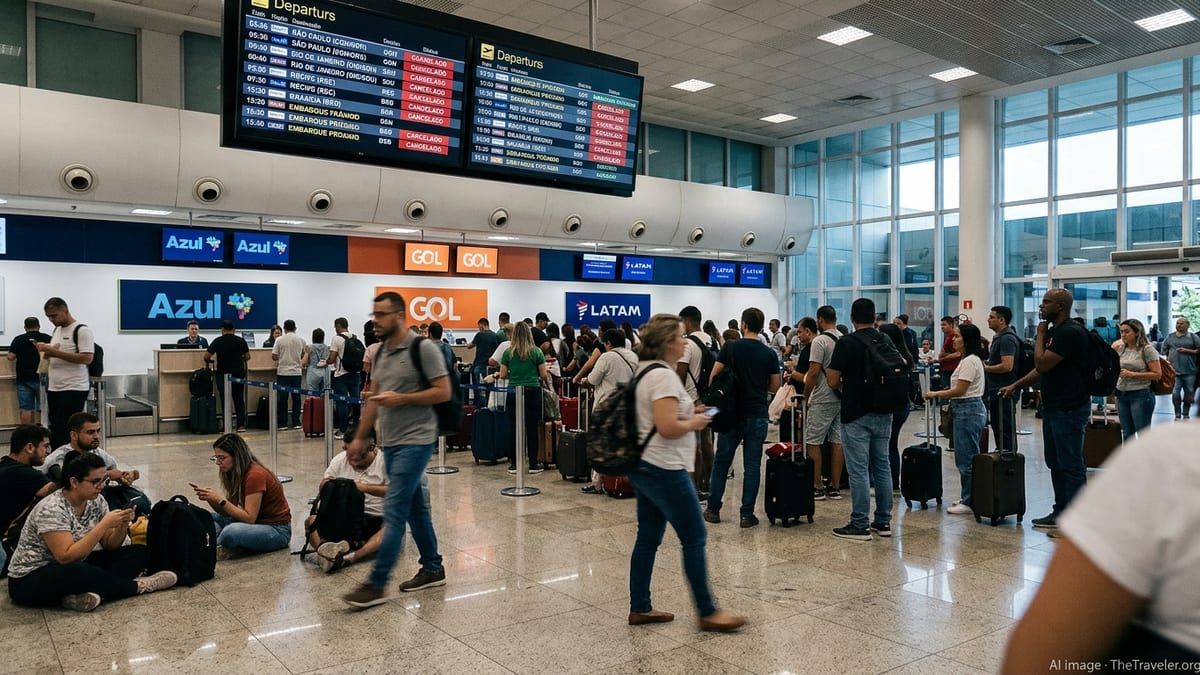
Wave of Cancellations Across Key Domestic Routes
Published airport and flight-tracking data for 2 April 2026 indicate that Brazil’s southeast aviation triangle is experiencing an unusual concentration of disrupted services, with more than a dozen cancellations and numerous delays across the country’s main business routes linking Belo Horizonte, Rio de Janeiro and São Paulo.
Information compiled from real-time status boards and independent tracking platforms shows multiple Azul, GOL and LATAM Brasil services either cancelled outright or operating with extended delays at major hubs including São Paulo–Guarulhos, Congonhas, Rio de Janeiro–Santos Dumont, Galeão and Belo Horizonte’s Confins airport.
The pattern is particularly visible on shuttle-style flights that normally offer high frequency for corporate and connecting traffic, such as São Paulo to Rio de Janeiro and São Paulo to Belo Horizonte, where gaps in schedules and rolling delays are forcing travellers onto later departures or alternative routings.
While the total number of affected passengers is still being assessed, seat maps and typical load factors on these trunk routes suggest that hundreds of travellers are having to rebook, reroute or delay their journeys on short notice.
Azul, GOL and LATAM Brasil Under Operational Strain
Azul Brazilian Airlines, GOL Linhas Aéreas Inteligentes and LATAM Brasil together carry a substantial share of Brazil’s domestic traffic, and disruptions at all three on the same day magnify the impact on the network. Publicly available timetables compared with live-status information show cancellations spread across carriers rather than concentrated at a single airline.
Azul, which has been restructuring its finances under a court-supervised process, has already been operating with a tighter network footprint. Industry observers note that in such conditions, even relatively minor operational issues can cascade more quickly, leaving fewer standby aircraft or spare crews to absorb irregular operations.
GOL and LATAM Brasil, for their part, have recently been active in adjusting capacity at São Paulo’s congested airports, including Guarulhos and Congonhas, where slot allocations and aircraft utilisation are closely calibrated to demand. When a disruption occurs during peak times, there is limited room to insert replacement flights without further impacting the schedule.
A mix of factors typically contributes to this kind of disruption cluster, ranging from weather variations and air traffic control flow restrictions to aircraft rotations arriving late from other cities. Early indications from operational data and media monitoring suggest that delays earlier in the day have propagated across multiple rotations in the southeast corridor.
Travellers Face Missed Connections and Overnight Changes
The immediate effect for travellers is visible in longer lines at check-in, service counters and boarding gates, particularly at São Paulo and Rio de Janeiro, where disrupted flights often feed international connections. Passengers bound for onward destinations in South America, North America and Europe face heightened risk of missed connections when domestic feeder flights depart late or are cancelled.
Reports from passenger forums and social media posts on 2 April describe travellers in Belo Horizonte and Rio de Janeiro being rebooked via alternative hubs, sometimes adding several hours and an extra stop to what is normally a direct journey. In some cases, itineraries between the three cities are being restructured to route passengers through Campinas or Brasília when seats on the main shuttle flights are no longer available.
Families returning from holiday periods and business travellers on same-day return trips appear to be among the most affected. Tight turnarounds, such as early-morning flights to São Paulo followed by evening returns to Belo Horizonte or Rio, are particularly vulnerable when the first leg of the day is delayed or cancelled.
Travel planning services and aviation-focused outlets are advising passengers moving through the southeast triangle to leave additional buffer time for domestic connections and to monitor flight status frequently, especially for late-afternoon and evening departures that may be affected by earlier knock-on delays.
Airports in Belo Horizonte, Rio and São Paulo Under Pressure
The concentration of disruptions in Belo Horizonte, Rio de Janeiro and São Paulo is amplifying existing capacity pressures at these airports. São Paulo–Congonhas and Santos Dumont in Rio, both centrally located and heavily used by business travellers, routinely operate close to their slot limits, which leaves little flexibility when irregular operations arise.
At Confins, outside Belo Horizonte, a growing mix of domestic and regional services means that cancellations on major trunk routes can quickly spill over to secondary destinations, as aircraft and crew schedules are reshuffled to prioritise core city pairs. When multiple airlines adjust their schedules at the same time, available gate space and ground-handling resources can become strained.
In São Paulo, Guarulhos remains a critical hub for long-haul flights. Disruptions on domestic feeds from Belo Horizonte and Rio risk leaving some international services with a higher share of misconnected passengers, which can increase rebooking volumes at customer service desks late into the evening.
Operational data monitored by aviation analysts show that even modest delays at one airport in the triangle can ripple across the others within hours, due to tight aircraft rotations. As a result, travellers departing from airports that are not directly experiencing weather or infrastructure issues may still encounter late departures or last-minute gate changes.
What Travellers Can Do if Their Flight Is Affected
For passengers whose flights are cancelled or significantly delayed, consumer guidance from Brazilian aviation regulators and airline customer-service policies generally emphasise proactive communication with the carrier. Publicly available information from airline policy documents and travel-industry advisories indicates that travellers are often entitled to rebooking at no additional cost or, in some circumstances, to a refund when a flight is cancelled.
Travel experts recommend checking flight status through multiple channels, including the airline’s app or call centre and the airport’s departure boards, as some third-party tools may lag behind real-time operational decisions. Where possible, passengers on critical itineraries are encouraged to move to earlier departures on the same route before these options fill up.
Those connecting from domestic flights in Belo Horizonte, Rio de Janeiro or São Paulo to international services may wish to allow extra connection time or consider moving to earlier feeder flights when weather or air traffic restrictions are forecast. Travel-planning resources suggest that carrying essential items in hand luggage and ensuring access to digital copies of tickets and identification can also help if a last-minute overnight stay or reroute becomes necessary.
With Brazil’s southeast corridor serving as the backbone of the country’s aviation network, any cluster of cancellations and delays quickly becomes a national issue for air travel. As operations gradually stabilise, observers will be watching for further schedule adjustments and for signs of how Brazil’s major carriers recalibrate their networks to reduce the impact of similar disruption waves in the months ahead.