

More news on this day
Air travel across several of China’s busiest hubs was disrupted as 74 flight delays and eight cancellations affected services in and out of Shanghai, Ürümqi, Guangzhou and Xi’an, impacting passengers on China Eastern, China Express Airlines, Qatar Airways, Air China and other carriers, according to real-time tracking data and airport operations updates.
Get the latest news straight to your inbox!
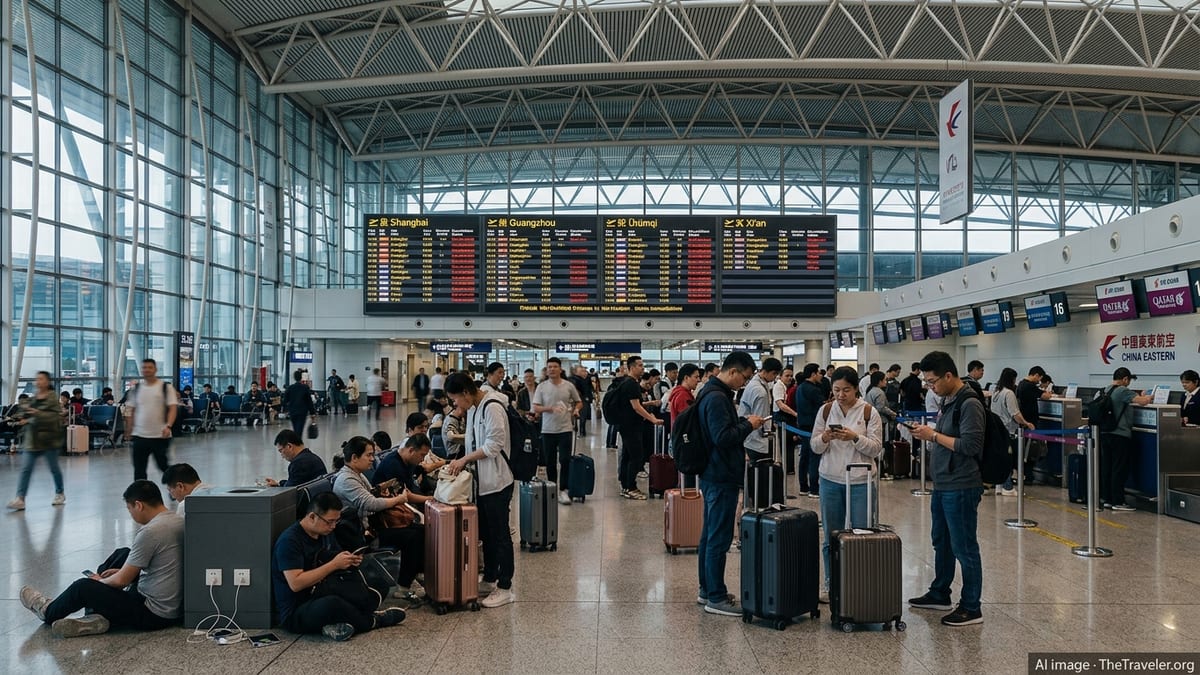
Major Chinese Hubs See Knock-on Operational Disruptions
Published tracking information shows a ripple of disruption across key Chinese airports, with Shanghai, Ürümqi, Guangzhou and Xi’an reporting a cluster of delayed and canceled flights in recent hours. The pattern spans both domestic and international routes, suggesting a combination of local operational pressures and wider network constraints.
Shanghai’s dual role as an international gateway and a primary base for several Chinese airlines makes any disruption there particularly visible. Delays at Shanghai Pudong and Hongqiao airports appear to have fed into wider schedule changes on routes to and from western China and southern hubs, prolonging turnaround times and squeezing connection windows for transit passengers.
In Guangzhou, a major southern hub with extensive domestic and long haul links, extended ground times and retimed departures have contributed to growing congestion in peak travel periods. Flight status boards show departures pushed back in multiple waves rather than a single, isolated event, indicating that airlines and airports are working through a backlog rather than a brief interruption.
Further west, Ürümqi and Xi’an, both strategic connectors between eastern China and inland destinations, have seen a smaller but still notable share of the 74 delays and eight cancellations. These airports serve as transfer points for travelers heading toward Central Asia, the northwest regions and major tourist cities, meaning schedule changes can quickly affect onward journeys even when the local weather appears stable.
China Eastern and Domestic Carriers Bear the Brunt
Publicly available operations boards and tracker data indicate that China Eastern, one of China’s largest carriers and a major operator in Shanghai, accounts for a significant share of the delayed flights. As a primary tenant at Shanghai’s airports and an important presence in Guangzhou and Xi’an, even modest schedule problems at one hub can echo through its network.
China Express Airlines, which runs a broad portfolio of regional routes, appears among the carriers with affected services, pointing to pressure on smaller airports and thinner routes as aircraft and crew rotations are adjusted. Regional operators are often more exposed to knock-on delays because a single aircraft typically covers several short sectors in a day, leaving limited margin to absorb disruptions.
Air China, with services linking these hubs to Beijing and beyond, also appears on delay lists, underscoring how interconnected the country’s major airline networks have become. When multiple carriers share hub airports and time banks, congestion or extended handling times for one airline can affect the availability of gates and ground resources for others.
For passengers, the concentration of delays among large domestic airlines means that both business and leisure travelers on high frequency trunk routes are feeling the impact. Reports from traveler forums and recent passenger accounts describe tighter connection times, hurried transfers between terminals and uncertainty around rebooked itineraries when cancellations occur on heavily used routes.
International Links Affected, Including Qatar Airways Services
While the bulk of today’s disruption appears to involve domestic flights, international services are also touched, notably those operated by Qatar Airways and other foreign carriers serving Chinese hubs. Qatar Airways links cities such as Shanghai and Guangzhou with Doha and onward destinations in Europe, Africa and the Middle East, so a delay in China can quickly cascade into missed long haul connections.
Flight status information indicates that some long haul departures have faced extended ground times, either departing later than scheduled or arriving after their planned local times. This compounds the challenge for passengers holding separate tickets, who may have less flexibility when minimum connection times are exceeded by even moderate delays.
Airlines generally prioritize keeping long haul aircraft moving to preserve wider network integrity, which can mean that short haul feeder flights absorb more of the rescheduling burden. The presence of delays and a small number of cancellations on routes between China’s inland hubs and coastal gateways reflects this balancing act, with carriers making real time decisions about which flights can most feasibly be retimed or consolidated.
Travelers connecting between domestic Chinese legs and international segments through Shanghai, Guangzhou or Xi’an are therefore particularly exposed when disruptions occur concurrently at several hubs. Public guidance from travel agents and online booking platforms typically emphasizes allowing generous connection windows in such circumstances, especially during busy travel periods.
Weather, Congestion and Tight Schedules Combine
Although comprehensive official explanations for each affected flight are not immediately available, the day’s pattern of disruption fits with a familiar mix of factors in China’s tightly scheduled aviation system. Weather variations over such a large geographic area can cause temporary air traffic control restrictions, which in turn reduce the capacity of already busy approach corridors and departure slots.
Congestion at the gate and on taxiways is another recurrent pressure point, particularly at major hubs that have seen rapid growth in both domestic and international traffic. When turnaround times extend, either because of ground handling delays or late arriving aircraft, subsequent flights inherit the delay, and the effect multiplies as the day progresses.
Industry data released in recent months for China’s major carriers highlights progress in punctuality compared with the most disrupted years of the pandemic era, but also shows that large networks operating at high utilization remain vulnerable to local shocks. A cluster of delays across multiple hubs on a single day illustrates how quickly those vulnerabilities can resurface when schedules are tight and buffers are limited.
Travelers are increasingly using real time apps and third party platforms to monitor operational trends, and posts from passenger communities in recent weeks point to ongoing caution around short connections and late evening departures. The events across Shanghai, Ürümqi, Guangzhou and Xi’an today are likely to reinforce those concerns, at least in the short term.
What Passengers Can Expect in the Coming Hours
As airlines work through the list of 74 delays and eight cancellations, operations data suggests that recovery is likely to be gradual rather than instantaneous. Aircraft and crew need to be repositioned, and some late afternoon or evening departures may continue to face minor knock-on changes while the system absorbs earlier disruptions.
Passengers already at airports in Shanghai, Ürümqi, Guangzhou and Xi’an can expect busy check in halls and longer lines at security and transfer counters while rebookings are processed. Visual displays at several terminals are cycling through new departure times, and announcements indicate that boarding for some flights is shifting among nearby gates as space becomes available.
Travelers due to depart later in the day are being encouraged by travel advisories and booking platforms to check their flight status frequently and allow additional time for ground transfers, especially when crossing between terminals or changing from high speed rail or metro services to airport check in. Those with tight domestic connections, in particular, may wish to explore earlier departures where inventory is available.
While the total number of affected flights remains limited compared with the overall daily schedule at these major hubs, the geographic spread from Shanghai to Ürümqi, Guangzhou and Xi’an highlights how sensitive China’s dense domestic and international networks remain to clusters of disruption. For travelers, today’s events serve as a reminder that flexibility, extra planning time and up to date information are becoming essential parts of flying in and out of the country’s busiest airports.