

More news on this day
Air travel across Mexico faced fresh turmoil as 181 flight delays and 22 cancellations were recorded at key hubs in Monterrey, Guadalajara, Cancún and Mexico City, disrupting plans for hundreds of domestic and international travelers on WestJet, VivaAerobus, AeroMéxico and several other carriers, according to early operational data and published coverage.
Get the latest news straight to your inbox!
Major Mexican Hubs Experience Knock-On Disruptions
The latest disruption has affected four of Mexico’s busiest airports, where a mix of domestic and cross-border services connect the country with North America and beyond. Operational summaries and airport boards reviewed on Friday indicate that departures and arrivals were hit unevenly, with some routes facing rolling delays while others were grounded outright.
In Monterrey and Guadalajara, which serve as important secondary hubs for low-cost and legacy airlines, delays were concentrated on high-frequency domestic routes to Mexico City, Cancún and northern industrial cities. At Cancún International Airport, a major gateway for Canadian and U.S. visitors, the impact was more visible on leisure routes, where aircraft and crew rotations are tightly scheduled and more vulnerable to small timing shocks.
Mexico City’s main international gateway, which already operates at high capacity, saw a combination of late turnarounds and cancellations that rippled through afternoon and evening banks of flights. Publicly available tracking data showed clusters of departures pushed back by more than an hour, amplifying missed connections and forcing rebookings onto already busy services later in the day.
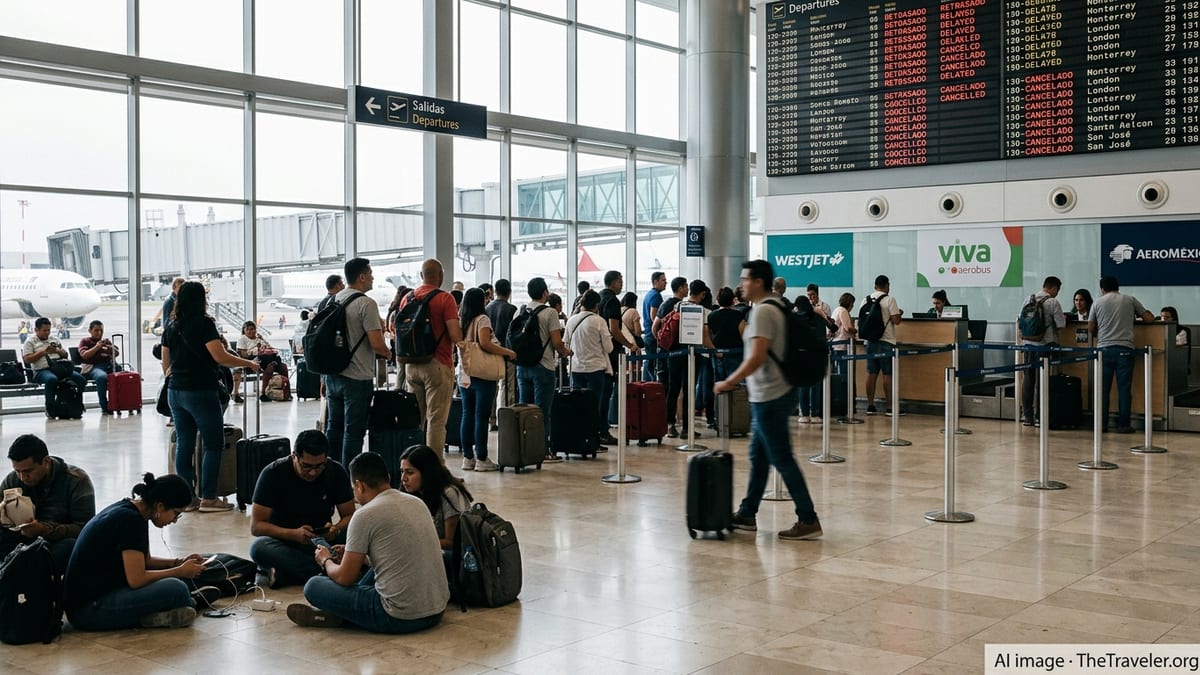
While overall traffic continued to move, the cumulative effect of 181 delays and 22 cancellations across the four airports produced long check-in lines, crowded departure halls and a spike in last-minute accommodation searches in key tourist areas and business districts.
Multiple Airlines Caught in Same Operational Web
The disruption has not been limited to a single carrier. WestJet, VivaAerobus and AeroMéxico were among the airlines with affected flights, alongside other Mexican and international operators serving the same corridors. Airline operations dashboards and schedule updates show that some carriers experienced clusters of delays on specific routes, particularly those linking Mexican hubs with Canadian cities at the tail end of the winter travel season.
VivaAerobus and AeroMéxico, both with dense domestic networks radiating from Mexico City, Monterrey and Guadalajara, appeared to bear a significant share of the knock-on effects. Publicly available information points to late arrivals from earlier segments, tight turnaround windows and aircraft reassignments as recurring themes behind the schedule changes reported on Friday.
WestJet, which operates seasonal and year-round services into Cancún and other Mexican destinations, has recently faced heightened scrutiny over its handling of delays and cancellations elsewhere in North America. Regulatory summaries and previous enforcement actions in Canada highlight ongoing pressure on carriers to comply with passenger protection rules when disruptions occur, a backdrop that shapes how travelers interpret new irregularities on routes to and from Mexico.
Other airlines with overlapping networks, including additional North American low-cost and full-service brands, also registered scattered delays on Mexico-bound flights. However, the pattern of disruptions suggests a wider operational web rather than a single systemic failure by one carrier.
Weather, Security and Congestion Add to a Fragile System
The timing of the latest wave of delays and cancellations comes after weeks of weather-related and security-linked disruptions affecting various parts of Mexico and North America. Earlier in the year, a major winter storm in the United States triggered one of the highest single-day tallies of cancellations in recent history, leaving airlines with complex recovery operations and aircraft out of position across the continent.
In western Mexico, recent civil unrest and security operations in Jalisco and coastal regions have led to temporary suspensions and schedule changes at airports such as Puerto Vallarta. While Guadalajara’s airport remained largely operational during those incidents, surface transport and airspace considerations contributed to a more fragile operating environment for airlines moving aircraft between Mexican hubs.
Against this backdrop, even modest weather changes, air traffic control restrictions or minor technical issues can cascade into large numbers of delayed flights. With many airlines running near-maximum utilization of aircraft during peak travel periods, there is less slack in the system to absorb disruptions, making secondary hubs like Monterrey and Guadalajara particularly sensitive to upstream irregularities.
Published analyses of airline performance across North America in early 2026 point to a broad pattern of mass-disruption days interspersed with relatively stable operations. The current episode in Mexico appears to fit within that regional context, rather than standing out as an isolated or unprecedented event.
Passengers Face Long Waits, Rebookings and Limited Options
For travelers, the operational nuances translated into a familiar set of challenges at the terminal. Reports from passengers on social platforms and forum posts describe extended waits at check-in counters and customer service desks in Cancún and Mexico City, as well as confusion over gate changes and evolving departure times.
Some travelers reported rolling delays that shifted departure times repeatedly over several hours, while others experienced outright cancellations requiring overnight stays and rebookings on later flights. With school holidays and spring travel demand filling many services, same-day alternatives were limited on popular routes between Mexico and major Canadian and U.S. cities.
Information from airline websites and travel waivers circulated in recent weeks underscores the importance for passengers of monitoring their bookings closely, using official apps, and being prepared for last-minute adjustments. In previous disruption events affecting Mexico, flexible-change policies, fee waivers and reaccommodation on partner airlines helped some passengers reach their destinations, though availability depended heavily on route and travel date.
Travelers caught up in the latest disruption are being advised by consumer advocates and travel writers to keep records of delay durations, boarding passes and out-of-pocket expenses, in case they qualify for compensation or reimbursement under Mexican, Canadian or other applicable regulations.
What Travelers Should Watch in the Coming Days
Operational data for Mexico’s main airports typically stabilizes within 24 to 48 hours after a spike in delays and cancellations, provided no new weather or security events intervene. For now, published schedules for the weekend continue to show high loads on leisure routes to beach destinations and business-heavy corridors connecting Mexico City with northern industrial centers.
Travel observers note that the interplay between Canadian and Mexican holiday calendars, combined with lingering winter weather risks in North America, may keep pressure on carriers such as WestJet, VivaAerobus, AeroMéxico and competitors through late March. Any additional disruption at a single hub could again reverberate quickly through Monterrey, Guadalajara, Cancún and Mexico City.
Prospective travelers are encouraged by industry guidance to build in longer connection times when routing through Mexican hubs, especially if journeys depend on tight same-day links between domestic and international segments. For those with nonrefundable hotel or tour bookings, considering travel insurance that explicitly covers delays and missed connections remains a recurring recommendation in the wake of repeated mass-disruption days across the region.
While Friday’s tally of 181 delays and 22 cancellations is modest compared with the worst days of winter disruption earlier in the year, it underlines the continued vulnerability of cross-border travel in North America. For many heading to or from Mexico’s key hubs, flexibility and up-to-date information remain the most valuable tools for navigating an increasingly unpredictable air travel landscape.