

More news on this day
Travelers passing through Newark Liberty International Airport on February 21 are facing another bout of disruption, with a cluster of six cancellations and 23 significant delays affecting flights operated by Spirit, United, Jazz, Lufthansa and other carriers on routes linking the United States with Israel, Canada, the Caribbean and key European hubs.
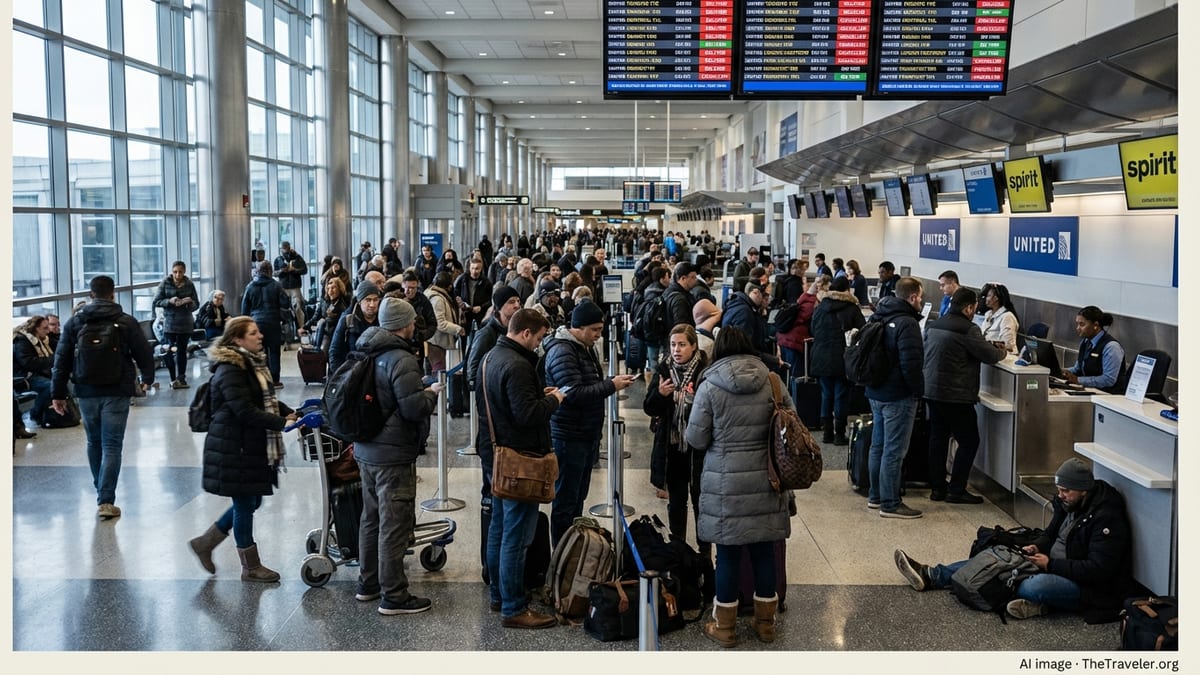
Localized Disruption at a Key U.S. Gateway
The latest operational turbulence at Newark Liberty comes just days after an emergency involving a JetBlue flight briefly halted movements at the airport and refocused attention on the fragility of tight airline schedules at one of the New York region’s busiest hubs. While overall operations are continuing and the airport is officially listed as on time, a cluster of cancellations and delays is again putting pressure on carriers and travelers across multiple continents.
Data from live flight tracking and airline status boards on Saturday morning indicate that six departures or arrivals tied to Newark have been cancelled, alongside at least 23 flights experiencing extended delays. Affected services include links to major U.S. destinations, transatlantic routes to Europe, regional services to Canada and the Caribbean, and connecting itineraries from Israel routed via European hubs. The impact is concentrated but emblematic of a system operating with little margin for error during the winter travel season.
Although the figures are modest compared with full-blown storm days that can wipe out hundreds of departures, the knock-on effects are significant for individual passengers. Missed connections, disrupted cruise departures from Caribbean ports, and rebooked business trips to European financial centers are among the immediate consequences, even as the airport reports mostly smooth conditions for the majority of flights.
Spirit, United, Jazz and Lufthansa Among Affected Carriers
The disruption has touched a cross-section of airlines that rely on Newark as either a primary base or an important spoke within their networks. United Airlines, which operates a major hub at Newark, has reported a mix of delayed departures to domestic leisure markets and international destinations. Some United services to Florida and the Caribbean have been pushed back, impacting travelers heading to Miami, Cancun and Bridgetown, while select long-haul flights face schedule pressure due to late-arriving aircraft and crew availability.
Spirit Airlines, a growing presence at Newark in the competitive low-cost segment, has also seen its tight turnarounds come under strain. Even a single delayed departure can cascade quickly for an ultra-low-cost carrier that operates high utilization patterns on its aircraft. For budget-conscious travelers trying to reach sun destinations or to connect via other U.S. hubs, the delays mean extended waits in already crowded concourses and the risk of missed onward journeys.
On the international front, Canadian regional operator Jazz and German flag carrier Lufthansa have both been swept into the disruption. Jazz operates feeder services that link Newark with Canadian gateways, where delays can interfere with onward domestic itineraries in Canada. Lufthansa’s transatlantic flights between Newark and major European hubs act as important bridges to destinations across the continent and to Israel, so a delayed departure out of New Jersey can ripple into late arrivals in Europe and compressed connection windows for onward flights to Tel Aviv.
Other international airlines serving Newark, including European and Caribbean carriers, have been working to keep their operations aligned with updated slot times and air traffic control instructions. Even when their own flights are nominally on schedule, delays at neighboring gates or on shared taxiways can impact pushback times and contribute to the overall sense of congestion in the system.
Knock-On Effects Across U.S., Israel, Canada, the Caribbean and Europe
The cluster of six cancellations and 23 delays at Newark is small in the context of the hundreds of daily movements at the airport, but its effects radiate outward along transcontinental and transatlantic routes. In North America, passengers on U.S. domestic services from Newark to hubs such as Miami and to Canadian destinations like Toronto and Montreal face rebookings and, in some cases, overnight stays when last onward flights of the day are missed.
In the Caribbean, leisure travelers are particularly vulnerable to tight scheduling. Delayed or cancelled Newark departures bound for island destinations can cause travelers to miss cruise ship departures or pre-arranged transfers, leading to costly last-minute changes. With many travelers stacking multiple segments on a single day, a delay of just over an hour can translate into a full day lost from a vacation.
Across the Atlantic, Europe feels the impact through Newark’s role as a transatlantic gateway. Late departures from New Jersey translate to late arrivals at European hubs, where passengers may be connecting onward to cities in Germany, France, Italy or the United Kingdom. For those headed to Israel via European hubs, disrupted Newark departures compress already tight connection times and can result in unexpected layovers if a missed flight to Tel Aviv is the last of the evening.
Canada’s regional network is similarly exposed. Jazz-operated flights that provide key links from Newark to Canadian cities not only serve point-to-point demand but also feed into broader domestic networks in Canada. When a Newark-originating leg is cancelled or delayed, entire itineraries built around these feeder services may need to be rebuilt, stretching call centers and airport service desks on both sides of the border.
Recent Emergency and Structural Congestion Add to Strain
The latest round of disruption unfolds against a backdrop of heightened scrutiny of Newark’s resilience. Earlier this week, a JetBlue flight departing Newark experienced an engine issue and reported smoke in the cabin shortly after takeoff, prompting an emergency return and slides evacuation on the taxiway. The incident triggered a temporary ground stop as emergency crews responded and safety checks were completed, pausing arrivals and departures and adding another layer of complexity to already tight operating conditions.
That emergency came as no surprise to aviation analysts who have long flagged Newark’s vulnerability to cascading delays. With three runways and heavy traffic volumes, the airport often operates close to saturation, particularly in the morning push and evening bank of departures. Even minor disruptions, whether mechanical issues, staffing shortages or brief weather changes, can quickly lead to queues on taxiways, gate holds and knock-on delays throughout the day.
Recent performance statistics show that the airport has been grappling with elevated average delay minutes and a higher number of cancellations over the winter months. A combination of winter weather, air traffic control constraints and congested airspace over the Northeast corridor has repeatedly tested schedules. Saturday’s pattern of targeted cancellations and scattered long delays fits into this broader trend of an overstretched system that struggles to quickly absorb shocks.
Industry experts note that carriers are trying to build more padding into their schedules, but competitive pressures and the high value of prime slots at Newark limit how much slack can realistically be introduced. As a result, events like the recent emergency landing or small clusters of weather-related issues can still trigger disproportionate disruption relative to the number of flights directly affected.
Weather, Air Traffic Measures and Operational Pressures
On Saturday, weather over Newark and the broader New York region has been largely manageable, with cool temperatures, broken clouds and solid visibility. Unlike major storm days that bring widespread cancellations, the current disruption appears driven more by a mix of lingering operational aftershocks, busy weekend traffic and targeted capacity management by air traffic authorities.
The Federal Aviation Administration has in recent months introduced and extended capacity and scheduling measures at Newark in an attempt to reduce chronic congestion. These policies limit the number of flights airlines can schedule during peak periods and encourage more realistic planning around the airport’s runway and airspace capacity. While such measures are designed to improve long-term reliability, they can also lead carriers to proactively trim flights or consolidate services on days when resources are tight.
In addition, staffing levels for pilots, flight attendants, ground handlers and air traffic controllers remain a key factor. Even when the weather is cooperative, shortages in any of these areas can constrain the number of flights an airport can effectively handle. Carriers operating at Newark have continued to face challenges around crew scheduling, particularly when earlier delays push flight duty times toward regulatory limits, forcing last-minute cancellations or aircraft swaps.
With winter not yet over and fresh weather advisories issued for parts of the East Coast for the coming days, airlines and passengers alike are bracing for further potential schedule adjustments. Some carriers have already published travel waivers for upcoming dates that include Newark, allowing travelers more flexibility to alter plans in anticipation of additional disruption.
What Travelers at Newark Are Experiencing Today
For passengers on the ground at Newark Liberty on Saturday, the disruption is most visible in the form of crowded departure gates, longer lines at customer service desks and frequent announcements of revised departure times. Many affected flights are delayed in the range of 30 to 90 minutes, although a handful of services have been pushed back further as airlines juggle aircraft and crew availability.
Travelers on cancelled flights are being rebooked on later departures from Newark or rerouted via partner hubs such as Chicago, Washington or Toronto. Those with complex itineraries, including connections to Israel through European gateways or multi-leg journeys to Caribbean resorts, face the greatest uncertainty. In some cases, travelers are opting to shift to flights from neighboring airports in the New York region where seats remain available.
Airport amenities, including lounges and food outlets, are playing an important role in absorbing stranded passengers. With delays extending into the afternoon peak, many travelers are turning to airport hotels, particularly those facing overnight misconnects. Travel insurance providers and credit card travel protections are also being activated as passengers seek compensation for extra accommodation, meals and missed prepaid activities.
Despite the disruption, airport operations teams report that security checkpoints and baggage handling systems are functioning normally. The main challenge lies in coordinating the movement of aircraft and crews in a way that keeps knock-on effects contained, particularly for carriers with dense schedules and limited spare aircraft on hand.
Airline Responses and Passenger Options
Airlines hit by Saturday’s disruptions at Newark are deploying a mix of standard playbooks and ad hoc measures. United, as the dominant carrier at the airport, has prioritized maintaining integrity on core hub-to-hub and long-haul routes, occasionally consolidating lower-demand flights or swapping aircraft types to preserve capacity. Spirit is offering same-day standby options for affected passengers, though limited spare seats during a busy travel weekend are constraining flexibility.
Lufthansa and other European carriers are closely managing their transatlantic schedules to ensure that long-haul departures align as closely as possible with banked connection waves in their home hubs. When Newark-originating flights leave late, airlines are sometimes holding key connections for a limited time, but in other cases are providing hotel vouchers and protection on later services for travelers who miss onward flights to Israel or other destinations.
Canadian regional operator Jazz and its codeshare partners are focusing on rebooking options that preserve essential connectivity between Newark and Canadian cities, where smaller aircraft and fewer daily frequencies leave passengers with fewer alternatives when a single flight is cancelled. Airlines are urging customers to monitor their booking apps and sign up for text or email alerts to stay updated on fast-moving changes to gate assignments and departure times.
For passengers, the most practical steps include checking flight status before leaving for the airport, arriving with extra time to navigate potential queues, and considering carry-on only travel where possible to make rebooking and tight connections easier. Travelers with time-sensitive commitments, such as cruises, international meetings or connecting long-haul flights, are increasingly advised to schedule key segments a day earlier to provide a buffer against Newark’s recurring delays.
Broader Implications for Newark’s Role in Global Connectivity
While the current numbers of cancellations and delays are modest relative to the airport’s daily operations, Saturday’s disruption underscores the pivotal role Newark Liberty plays in linking the United States with Canada, the Caribbean, Europe and onward connections to Israel. Each targeted cluster of operational issues highlights how little slack exists in the system and how quickly local challenges can reverberate globally.
For airlines, Newark remains both an essential asset and a chronic headache. The airport’s proximity to New York City and its established connectivity make it indispensable for carriers like United and their partners. At the same time, the recurring pattern of congestion and high delay minutes has prompted ongoing investment in technology, procedures and infrastructure aimed at smoothing operations and reducing the risk of cascading disruption.
For travelers, the message is increasingly clear: Newark offers unrivaled connectivity to a wide range of destinations, but it also demands a degree of flexibility and preparedness. As the winter season continues and carriers adjust to evolving weather patterns and regulatory constraints, passengers flying through the airport are likely to see more days where a small number of cancellations and a couple of dozen delays reshape travel plans far beyond New Jersey’s borders.
With aviation authorities and airlines pledging to refine schedules, increase resilience and improve communication, Newark’s latest day of disruption is likely to feed into broader discussions about how to balance capacity, efficiency and reliability at one of the world’s most important international gateways.