

More news on this day
Fresh air travel disruption in Brazil is rippling through two of the country’s busiest hubs, with Rio de Janeiro and Campinas airports recording 10 cancelled flights and 55 new delays that are affecting operations at Azul Brazilian Airlines, LATAM Brasil and GOL Linhas Aéreas Inteligentes.
Get the latest news straight to your inbox!
Operations at Key Brazilian Hubs Under Strain
The latest wave of disruption is centered on Rio de Janeiro and Campinas, two airports that serve as crucial domestic and regional connectors. Publicly available data from flight-tracking platforms and airport information boards shows a combined tally of 10 cancellations and 55 newly reported delays across the two cities, compressing schedules and complicating travel plans across Brazil’s dense domestic network.
These disruptions are particularly significant because both locations act as strategic nodes in Brazil’s aviation system. Rio de Janeiro handles a mix of business and leisure traffic heading to major destinations such as São Paulo, Brasília and the country’s northeast, while Campinas operates as a key base for Azul and an alternative gateway to the São Paulo metropolitan region. When both hubs experience irregular operations at the same time, knock-on effects tend to spread quickly to secondary cities.
Initial indications suggest the disrupted flights include a mix of morning and evening departures, raising the risk of missed connections and extended layovers for passengers relying on onward domestic legs. With Brazilian airlines already operating tight turnarounds to maximize capacity, even small clusters of delays can cascade across the day’s schedule.
While official cause breakdowns are still limited, the pattern of clustering at two high-traffic hubs points to a combination of operational factors, including weather constraints at certain periods and congestion on heavily used flight corridors in southeastern Brazil.
Azul, LATAM and GOL Face Network Ripple Effects
The disruptions are impacting the country’s three largest carriers, Azul Brazilian Airlines, LATAM Brasil and GOL Linhas Aéreas Inteligentes, which together move the bulk of Brazil’s domestic air traffic. According to published coverage and live monitoring services, all three airlines show affected services in and out of Rio de Janeiro and Campinas, with Azul particularly exposed through its strong presence at Campinas.
Networked domestic carriers are especially vulnerable when disruptions hit hub airports rather than outstations. Delays on one leg can quickly spill into subsequent rotations, leaving aircraft, crews and passengers out of position. For Azul, any extended hold-ups at Campinas risk reverberating into smaller regional destinations that often rely on fewer daily frequencies. LATAM and GOL, which utilize Rio de Janeiro as a key connecting point, also face challenges maintaining tight banked connections.
Publicly available information indicates that airlines are attempting to absorb part of the impact by swapping aircraft, adjusting departure times where possible and consolidating some lightly booked services. However, with 10 cancellations already logged, some travelers are likely being re-accommodated on later flights or rerouted through alternative hubs such as São Paulo–Guarulhos.
The timing of the disruption adds further pressure, as Brazilian carriers have been working to rebuild capacity, manage costs and stabilize on-time performance in the face of lingering infrastructure constraints and strong passenger demand on core domestic routes.
Passenger Experience: Longer Queues and Tight Connections
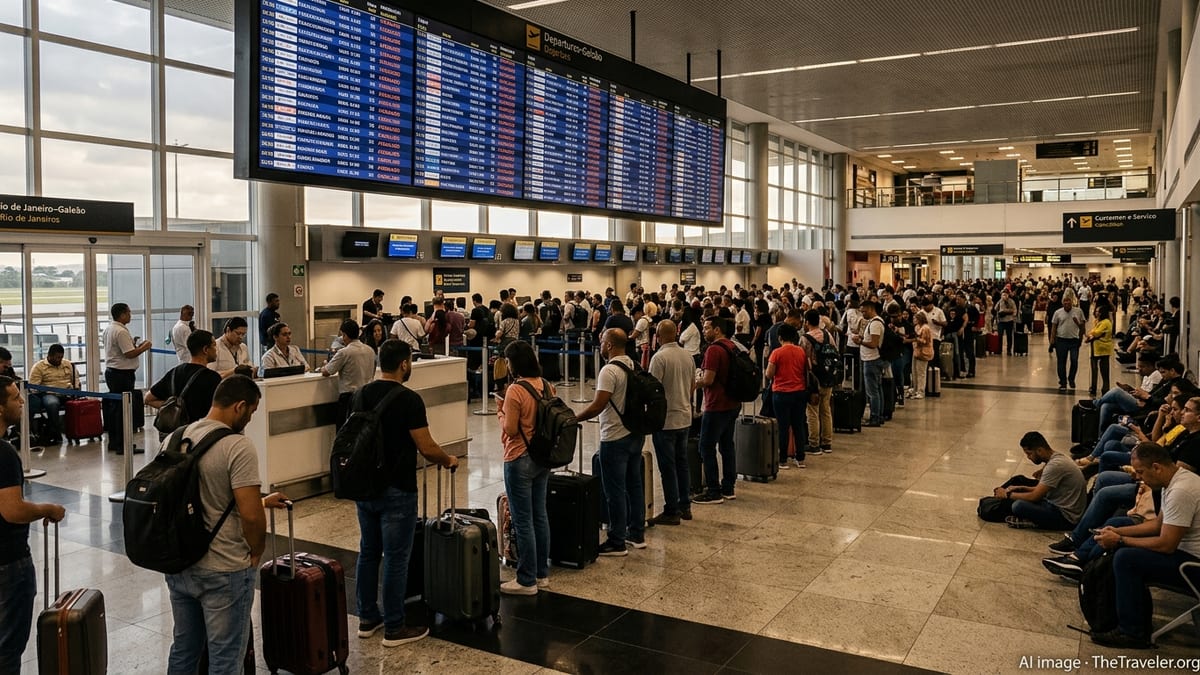
For travelers on the ground at Rio de Janeiro and Campinas, the immediate effect is visible in longer check-in and security lines, busier customer service counters and crowded gate areas. When delays accumulate, ground handling teams and airport facilities often struggle to keep pace, particularly during peak travel banks when several flights board and depart in quick succession.
Reports from recent travel seasons in Brazil highlight how missed or tight connections at major hubs can quickly turn into overnight stays, especially for passengers on separate tickets or those connecting between different airlines. The current pattern of 55 additional delays raises the risk of such scenarios, as seemingly modest hold-ups in departure times can wipe out scheduled transfer buffers of one to two hours.
Travelers connecting through these hubs may find that even when their own flight operates, baggage transfer and re-check processes become more time-consuming. For those unfamiliar with Brazilian airports or traveling with families, this can add stress and uncertainty to already complex itineraries.
Consumer advocates in Brazil have frequently drawn attention to the importance of clear information when irregular operations occur. In situations like the current one, passengers are often advised in public guidance materials to monitor airline apps and airport displays closely, build extra time into connections when possible and keep documentation of any additional expenses linked to severe delays or cancellations.
Broader Context for Reliability in Brazil’s Domestic Market
The latest cluster of disruptions fits into a broader discussion about the resilience of Brazil’s domestic aviation network. Over recent years, published data sets and traveler accounts have described a mixed picture, with periods of high on-time performance punctuated by episodes of concentrated delays tied to weather, infrastructure limitations or operational rescheduling by carriers.
Brazil’s southeast, home to Rio de Janeiro, São Paulo and Campinas, is both the busiest air corridor and one of the most weather-sensitive, with heavy rain and low visibility periodically constraining airport capacity. When these conditions overlap with peak demand days, airlines face difficult choices between holding flights for connecting passengers, rerouting aircraft or cancelling individual services to protect the broader schedule.
For Azul, LATAM and GOL, the immediate challenge is to work through today’s backlog while minimizing further disruption to evening and following-day operations. Publicly available trackers will likely show lingering effects in the form of rolling delays, as aircraft and crews gradually return to their planned rotations. Travelers with imminent departures from Rio de Janeiro or Campinas may still experience schedule adjustments even after the headline figures of cancellations and delays stabilize.
In the medium term, the episode underscores how reliant Brazil’s domestic connectivity remains on a small number of high-density hubs. Any disruption at these airports tends to be felt not only in major cities, but also across a wide network of regional destinations that depend on timely feed from Rio de Janeiro and Campinas to sustain tourism, business travel and essential mobility.