

More news on this day
Travelers connecting through Amman’s Queen Alia International Airport are facing fresh disruption as Royal Jordanian Airlines reports a series of cancellations and delays on major regional and long-haul routes, affecting journeys to and from Beirut, Frankfurt, Amsterdam, Addis Ababa and other key cities.
Get the latest news straight to your inbox!
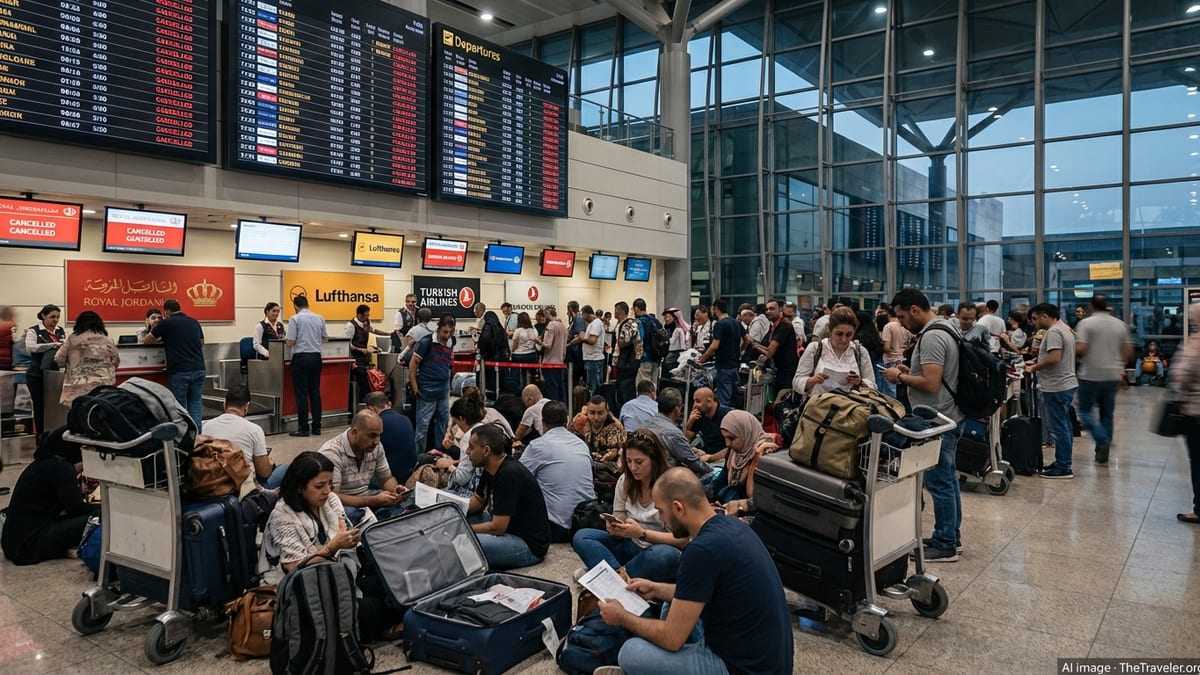
Cluster of Cancellations and Delays Disrupts Key Routes
Publicly available flight tracking data and traveler reports indicate that at least three Royal Jordanian services linked to Queen Alia International Airport were canceled over a recent travel period, alongside multiple delayed departures and arrivals. The disruptions are concentrated on high-demand routes connecting Amman with major hubs such as Beirut, Frankfurt, Amsterdam and Addis Ababa, putting pressure on transit flows across the Middle East, Europe and East Africa.
The affected flights form part of Royal Jordanian’s core network, which uses Amman as a primary transfer point for passengers traveling between the Levant, Europe, North America and Africa. Even a relatively small cluster of cancellations can trigger a wider knock-on effect for connecting itineraries, especially during peak travel days when spare capacity is limited and alternative options are quickly exhausted.
Reports from recent days describe passengers experiencing extended waits at Queen Alia International Airport as departure times shifted, with some services pushed back significantly before eventually taking off, while a handful were removed from departure boards after being listed as delayed. The pattern reflects a mix of outright cancellations and operational delays rather than a blanket suspension of routes.
Current information about Jordan’s airspace shows that commercial operations in and out of Amman remain open, but regional security tensions and operational constraints have periodically led airlines to adjust schedules and routings. In this environment, even modest timetable changes can translate into visible disruption for passengers relying on tight connections through the hub.
Regional Tensions and Operational Pressures in Amman
Travel conditions in and around Jordan are unfolding against a backdrop of broader regional uncertainty, including recent missile activity and heightened security alerts. While Jordanian authorities have kept airspace open to commercial traffic, airlines operating at Queen Alia International Airport are routing flights with added caution and contingency planning. Aviation and tourism briefings published in late March note that flights continue to arrive and depart, but with an emphasis on close monitoring of airspace conditions and coordination with regional partners.
Jordan-based travel and aviation commentary in recent weeks has described a travel environment that is operational but fragile, with some carriers adjusting capacity or temporarily suspending services on certain routes, while others, including Royal Jordanian, continue to operate most flights broadly in line with published schedules. This mixed picture means that day-to-day reliability can vary sharply depending on the carrier, destination and timing.
Weather and infrastructure considerations can add an additional layer of pressure at Queen Alia International Airport. Past episodes of poor visibility from dust storms have forced inbound flights into holding patterns or diversions, illustrating how standard operational challenges can quickly intersect with regional risk factors. Although no single cause is being cited for the current cluster of Royal Jordanian disruptions, the combination of regional tensions, airspace management and routine operational constraints appears to be shaping the experience for travelers on affected routes.
Royal Jordanian’s published customer commitments for international routes highlight its obligations in the event of long delays or cancellations, including efforts to rebook travelers on the next available services and provide assistance where required. However, when multiple flights on the same day are affected, options to re-accommodate passengers can narrow rapidly, particularly on long-haul or less frequent routes.
Impact on Passengers Bound for Beirut, Frankfurt, Amsterdam and Addis Ababa
The cancelations and delays involving Beirut, Frankfurt, Amsterdam and Addis Ababa are especially disruptive because these cities serve as pivotal points in Royal Jordanian’s network. Beirut acts as a key short-haul link in the eastern Mediterranean, while Frankfurt and Amsterdam are important gateways for European and transatlantic connections, and Addis Ababa links Amman to East Africa and beyond via regional partners.
Travelers booked on these routes report having to rearrange itineraries at short notice, with some missing onward connections in Europe or the Middle East after late departures from Amman. Others have described being rebooked onto later services or alternative routings on partner airlines, sometimes extending journeys by many hours or requiring unscheduled overnight stays.
For passengers originating outside Jordan, the reliance on precise connection windows through Queen Alia International Airport means that even moderate delays on the first leg can cascade into missed onward flights. This is particularly acute for those connecting from regional feeders into long-haul services bound for major European or African destinations, where one canceled sector can effectively disrupt an entire trip.
Travel planning has therefore become more complex for those transiting Amman, with some passengers opting to allow longer layovers than they might have scheduled in more stable conditions. Others are watching flight status more closely in the 24 to 48 hours before departure, seeking reassurance that their services remain on schedule before committing to ground arrangements such as hotel checkouts and airport transfers.
Guidance for Travelers Transiting Queen Alia International Airport
Publicly available travel advisories and airline guidance emphasize the importance of proactive planning for anyone traveling via Amman in the current environment. Passengers are being encouraged to monitor flight status through official airline channels and mobile applications, and to ensure that contact details on their bookings are accurate so that they can receive short-notice updates or rebooking offers in case of disruption.
Travel industry commentary suggests that building additional flexibility into itineraries can significantly reduce the risk of missed connections. This may include selecting longer transfer times at Queen Alia International Airport, avoiding the latest possible departure of the day on critical sectors, and considering travel insurance products that explicitly cover delays and cancellations linked to regional instability or airspace disruptions.
For those with essential travel to or from Beirut, Frankfurt, Amsterdam, Addis Ababa and other affected destinations, checking alternative routings through different hubs may offer a backup plan if further cancellations occur. However, with several carriers periodically adjusting their own schedules in response to evolving conditions, alternative options can also change rapidly, reinforcing the value of up-to-date information.
Despite the recent turbulence, broader reporting on Jordan’s aviation sector indicates that Queen Alia International Airport continues to function as the country’s primary international gateway, with the majority of scheduled flights operating. The current spate of Royal Jordanian cancellations and delays highlights how quickly conditions can shift for travelers relying on a single hub, and underlines the importance of staying informed and allowing room for contingency when planning journeys through the region.