

More news on this day
Travelers flying through São Paulo on Friday faced a fresh wave of disruption as LATAM and AeroMéxico recorded at least five cancellations and a string of delays, snarling operations at Brazil’s busiest air hub and rippling through regional networks across Latin America.
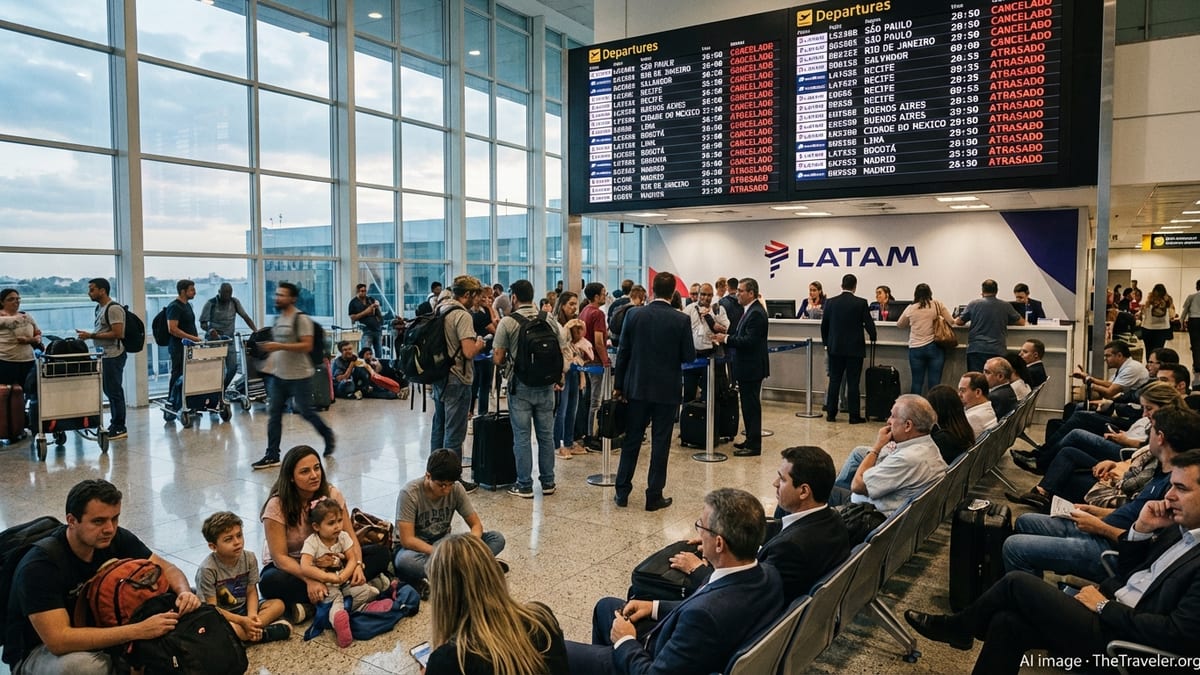
Fresh Turmoil at Brazil’s Busiest Aviation Hub
The latest bout of disruption comes at a time when Brazil’s aviation system is already under pressure from a series of recent operational hiccups, weather challenges and shifting regional traffic flows. São Paulo’s Guarulhos and Congonhas airports, which together handle tens of millions of passengers a year, once again found themselves at the center of cascading delays that affected both domestic and international itineraries.
Operational data reviewed on Friday showed LATAM cancelling multiple departures and pushing back departure times on several others, while AeroMéxico scrubbed at least one São Paulo service and delayed others on its Brazil–Mexico corridor. While the overall number of cancellations remained limited compared with previous large-scale episodes, the concentration of disruptions during peak travel hours created outsized knock-on effects for connections throughout South America.
Airport displays at Guarulhos on Friday afternoon showed a patchwork of red and amber status indicators, with LATAM departures to regional hubs such as Santiago and Buenos Aires posting delays, and AeroMéxico’s long-haul services to Mexico City experiencing schedule revisions. For many travelers, even a short delay at Guarulhos was enough to break carefully planned connections onward to Europe, North America or secondary Brazilian cities.
Airport authorities said core infrastructure at Guarulhos, from runways to air traffic control, remained fully operational, pointing instead to a mix of airline-specific issues, tight aircraft rotations and residual congestion from earlier weather systems as primary drivers of the current wave of disruptions.
LATAM Operations Strained After Recent Safety Incident
The fresh delays come less than a week after a high-profile incident involving a LATAM Brasil Boeing 777-300 departing São Paulo for Lisbon. On February 15, the aircraft was forced to reject takeoff after the crew reported abnormally high engine temperature readings late in the takeoff roll, prompting an emergency stop and a full response from airport fire and rescue teams. All passengers were safely disembarked on the taxiway and bussed back to the terminal, but the event added new pressure to an already stretched operation.
Brazil’s aviation investigation authority classified the episode as an incident rather than a serious accident, and authorities have so far indicated that a full-scale probe is unlikely. Even so, LATAM engineers have been working through follow-up inspections and checks on the carrier’s long-haul fleet, tightening rotation margins and contributing to occasional schedule knock-ons at Guarulhos.
While there is no indication that Friday’s cancellations and delays were directly tied to aircraft safety concerns, the incident underscored how little slack exists in the region’s long-haul schedules. A single widebody sidelined for unscheduled maintenance can trigger equipment swaps, crew reassignments and last-minute timetable changes that leave some departures delayed and others cancelled outright.
The episode also landed at a sensitive moment for LATAM, which has been working to consolidate its post-restructuring recovery, rebuild international capacity and restore traveler confidence after several years of pandemic-era volatility and shifting ownership dynamics.
AeroMéxico Disruptions Add Cross-Border Ripple Effects
AeroMéxico’s Brazil operations, centered on services linking São Paulo with Mexico City and other Mexican hubs, have become a key pillar in the growing traffic flows between South America and North America. On Friday, passengers booked on AeroMéxico services out of São Paulo reported late-notice schedule changes, longer-than-expected ground times and, in at least one case, outright cancellation.
Because many AeroMéxico itineraries through São Paulo involve onward connections to destinations in Mexico, the United States and Canada, even modest delays at departure can cascade into missed links further along the journey. Travel agents in both São Paulo and Mexico City said they were fielding urgent calls from customers seeking to reroute through alternative hubs such as Panama City or Bogotá to salvage long-planned trips.
Analysts noted that AeroMéxico, like LATAM, is operating its long-haul fleet on tight rotations to maximize aircraft utilization amid strong demand and still-constrained capacity. When aircraft arrive late from previous legs or require additional maintenance checks, there is often limited backup equipment available, forcing carriers to consolidate flights or stretch schedules in ways that are highly visible to passengers.
The disruptions also serve as a reminder of how intertwined Latin American aviation networks have become. A delay on a São Paulo–Mexico City leg can ripple into schedules from Los Angeles to Lima, affecting travelers with no direct link to Brazil but whose journeys depend on punctual operations in its largest city.
São Paulo’s Airports Grapple With Repeated Disruption
Friday’s turmoil is the latest in a succession of difficult days for São Paulo’s airports. In mid-January, data compiled by aviation trackers showed Guarulhos and Congonhas among Brazil’s most disrupted airports, with more than thirty cancellations and hundreds of delays in a single day, heavily involving LATAM, GOL and Azul on both domestic and regional routes.
Guarulhos, Brazil’s primary international gateway, has borne the brunt of these episodes. As the main hub for LATAM’s long-haul network and a key operating base for several foreign carriers, any operational bottleneck at the airport quickly spreads beyond Brazil’s borders. Congestion in security lines, high runway utilization and weather-related restrictions have all contributed to recent strains, often exacerbated by tight airline scheduling.
Congonhas, located closer to São Paulo’s city center and primarily handling domestic traffic, has seen its own share of disruptions, particularly on shuttle routes to Rio de Janeiro and Brasília. When flights are cancelled or heavily delayed at Congonhas, airlines frequently attempt to consolidate traffic through Guarulhos, adding further stress to an already crowded hub and stretching ground-handling capacity.
Industry observers say these repeated episodes highlight the need for both infrastructural investments and operational reforms, including improved coordination between airlines and airport operators, more resilient scheduling practices and better communication channels for affected travelers.
Passenger Experience: Long Queues, Frayed Connections
For passengers on the ground, the statistics translate into hours lost in terminals and an often-frustrating search for information. At Guarulhos on Friday, travelers reported extended check-in queues for LATAM and AeroMéxico services, with airline staff struggling to rebook customers off cancelled or severely delayed flights while simultaneously processing departures that were still operating on time.
Families traveling with children, elderly passengers and those with tight connections appeared to be hardest hit. With hotel occupancy in airport precincts running high on busy travel days, re-accommodating stranded travelers is increasingly challenging, forcing some to spend the night in terminal seating areas or pay out of pocket for last-minute rooms further from the airport.
Communications were a recurring sore point. Although both airlines pushed schedule-change notices through mobile apps and email, passengers without reliable data access or those booked through third-party agencies sometimes only learned of cancellations when they arrived at the airport. Announcements over public address systems, often delivered in rapid Portuguese and Spanish, could be difficult for foreign travelers to follow, adding to tension in crowded departure halls.
Consumer advocates in Brazil emphasized that passengers facing significant delays or cancellations may be entitled to assistance under national consumer-protection rules, including food vouchers, accommodation and alternative transport options in certain circumstances. They urged travelers to keep detailed records of disruption times, receipts and communications with airlines should they decide to pursue compensation claims later.
Operational and Regional Factors Behind the Snarl
Behind the latest wave of disruption sits a complex mix of operational and regional factors. LATAM is still fine-tuning its network following capacity adjustments and labor issues in neighboring markets, including a general strike in Argentina on February 19 that prompted changes to flights serving Buenos Aires and other Argentine cities. Those schedule changes forced the airline to juggle aircraft and crew across its Southern Cone network, narrowing buffers at its main Brazilian hub.
On the operational side, high aircraft utilization means even minor technical checks or weather diversions can generate outsized timetable distortions. A narrow window of slack in daily rotations, especially for long-haul aircraft, increases the likelihood that disruptions in one city will be felt thousands of kilometers away later in the day. Friday’s pattern of scattered cancellations and multiple smaller delays across LATAM and AeroMéxico’s São Paulo operations reflected this dynamic.
Seasonal factors have also played a role. Late southern summer remains a busy period for leisure travel within Brazil and across Latin America, with heavy demand on beach, festival and family-visit routes. Carriers have loaded ambitious schedules to capture that demand, leaving limited room to absorb shocks from storms, air traffic restrictions or equipment issues without resorting to tactical cancellations.
While neither airline reported systemic technical problems on Friday, both pointed to “operational adjustments” and “schedule optimization” in prior statements about recent disruptions, language that typically signals a blend of staffing, maintenance and traffic-management challenges rather than a single, easily fixable cause.
Advice for Travelers Heading Through São Paulo
With São Paulo’s air traffic once again under strain, travel experts urged passengers to build extra flexibility into any itinerary that relies on connections through Guarulhos or Congonhas in the coming days. Where feasible, they recommend selecting longer connection windows, opting for earlier departures that provide more rebooking options if things go wrong, and avoiding the tightest legal minimum connection times.
Travelers are also encouraged to monitor flight status actively rather than relying solely on airline notifications. Checking flight status on the day of departure, and again before leaving for the airport, can provide early warning of schedule changes. For those already in transit, keeping airline apps updated and ensuring access to email or SMS can make it easier to react quickly if a flight slips or is cancelled.
Booking directly with airlines, rather than through online travel intermediaries, may simplify the rebooking process when disruptions hit, particularly on complex multi-leg itineraries involving several partner carriers. For trips that cannot tolerate significant delay, some agents suggest considering alternative routings via other South American hubs, even if these require longer flight times, as a hedge against localized disruption in São Paulo.
Finally, passengers are reminded to familiarize themselves with their rights under Brazilian aviation and consumer law, as well as any protections embedded in their travel insurance policies or premium credit cards. Understanding what assistance and compensation may be available can help travelers make more informed decisions in the moment and avoid leaving money on the table after a disrupted trip.
Growing Calls for Resilience in Brazil’s Air Network
The cluster of cancellations and delays involving LATAM and AeroMéxico on Friday has reignited debate about the resilience of Brazil’s wider aviation network. Airlines, airports and regulators all face mounting pressure to ensure that a system operating closer than ever to its capacity limits can still deliver reliable service in the face of weather events, technical incidents and regional labor disruptions.
Industry analysts note that Brazil has made important strides in recent years, including infrastructure upgrades at major airports and the introduction of more sophisticated air traffic management tools. Yet the recurring scenes of stranded travelers and clogged departure halls in São Paulo suggest that demand is growing faster than the system’s ability to absorb shocks.
For LATAM and AeroMéxico, rebuilding passenger trust will depend not only on reducing the number of cancellations and delays, but also on how they handle the disruptions that inevitably occur in a complex global network. Clearer communications, more proactive rebooking and visible on-the-ground support for affected customers could go a long way toward easing frustration when operations falter.
As Brazil heads toward the next peak travel periods on its calendar, from Easter holidays to the southern winter season, Friday’s disruptions in São Paulo will serve as a fresh warning that incremental improvements may not be enough. Without broader efforts to build redundancy and flexibility into airline schedules and airport operations, even a handful of cancellations can be enough to plunge one of Latin America’s most important air hubs back into turmoil.