

More news on this day
Air travel across Türkiye faced fresh disruption on March 13, 2026, as Qatar Airways, Gulf Air, Lufthansa and Turkish Airlines cancelled more than a dozen flights, cutting key links to Hamad International Airport in Doha, Bahrain, Frankfurt, Brussels, Dubai, Sharjah and other major hubs amid ongoing Middle East security turbulence.
Get the latest news straight to your inbox!
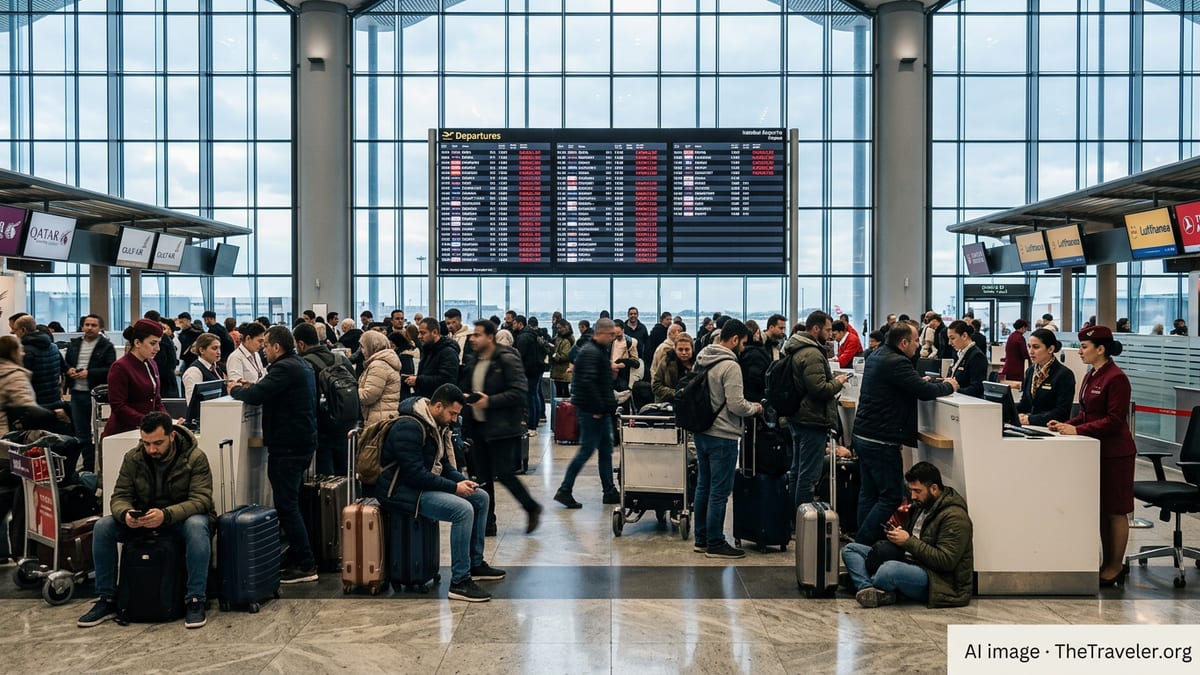
Key Türkiye Departures Scrapped as Carriers Trim Gulf and Europe Links
According to updated schedules published on Friday, flights from Istanbul and other Turkish gateways to Doha, Bahrain, Frankfurt, Brussels, Dubai and Sharjah were among those removed or marked as cancelled, as airlines recalibrated networks in response to airspace restrictions and operational uncertainty in the Gulf region. The latest round of cuts primarily affects transit passengers who rely on Türkiye as a bridge between Europe, Asia and Africa.
Qatar Airways, which uses Hamad International Airport in Doha as a major connecting hub, has continued to operate a limited number of repatriation and essential services while cancelling many regular commercial flights through at least mid March. Travel agents in Istanbul reported that several Qatar Airways departures to Doha were withdrawn from sale or zeroed out, leaving passengers with confirmed tickets but no operating flight.
Bahrain based Gulf Air also reduced frequencies linking its Manama hub with Istanbul and other Turkish cities, further squeezing capacity for travellers trying to reach the wider Gulf. At the same time, Turkish Airlines adjusted selected services that feed into Gulf Air and Qatar Airways connections, creating a knock on effect across codeshare itineraries.
Lufthansa’s schedule changes removed a small number of rotations between Frankfurt and Türkiye on days when regional routings over the Middle East would have been most constrained. While core trunk services remain in place, the loss of specific frequencies is complicating connections for passengers bound for North America, Africa and South America via Frankfurt.
Security Situation in Gulf Region Drives Operational Decisions
The latest wave of cancellations is directly linked to the broader security situation in the Gulf, which has already led to thousands of regional and overflying services being suspended or rerouted in recent weeks. Temporary airspace closures and restrictions, particularly around Qatar, Bahrain and parts of the United Arab Emirates, have forced airlines to introduce lengthy detours or pause operations on certain days.
Qatar’s civil aviation authority has authorised limited contingency corridors into and out of Doha, enabling a constrained schedule of repatriation and essential flights. However, capacity through Hamad International Airport remains well below normal, prompting Qatar Airways to prioritise specific routes and cancel others, including several services used heavily by Türkiye based travellers heading to Asia and Australasia.
In Bahrain and the wider Gulf, carriers are facing similar constraints as they navigate changing military advisories, insurance conditions and crew duty time limitations created by longer routings. Gulf Air has concentrated its resources on maintaining core links with regional neighbours and key long haul destinations, reducing optional frequencies such as some Istanbul and Ankara flights.
European operators including Lufthansa have also adjusted routings to avoid sensitive airspace, adding flight time and cost on certain sectors. Where alternative routings are not commercially viable or clash with airport curfews, airlines have opted to cancel individual rotations rather than run significantly delayed or heavily loss making flights.
Impact on Passengers Traveling Between Türkiye, Gulf Hubs and Europe
For passengers in Türkiye, the most immediate impact is reduced same day connectivity to Doha, Bahrain, Dubai, Sharjah and onward long haul destinations. Travellers booked to Australia, Southeast Asia and parts of Africa via Gulf hubs have seen itineraries collapse as their Türkiye to Gulf segments are cancelled with little notice.
Travel forums and social media channels on Friday were filled with accounts of passengers receiving cancellation notices for Qatar Airways and Gulf Air services from Istanbul and other Turkish airports, followed by offers to rebook several days later or travel via alternative partner airlines. Some reported being automatically shifted to later Qatar Airways flights that themselves remain at risk if airspace restrictions tighten again.
Those booked via Frankfurt and Brussels are experiencing a different kind of disruption. While most Lufthansa and Turkish Airlines services between Türkiye and Europe are still running, the targeted removal of select frequencies is reducing connection options and forcing longer layovers. Business travellers in particular are facing challenges maintaining tight schedules, especially on complex multi leg itineraries that once depended on precise timing through Frankfurt.
Passengers transiting Dubai and Sharjah are contending with capacity constraints as Gulf carriers redistribute aircraft and crews. Even when Turkish Airlines flights to the United Arab Emirates operate as planned, onward seats to Asia and Oceania are often oversubscribed as travellers from disrupted routes are re accommodated.
What Affected Travellers in Türkiye Should Do Now
Airlines and travel agents are urging customers in Türkiye with March and early April departure dates to check their booking status repeatedly rather than relying on a single confirmation email. Schedules are being updated frequently, and flights that appear as confirmed one day can switch to cancelled the next as operators react to evolving security assessments and regulatory guidance.
Passengers whose flights have already been cancelled typically have three main options: rebooking on a later date with the same airline, rerouting via an alternative hub or partner carrier where agreements exist, or requesting a refund of the unused portion of their ticket. The precise rights and choices available depend on the airline’s current disruption policy and, for itineraries touching the European Union, consumer protection rules on cancellations and significant schedule changes.
Travel experts recommend that passengers departing from Türkiye who must travel urgently should proactively explore routings that bypass the most affected Gulf hubs, even if it means backtracking through European cities such as Frankfurt, Munich or Vienna, or using alternative regional hubs where capacity remains more stable. However, they caution that availability can change quickly as airlines consolidate disrupted passengers onto the remaining flights.
Those with flexible plans are being advised to consider postponing non essential trips or pushing departures into late April if possible, when airlines hope to have more clarity on airspace access, insurance conditions and sustainable schedules. Until then, travellers should build in substantial buffers for connections, keep contact details updated with airlines, and monitor both carrier statements and airport departure boards on the day of travel.
Outlook for Türkiye’s Role as a Transit Hub
Türkiye’s position as a vital east west bridge means it is acutely exposed to upheaval in neighbouring regions, particularly the Gulf. Istanbul’s large international airports and Turkish Airlines’ global network normally provide resilient alternatives when other hubs are strained, but the current situation has demonstrated that extended airspace disruptions can still ripple through even the most diversified systems.
Airline executives and analysts expect that once the security situation stabilises, carriers such as Qatar Airways, Gulf Air, Lufthansa and Turkish Airlines will seek to restore suspended services between Türkiye and hubs including Doha, Bahrain, Frankfurt, Brussels, Dubai and Sharjah, though the pace of recovery will depend on demand, risk assessments and network profitability.
In the meantime, industry observers say the disruption is likely to accelerate efforts by airlines and regulators to refine contingency routings around sensitive areas, strengthen crisis communication with passengers and review interline agreements that allow smoother rebooking when one carrier cancels. For Türkiye based travellers and the country’s tourism sector, the next few weeks will test the resilience of these systems as airlines juggle safety, operational feasibility and the need to keep people moving across a still volatile region.