

More news on this day
Flight disruption at Cairo International Airport has intensified in early April 2026, with operational data and regional coverage pointing to a sharp rise in delays and scattered cancellations that are reverberating across key routes linking Europe, Africa and the Gulf.
Get the latest news straight to your inbox!
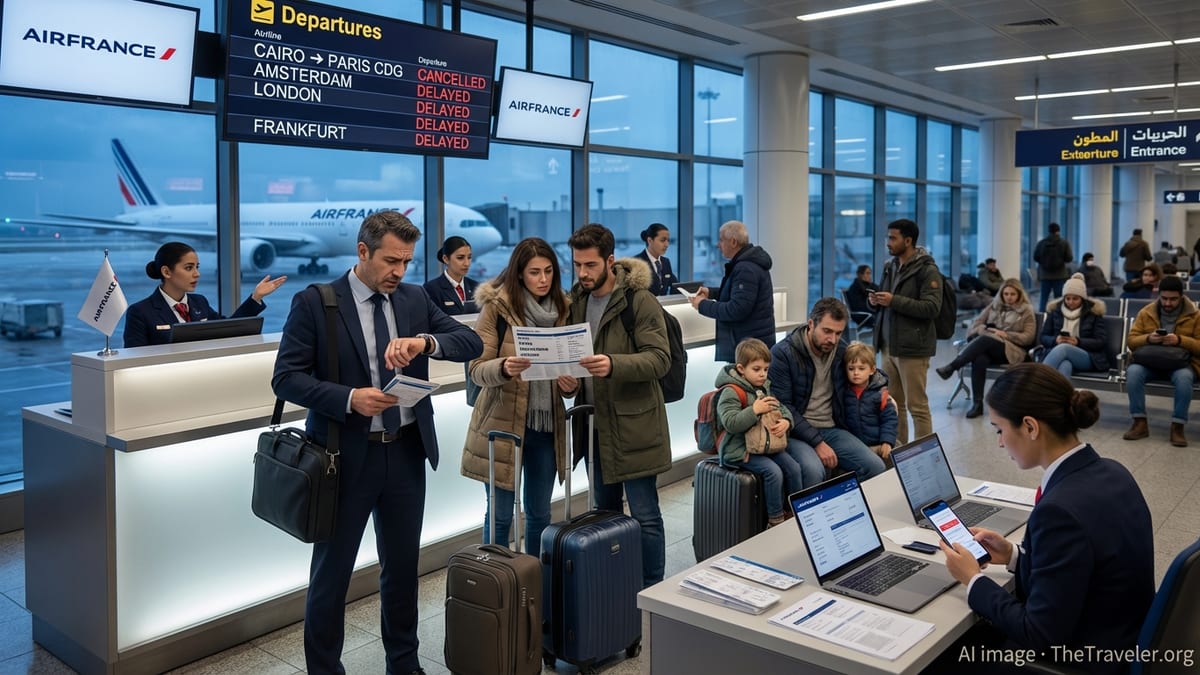
Delays and Cancellations Spike in Early April
Operational tallies for April 6 indicate that Cairo International Airport recorded more than 150 delayed flights and at least six cancellations in a single day, marking one of the most disrupted days at the hub so far this year. Published aviation coverage describes the airport as among the hardest hit in a wider Middle East disruption pattern affecting Cairo, Istanbul and Dubai.
The disruption has affected both domestic and international services. Reports highlight EgyptAir among the most impacted carriers, alongside major international airlines operating routes to Frankfurt, Doha, Dubai, Istanbul and London. The combination of delayed departures and missed inbound connections has created rolling congestion across the airport’s terminals.
Travel-focused outlets tracking the situation describe scenes of extended waiting times at check in, security and boarding gates as airlines work through backlogs. With many affected flights forming part of complex multi leg itineraries, even a modest number of cancellations has had an outsized impact on onward connectivity through Cairo.
While the April 6 figures are the most widely cited so far, industry observers suggest that a pattern of elevated disruption has persisted into the first full week of April, as carriers continue to adjust schedules and aircraft rotations.
Regional Tensions and Weather Amplify Operational Strain
The mounting disruption at Cairo is unfolding against a backdrop of severe regional turbulence for aviation. Since late February 2026, airspace closures and military escalation involving Iran, the United States, Israel and Gulf states have led to widespread rerouting, diversions and cancellations across the Middle East. Coverage of regional air travel points to thousands of flights cancelled or altered in March as airlines sought to avoid conflict zones and comply with fast changing restrictions.
Egypt’s geographic position has made Cairo a critical corridor between Europe, Africa and Asia while other routings face constraints. Egypt based outlets note that multiple international flights have been diverted to Egyptian airports in recent weeks amid closures or congestion at neighboring hubs, adding pressure to local infrastructure even when individual services operate safely.
At the same time, Egypt has experienced episodes of disruptive weather. In late March, EgyptAir issued a public travel alert in response to severe storms and heavy rainfall affecting Greater Cairo and Suez Canal cities, urging passengers to arrive significantly earlier than usual for both international and domestic departures. That guidance reflected concerns about road conditions, visibility and knock on effects for airport punctuality, and it set the stage for tighter operating margins as April began.
These regional and meteorological pressures have combined with existing operational challenges common to large hubs, including air traffic control congestion, crew rostering limits and aircraft positioning. Analysts note that when several of these factors converge, even routine schedule adjustments can quickly cascade into large numbers of delayed flights.
Impact on Passengers at Cairo International Airport
For passengers transiting Cairo in early April, the disruptions have translated into long queues, missed connections and extended time in the terminal. Publicly available travel reporting describes travelers stranded for hours as departure boards cycled through rolling delay announcements for flights across Europe, the Gulf and key African destinations.
With Cairo playing a major role as a connecting point between Europe and cities in East and North Africa as well as the Middle East, delays at the hub can quickly affect itineraries well beyond Egypt’s borders. Missed onward flights often require complex rebooking across multiple airlines and alliances, particularly when travelers are ticketed on separate legs rather than through itineraries.
Consumer oriented travel advisories are increasingly recommending that passengers allow more time for connections at Cairo this month and closely monitor flight status through airline apps and airport information channels. Some observers suggest that connection windows that might be acceptable under normal conditions are now risky, particularly for itineraries involving immigration checks or terminal changes.
Hotel stays and additional expenses have become a feature of many disrupted journeys. Travel industry commentary notes that passengers with flexible tickets or comprehensive travel insurance are generally finding it easier to secure rerouting and compensation than those on heavily restricted fares.
Airlines Adjust Schedules and Policies
Airlines serving Cairo have responded with a mix of schedule changes and customer policy adjustments. EgyptAir has issued multiple public notices since late February on cancellations affecting its network through April 20, signaling a period of sustained operational volatility. The carrier has encouraged passengers to review bookings and track updates through official channels as schedules are fine tuned.
Earlier regional disruption prompted several Gulf based carriers to revise services to and from Cairo, in some cases offering rebooking windows or refund options for passengers scheduled to travel between late February and the end of March. Although many of those measures targeted the initial weeks of the regional crisis, the knock on effects are still evident in April as aircraft and crew rotations normalize only gradually.
Industry analysis points to a broader recalibration of routings between Europe and Asia that favors Egyptian airspace at a time when some traditional corridors remain constrained. This shift has increased the strategic importance of Cairo as a hub but has also made the airport more vulnerable to regional shock events, since any new restriction or incident can reverberate quickly through already crowded airways.
Airlines are also reassessing minimum connection times and block times on key Cairo routes, seeking to build more resilience into schedules. However, such adjustments can take several timetable cycles to filter through, meaning passengers in April are still flying on schedules drafted before the full scale of the regional disruption became clear.
What Travelers Should Expect Through the Rest of April
Based on current disruption patterns and public advisories, travelers planning to use Cairo International Airport in April 2026 should be prepared for continued operational uncertainty, even if safety measures and core infrastructure remain robust. Aviation ministries and airport operators across Egypt emphasize that air traffic is being closely monitored, but the regional environment remains fluid.
Travel analysts suggest that further spikes in delays are possible on days with heavy diversion traffic from neighboring states or when weather conditions tighten operating windows around Cairo. Periods of relative normality may alternate with sudden bouts of congestion as airlines adjust to developments in regional airspace restrictions or security dynamics.
Passengers are widely advised in public guidance to arrive earlier than normal for departures from Cairo, particularly during peak travel periods and for long haul international flights. Building additional buffer time into itineraries, including overnight stays before crucial connections, is increasingly framed as a prudent measure rather than an optional precaution.
For now, the mounting disruptions at Cairo International Airport in April underline both the airport’s growing importance as a regional crossroads and its exposure to the wider instability shaping Middle East aviation in 2026. How quickly schedules stabilize will depend not only on local operational measures, but also on the evolution of the broader regional crisis that continues to reshape flight paths across the region.