

More news on this day
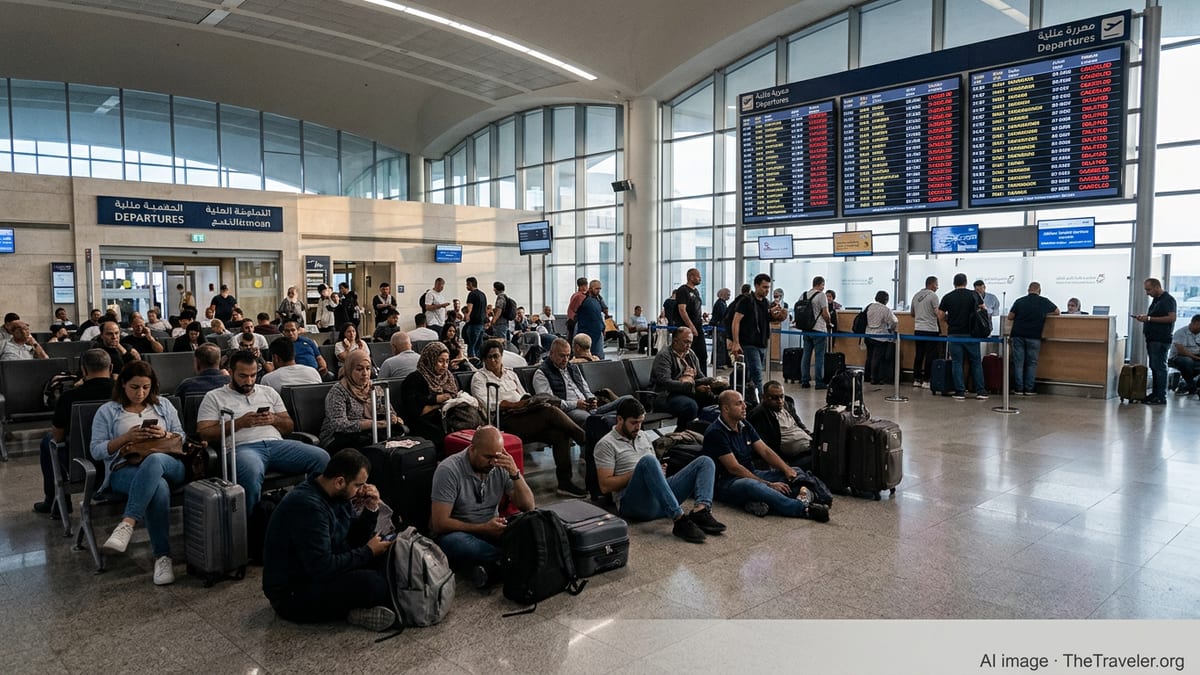
Hundreds of passengers were left facing missed connections and overnight waits at Cairo International Airport after a fresh wave of operational disruption triggered 106 flight delays and five cancellations across key routes to London, Dubai, Riyadh and Amman.
Get the latest news straight to your inbox!
Regional Turbulence Hits Cairo’s Key International Links
Recent disruption across Middle East air corridors has increasingly converged on Cairo, with EgyptAir, Flynas, Nile Air and Air Cairo among the carriers experiencing significant schedule pressure. Publicly available operational tallies indicate that, in a single day, services touching four major destinations London, Dubai, Riyadh and Amman absorbed 106 delays and five outright cancellations at or via Cairo.
The hardest hit flows are those that connect Egypt to Gulf hubs and European capitals. Industry coverage in recent days has highlighted how routes between Cairo and major Gulf airports, particularly Dubai and Riyadh, have been among the most affected, with knock on effects for onward services into Europe, including London, and to regional centers such as Amman.
These problems come on top of a broader pattern of instability in regional airspace since early March, when heightened tensions and temporary airspace restrictions in parts of the Middle East forced airlines to reroute or consolidate services. While many of those restrictions have eased, schedules remain fragile, and operational buffers at hubs like Cairo can quickly erode when several flights run late at once.
Cairo’s role as both an origin airport and a transfer point for Africa, the Gulf and Europe means that disruption on a handful of core routes can ripple through the network. Passengers arriving late from Riyadh or Dubai risk missing onward connections to London, while those bound for Amman can be delayed by late inbound aircraft or ground handling bottlenecks earlier in the day.
EgyptAir, Flynas, Nile Air and Air Cairo Under Strain
Among the airlines operating through Cairo, EgyptAir has been particularly visible in recent disruption tallies, reflecting its position as the largest carrier at the airport and a key operator on London and Gulf routes. Recent travel industry reporting points to dozens of late departures and a smaller number of cancellations for the airline at Cairo during periods of concentrated disruption.
Flynas, which links Cairo with Saudi Arabian cities including Riyadh, has also been operating under pressure on its regional schedule. Data from flight tracking and performance platforms in early April show elevated delay ratios for some Flynas routes touching Cairo and Riyadh, underscoring how congestion at one end can quickly spill over into the other.
Nile Air and Air Cairo, both important players on short and medium haul sectors from Egypt, have likewise been caught in the congestion. Coverage focusing on the disruption at Cairo notes that these carriers have seen double digit delay impacts on selected days, particularly on services feeding Gulf destinations and regional points such as Amman, where even modest schedule slippage can undermine tightly timed connections.
For all four airlines, the combination of busy spring travel demand, constrained aircraft availability and tight turnarounds at Cairo amplifies the operational challenge. Once rotations start to run late in the morning, the delay often migrates through the afternoon and evening, increasing the likelihood that some sectors are eventually cancelled to reset the schedule.
Passengers Face Missed Connections, Long Queues and Confusion
The practical impact for travelers has been felt most acutely at departure gates and transfer desks, where long queues and crowded waiting areas have become common whenever a cluster of delayed flights coincides. Travel reports from recent days describe passengers bound for London, Dubai, Riyadh and Amman facing hours long waits as departure times were repeatedly pushed back.
For connecting passengers, the consequences have been particularly severe. Many itineraries through Cairo rely on relatively short transfer windows to keep overall journey times competitive. When an inbound service from Riyadh or Dubai arrives significantly late, passengers heading on to London or Amman can miss their onward flights entirely, forcing them onto later departures or overnight stays.
In some cases, disruption at Cairo has intersected with congestion at other regional hubs, especially Dubai, where separate operational issues recently produced more than one hundred delays and several cancellations on services linking that airport with major long haul destinations. When both ends of a route pair are under strain, passengers can experience rolling uncertainty over multiple flight segments.
Confusion has also arisen around real time information. Travel advisories note that airport departure boards and airline mobile applications do not always update at the same pace during periods of heavy disruption. Some passengers discovered schedule changes at the gate rather than via advance notification, adding to frustration and complicating efforts to rebook or arrange accommodations.
Operational and Weather Pressures Behind the Numbers
While each delayed or cancelled flight has its own specific cause, several common factors appear to be driving the current pattern at Cairo. Regional airspace constraints earlier in the season forced many carriers to operate longer routings and tighter aircraft rotations, eroding schedule resilience. Even as routings normalize, those thinner buffers leave airlines more vulnerable to localized weather or technical issues.
Operational data compiled for recent coverage of Middle East disruption points to hundreds of delayed and cancelled flights in a single day across Cairo, Istanbul and Dubai, with Cairo accounting for a significant share of the late departures. When winds, storms or visibility issues affect one of these hubs, the result can be cascading knock on delays that extend for many hours.
Ground handling capacity is another pressure point. Cairo International manages dense waves of departures to Gulf cities in the late afternoon and evening, alongside departures to European capitals such as London. A delay in aircraft turnaround, security processing or baggage handling during these peaks can rapidly compound, especially for airlines with limited spare aircraft to substitute into the schedule.
Analysts following the region also note that strong seasonal travel demand is leaving little slack in the system. High load factors on flights to Dubai, Riyadh and other Gulf destinations make voluntary rebooking difficult, as there are fewer empty seats available on alternative departures when a service from Cairo is significantly delayed or cancelled.
Advice for Travelers Booked Through Cairo in the Coming Days
With the recent pattern of 106 delays and five cancellations affecting services between Cairo and major cities including London, Dubai, Riyadh and Amman, travel experts are urging passengers to treat itineraries through the airport with extra caution in the short term. Public guidance emphasizes checking flight status frequently through airline channels before leaving for the airport and again after clearing security.
Passengers holding separate tickets for different legs of their journey are considered particularly vulnerable, as missed onward flights may not be automatically protected. Industry advice suggests allowing longer connection times at Cairo than usual, especially when linking regional flights from Riyadh or Dubai with long haul services to London or onward European destinations.
Travel rights organizations recommend that affected passengers keep boarding passes, booking confirmations and receipts for meals, accommodation and ground transport incurred during lengthy delays or overnight disruptions. These documents can be important when seeking reimbursements or asserting rights under applicable passenger protection regimes for flights involving London or other European Union connected sectors.
Although airlines at Cairo have been working to stabilize their operations as regional conditions evolve, the recent wave of delays and cancellations highlights the continued fragility of schedules in this part of the world. For now, travelers connecting through Cairo to London, Dubai, Riyadh or Amman may benefit from flexible plans, additional buffer time and close monitoring of their flights on the day of travel.