

More news on this day
Air travel across Colombia faced another day of disruption as a cluster of 28 delays and 45 cancellations affected services at major hubs in Bogotá, Bucaramanga, Medellín and Cali, complicating operations for Avianca, LATAM, Wizz Air, EasyJet and thousands of passengers moving through the country’s busiest corridors.
Get the latest news straight to your inbox!
Fresh Wave of Disruptions Hits Key Colombian Hubs
Publicly available tracking data and operational summaries for April indicate that several dozen flights were either delayed or canceled within a short window at major Colombian airports, including El Dorado International in Bogotá, Palonegro International in Bucaramanga, José María Córdova International serving Medellín and Alfonso Bonilla Aragón near Cali. The pattern points to a concentrated spell of disruption rather than isolated schedule adjustments.
The tally of 28 delays and 45 cancellations, drawn from real-time monitoring and aggregated aviation statistics, reflects how even a modest number of affected flights can ripple across tightly timed networks. With Bogotá acting as the principal hub for domestic and international connections, disruptions there quickly cascade into secondary cities such as Bucaramanga, Medellín and Cali, amplifying the impact for travelers who rely on onward connections.
Data from performance trackers for major Colombian carriers show elevated delay averages on routes linking these cities, underscoring how routine congestion, weather variability and operational strain can converge. El Dorado remains one of Latin America’s busiest airports by passenger volume, and when bottlenecks occur at security, immigration or on the apron, recovery windows narrow and airlines face mounting pressure to reshuffle aircraft and crews.
The latest turbulence in Colombia coincides with a broader period of aviation stress across the Americas, where recent storms and capacity constraints have pushed airlines closer to their operational limits. Travel-focused outlets are noting similar spikes in delays and cancellations at hubs elsewhere in the region, suggesting that what is unfolding in Colombian skies is part of a wider pattern of strain in global air travel.
Avianca, LATAM and Low-Cost Rivals Under Pressure
The disruptions have particular resonance for Avianca and LATAM, the two dominant network carriers in Colombia, alongside newer and lower-cost operators such as Wizz Air and EasyJet that link the country to European and regional markets. Performance statistics show that Avianca and LATAM carry the bulk of passenger traffic on key domestic corridors, making them especially exposed when airport operations slow.
On core routes such as Bucaramanga to Bogotá and Medellín to Bogotá, independent trackers report average delays measured in tens of minutes, with some services pushing into longer holds when inbound aircraft arrive late or ground congestion builds. These incremental setbacks quickly translate into missed connections for travelers attempting same-day links from Colombia to North America and Europe.
For Wizz Air and EasyJet, which operate thinner schedules into and out of Latin America and depend on high aircraft utilization, a single cancellation or extended delay can upend rotations for an entire day. With fewer daily frequencies on many long-haul or leisure-oriented routes, passengers affected by a cancellation may have limited immediate options and may be forced to rebook via other hubs or overnight in transit cities.
Industry analyses of recent months suggest that staffing levels, aircraft availability and the continuing need for unscheduled maintenance across global fleets are all contributing to fragility. In Colombia, this aligns with anecdotal reports from travelers who describe last-minute schedule changes, lengthy call-center waits and difficulty securing rebookings during peak periods when alternative seats are scarce.
Passenger Experience: Long Queues, Tight Connections and Frayed Nerves
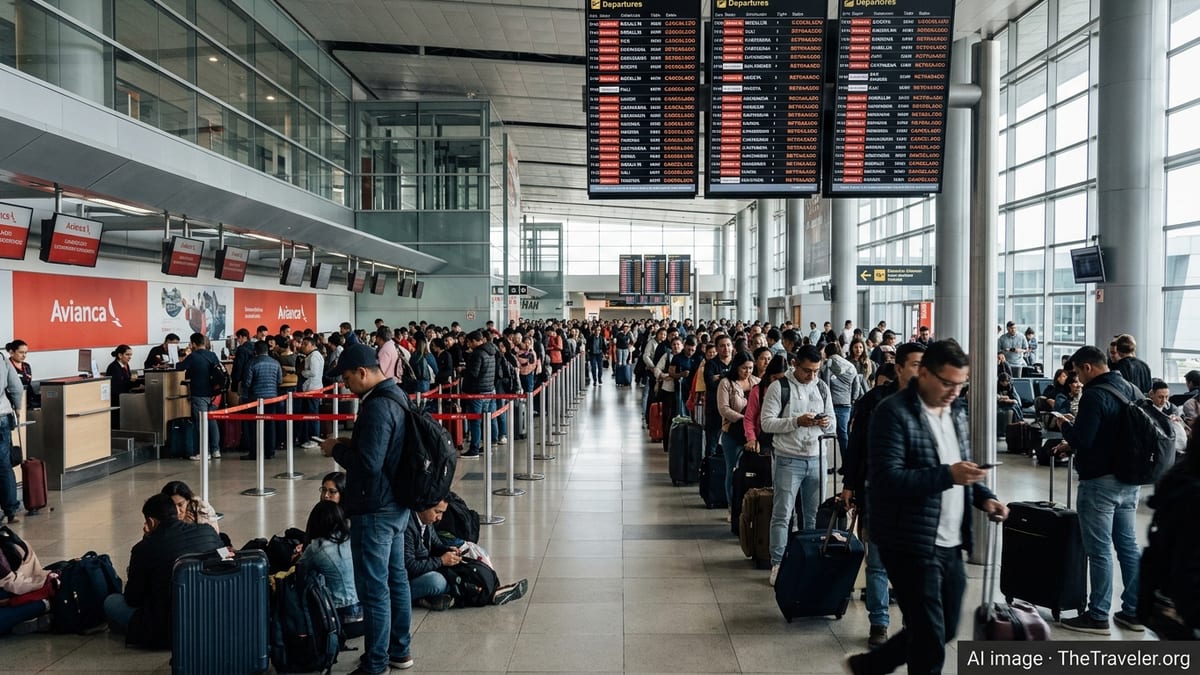
For passengers on the ground in Bogotá, Bucaramanga, Medellín and Cali, the immediate impact of 28 delays and 45 cancellations is felt in long queues at check-in counters, crowded departure halls and uncertainty around missed connections. Social media posts and forum discussions from recent weeks describe travelers racing between terminals, sleeping on airport floors and negotiating complex rebooking scenarios after overnight disruptions.
Travelers connecting through Bogotá in particular report that even relatively modest delays can prove critical when layovers are scheduled at or below one hour. With bus transfers between remote stands, immigration control for some international connections and security screening, any additional wait at the gate can erase the margin needed to make the next flight in time.
Accounts circulating on traveler forums in March and early April describe missed connections in Bogotá leading to same-day or next-day rebookings, sometimes with altered routings through other South American hubs. In several cases, travelers reported receiving automated notifications of schedule changes, only to discover at the airport that their new itineraries left insufficient time to clear formalities and reach onward departures.
Consumer advocates often point to such episodes as evidence that schedules in the region are being planned with tight turnarounds and lean buffers. When disruption occurs, passengers must navigate complex fare rules, varying compensation policies and language barriers, all while trying to salvage business trips, family visits or long-planned holidays.
Weather, Infrastructure and a Fragile Global Network
Recent international coverage highlights how severe weather events in North America and Europe have triggered cascading disruptions across long-haul networks, with knock-on effects for airlines operating in Latin America. Winter storms and late-season blizzards have grounded aircraft, disrupted crew positioning and forced carriers to reshuffle fleets, leaving fewer spare planes available to absorb new problems in distant markets such as Colombia.
Colombia’s own exposure to heavy rainfall and occasional flooding adds another layer of risk for airport operations, affecting visibility, runway conditions and approach patterns at high-altitude hubs like Bogotá. Publicly available climate and disaster assessments rank the country among those facing significant economic exposure to weather-related hazards, which can lead to periodic airspace restrictions and extra holding patterns for arriving flights.
Aviation analysts tracking March and April 2026 describe a system operating close to capacity, where a disruption at one major hub in North America or Europe can leave aircraft out of position for days. When those aircraft are scheduled to serve Bogotá, Medellín or Cali, the result can be a wave of last-minute timetable adjustments, with airlines forced to choose between protecting key trunk routes and trimming secondary services.
Operational data from Colombian airports show that, under such conditions, even routine afternoon thunderstorms or short-lived ground stops can tip a fragile schedule into widespread disruption. With multiple airlines sharing limited runway and gate capacity, recovery windows shrink and carriers resort to cancellations in order to reset operations for the following day.
What Travelers Can Do as Disruptions Continue
Given the recent pattern of flight chaos in Colombia and across the wider Americas, travel specialists and consumer commentators are renewing calls for passengers to build extra resilience into their plans. Common recommendations include booking earlier departures, avoiding tight connections at major hubs and favoring routes with multiple daily frequencies that offer more options if a flight is canceled.
Advisers also stress the importance of monitoring flight status through official airline apps and airport information boards, as last-minute aircraft swaps or minor schedule shifts can change boarding times with little warning. For travelers departing from or connecting through Bogotá, Bucaramanga, Medellín or Cali, this is particularly relevant when weather systems are moving through or when global headlines signal broader aviation disruption.
In the event of a cancellation, publicly available guidance from airlines serving Colombia typically instructs passengers to rebook via digital channels before lining up at airport counters. This can reduce wait times and improve the chances of securing scarce seats on the next available service, especially during holiday peaks or after major storms elsewhere in the hemisphere.
As April 2026 unfolds, the cluster of 28 delays and 45 cancellations in Colombia serves as another reminder that global aviation remains vulnerable to shocks at home and abroad. For travelers, the lesson is clear: build in buffers, stay informed and be prepared for plans to change, even on routes that once felt routine.