

More news on this day
Air travel across Japan has been hit by a fresh wave of disruption, with publicly available data indicating around 470 flight delays and 26 cancellations affecting major carriers such as All Nippon Airways (ANA), Japan Airlines (JAL), and low cost operator Peach Aviation at key hubs including Tokyo, Osaka, and Fukuoka.
Get the latest news straight to your inbox!
Major Hubs See Knock-On Disruptions
The latest disruption has been most visible at Tokyo’s Haneda and Narita airports, which together handle the bulk of Japan’s domestic and international air traffic. Reports from flight tracking boards and local coverage indicate that dozens of departures and arrivals fell significantly behind schedule, creating long queues at check in, security, and boarding gates.
Osaka’s Kansai and Itami airports, important gateways for western Japan, have also reported clusters of delayed departures, particularly on heavily trafficked trunk routes to Tokyo and Fukuoka. Passengers faced extended waiting times in terminal areas as aircraft and crews rotated late between flights, magnifying the impact beyond the immediate cancellations.
Additional disruption has been noted at Fukuoka, Sapporo New Chitose, and other regional airports, where domestic schedules are tightly timed to connect with long haul flights and shinkansen services. When one sector is delayed, follow on services often depart late, compounding inconvenience for travelers attempting to make same day rail or onward air connections.
While the number of outright cancellations remains relatively limited compared with the scale of Japan’s daily operations, the high volume of delayed flights has still affected thousands of passengers, particularly during peak morning and evening departure banks.
Flag Carriers ANA and JAL Under Pressure
ANA and JAL, which together operate a large share of domestic and international flights from Japanese hubs, appear to account for a significant portion of the affected services. Publicly available flight boards show repeated delays on key routes linking Tokyo with Osaka, Fukuoka, Sapporo, and other major cities, highlighting how disruption on trunk sectors quickly cascades across both networks.
Operational challenges have emerged at a time when demand for travel to and within Japan remains robust. Recent months have seen strong inbound tourism and busy domestic corridors, leaving limited slack in schedules when weather, congestion, or aircraft rotations do not run as planned. With aircraft and crews heavily utilized, even minor disturbances can lead to rolling delays through the day.
Observers note that both carriers have already been adjusting timetables and capacity in response to broader regional developments, including shifting demand on routes to and from East Asia. This context has left airlines fine tuning their fleets and schedules while also attempting to preserve reliability for domestic travelers who depend on high frequency services between major metropolitan areas.
For premium and connecting passengers, delays on flagship domestic routes can also result in missed long haul departures to Europe, North America, and Southeast Asia, further amplifying the operational strain on the two large full service airlines.
Low Cost Carrier Peach Aviation Feels the Strain
Low cost carrier Peach Aviation, which operates an extensive domestic and short haul regional network from Osaka Kansai, Tokyo Narita, and other airports, has also been caught up in the disruption. Coverage of the latest irregular operations shows that several Peach flights have been delayed or cancelled, particularly on busy links between Kansai, Fukuoka, and Tokyo area airports.
As a point to point operator with lean turnarounds, Peach is especially sensitive to small schedule disruptions. When an early morning service departs late due to weather, ground handling, or airspace constraints, that delay can quickly ripple through subsequent rotations, affecting travelers scheduled to fly later the same day.
Japan’s low cost carriers have seen solid demand from price conscious domestic and regional travelers, leading to high load factors on popular routes. This popularity, however, can leave fewer empty seats for same day reaccommodation when irregular operations occur, meaning affected passengers may face longer waits before securing alternative flights.
The situation underscores how interconnected Japan’s aviation ecosystem has become, with low cost and full service airlines sharing airspace, runways, and terminal infrastructure at the same congested hubs.
Passengers Face Long Queues and Tight Connections
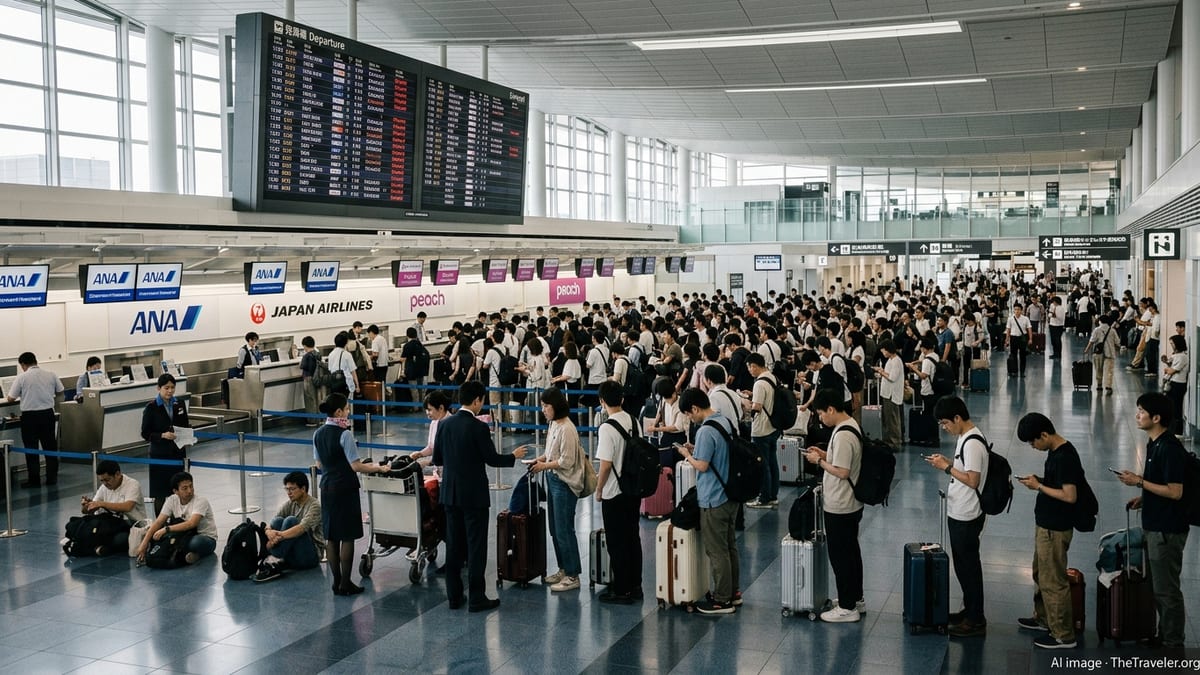
For travelers on the ground, the wave of disruptions has translated into long lines, uncertainty, and in some cases missed connections to trains, ferries, and connecting flights. Photos and descriptions shared via social platforms depict crowded check in areas and busy customer service counters at Tokyo and Osaka airports as passengers seek rebooking options.
Japan’s domestic air network is closely integrated with the country’s rail system, including connections to shinkansen stations at hubs such as Tokyo, Shin Osaka, and Hakata, which serves Fukuoka. When flights arrive late, travelers often face a scramble to adjust rail reservations or purchase new tickets, adding to the overall cost and stress of the journey.
The impact is particularly acute for visitors on tightly planned itineraries, who may only have limited time scheduled in each destination. Delayed or cancelled flights can force last minute changes to hotel stays, sightseeing plans, and regional excursions, reducing flexibility for those unfamiliar with local transport alternatives.
Business travelers are also affected, with some reportedly missing meetings or being forced to compress schedules when same day round trips no longer align with delayed departure and arrival times.
How Travelers Can Navigate the Ongoing Disruptions
Travel experts recommend that passengers flying within or to Japan build additional buffer time into itineraries while operations remain unsettled. Allowing extra hours for connections, especially when coordinating between air and rail, can help reduce the risk of missed onward segments when delays occur.
Publicly available information from airlines and airports indicates that same day rebooking is possible in many cases when flights are significantly delayed or cancelled, though options may be limited on peak travel days. Travelers are advised to monitor flight status frequently through airline apps and airport displays, and to be prepared for gate or departure time changes at short notice.
For those planning trips in the coming weeks, flexible tickets and accommodation bookings that permit changes without heavy penalties may provide welcome peace of mind. Some travelers are also considering alternative routings, including using different gateways within Japan or shifting certain journeys to the shinkansen network where travel times are competitive on major intercity corridors.
While Japan’s aviation sector is widely regarded for its efficiency and punctuality, the current pattern of disruptions serves as a reminder that even mature, high frequency networks can experience significant operational strain. Travelers heading to or within the country in the near term are likely to benefit from staying informed, remaining flexible, and allowing extra time to navigate some of the world’s busiest air corridors.