

More news on this day
Passengers traveling through Brazil’s busiest aviation hubs in São Paulo, Rio de Janeiro, Brasília and Recife faced mounting disruption today, as publicly available data showed at least 59 delayed flights and 18 cancellations affecting services operated by LATAM, Gol, Azul and American Airlines.
Get the latest news straight to your inbox!
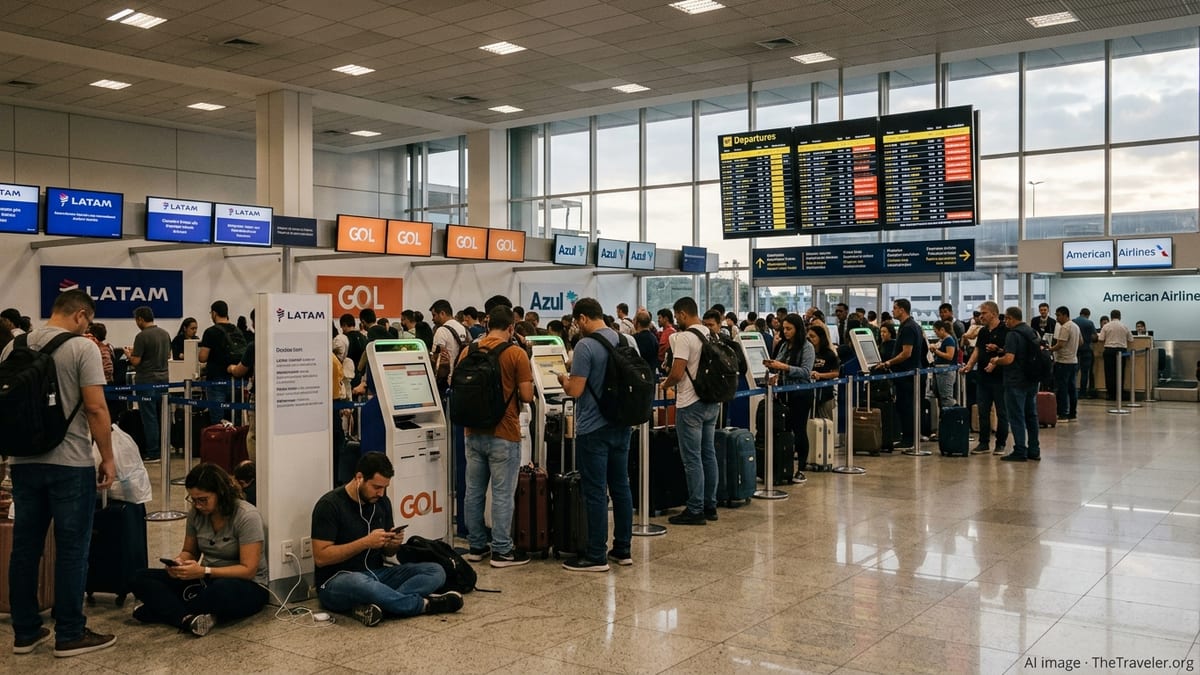
Major Hubs Face Knock‑On Delays and Cancellations
The latest operational data from Brazilian flight tracking and airport monitoring platforms indicates that disruptions were concentrated at São Paulo’s Guarulhos and Congonhas airports, Rio de Janeiro’s Galeão and Santos Dumont, Brasília International Airport and Recife/Guararapes. Together, these airports form the backbone of Brazil’s domestic and long haul network, meaning local issues quickly rippled across the country’s flight schedules.
Across these hubs, a total of 59 flights were reported delayed, many by more than an hour, while 18 services were fully canceled. The pattern affected both short haul domestic routes and key international connections linking Brazil with North America and other parts of Latin America, amplifying the impact for passengers attempting to make onward connections.
Operational statistics published by industry and government platforms in recent months already highlighted pressure on punctuality at several Brazilian airports, including São Paulo and Recife, where variability in flight times and turnaround performance has been under close scrutiny. The latest wave of delays is adding fresh strain to airports already managing heavy traffic volumes.
Airports in these cities have been working close to capacity during peak periods, and observers note that relatively small schedule disruptions can cascade into widely felt travel chaos. With aircraft and crews tightly rotated across Brazil’s dense domestic network, a late departure in São Paulo or Rio often results in knock on delays to subsequent legs reaching secondary cities.
LATAM, Gol, Azul and American Bear the Brunt
Brazil’s three largest domestic carriers, LATAM, Gol and Azul, were among the most affected operators, reflecting their dominant presence at the impacted hubs. Publicly available information shows that these airlines collectively account for the majority of daily movements at Congonhas, Guarulhos, Brasília and Recife, making them particularly vulnerable when schedules start to slip.
Recent performance reports from Brazil’s air navigation authorities and regional aviation monitors have noted fluctuating on time performance across the country’s main carriers, with Azul, Gol and LATAM all experiencing varying degrees of delay and cancellation pressure in the past year. While overall completion rates remain high, even a small proportion of disrupted flights can translate into thousands of inconvenienced travelers when traffic levels are elevated.
American Airlines, which serves São Paulo and Rio de Janeiro with long haul connections to the United States, was also caught in the disruption pattern. The carrier has been managing its own network difficulties in North America in recent months, and residual schedule adjustments have occasionally contributed to irregular operations on routes to Brazil. When long haul services arrive late into busy hubs such as Guarulhos, tight onward connections on Brazilian partners can be jeopardized.
The combined effect is a complex web of missed connections, rebookings and extended layovers for passengers traveling between Brazilian cities and on to international destinations. Social media posts and traveler forums on recent days have described extended waits, repeated gate changes and last minute reassignments across these airlines, painting a picture of a system under notable strain.
Travelers Confront Long Queues and Missed Connections
For passengers, the most immediate impact of today’s disruption has been at check in counters, security lines and boarding gates, where long queues and shifting departure times created uncertainty around travel plans. At São Paulo’s Guarulhos in particular, travelers on domestic connections to Rio, Brasília and northeast capitals such as Recife and Salvador reported tight or missed connections as delays accumulated.
Online travel communities discussing Brazil routes in recent weeks have repeatedly warned that short connection windows at congested hubs like Guarulhos and Recife can be risky even under normal conditions. When delays multiply, these risks increase significantly, especially for passengers who must reclaim and recheck baggage when transferring between international and domestic flights.
In Rio de Janeiro, both Santos Dumont, which handles dense shuttle traffic to São Paulo, and Galeão, the city’s main international gateway, experienced schedule knock ons from late arriving aircraft. Similar patterns were reported in Brasília, a key connecting point for flights from Brazil’s interior to the southeast and northeast, where a handful of cancellations forced passengers onto later services or alternative routings.
Families traveling at the end of the Southern Hemisphere summer holiday period, along with corporate travelers returning to major business centers, appeared to be among the most affected. Several recent consumer complaints logged with Brazil focused on last minute schedule changes and the difficulty of securing compensation or alternative arrangements in the face of rolling delays.
Structural Strains Behind Brazil’s Flight Irregularities
While each day of disruption has its own operational triggers, analysts point to a set of structural challenges that make Brazil’s air network particularly susceptible to cascading delays. Concentrated traffic through a small number of mega hubs, tight scheduling designed to maximize aircraft utilization, and the growing complexity of code share and alliance arrangements all contribute to fragile punctuality.
Recent comparative punctuality studies for Latin American airlines show that LATAM Brasil, Gol and Azul generally achieve respectable on time performance on an annualized basis. However, these same reports highlight spikes in delays and cancellations during peak travel periods or when adverse weather, air traffic control constraints or technical issues coincide at a major hub.
Long haul carriers such as American Airlines add another layer of complexity. When flights from North American hubs depart late because of congestion or weather, their late arrival into Brazil often falls into already busy bank structures for domestic departures. This can overwhelm rebooking desks and strain airport infrastructure for baggage handling and passenger processing.
In Recife, where infrastructure upgrades have been under way and traffic has grown steadily, comparative reports from Brazilian air traffic management authorities have noted variability in departure and arrival times that can intensify during weather disruptions along the northeast coast. These factors combine with congested southeast airports to produce the kind of multi city irregular operations seen today.
What Passengers Can Do Amid Ongoing Uncertainty
With delays and cancellations now a recurring feature of global air travel, passenger advocates in Brazil and abroad have been emphasizing preparation and flexibility for anyone transiting major hubs. Guidance circulating on travel forums and consumer advice platforms suggests that travelers through Guarulhos, Galeão, Brasília and Recife should build in additional connection time where possible and monitor flight status closely on airline apps and airport information screens.
For those impacted by disruptions, publicly available passenger rights information in Brazil outlines options that may include rebooking on later flights, meal and accommodation support in certain circumstances, and refunds for canceled services. However, travelers frequently report challenges in accessing these remedies during peak disruption events when call centers, airport counters and digital channels are overwhelmed.
In the short term, the 59 delays and 18 cancellations recorded across Brazil’s primary hubs underscore the importance of resilient scheduling and transparent communication from airlines and airports. As LATAM, Gol, Azul and American Airlines adjust their operations to recover regular service, travelers are being urged by consumer advocates to document any additional expenses and keep detailed records of schedule changes.
Industry watchers note that Brazil’s aviation market is likely to remain busy through upcoming holiday and business travel peaks, leaving limited margin for error. Unless underlying bottlenecks in infrastructure and scheduling are addressed, the type of multi city travel chaos seen across São Paulo, Rio, Brasília and Recife may become an increasingly familiar experience for domestic and international passengers alike.