

More news on this day
Early April travel across the United States is off to a turbulent start as Boston Logan International Airport and several major hubs grapple with a new wave of delays and cancellations linked to severe weather, tightening federal safety rules and lingering network shocks from recent ground stops.
Get the latest news straight to your inbox!
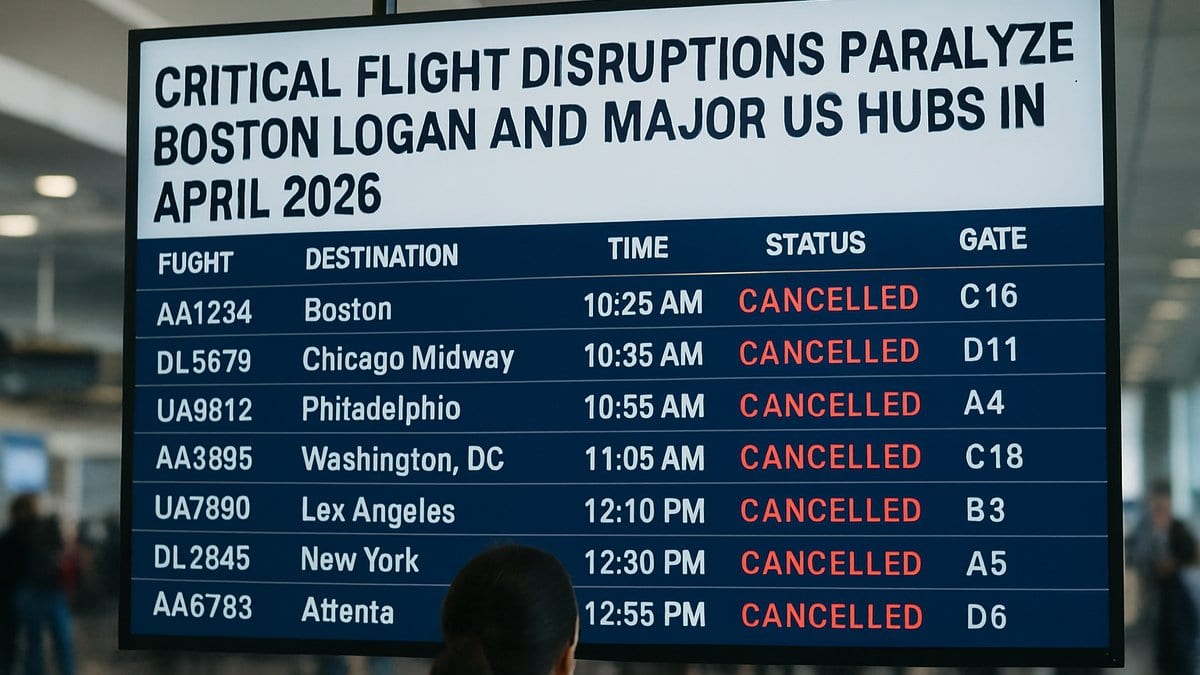
Boston Logan Feels the Fallout of a Strained National Network
Boston Logan is entering April 2026 under persistent operational pressure, with travelers facing longer lines, rolling delays and periodic cancellations despite relatively normal local conditions. Publicly available tracking data and recent disruption tallies show Boston repeatedly appearing among the top affected airports for late March and early April, reflecting its role as a busy transcontinental and transatlantic gateway.
Coverage of late March operations indicates that storms in key connecting regions and crew shortages at partner carriers triggered dozens of cancellations and well over one hundred delays at Boston in a single day, as missed connections cascaded through airline schedules. That pattern has carried into April, with Logan absorbing the ripple effects of disruption elsewhere, even when New England skies are clear.
Industry analysts note that Boston’s growing status as a strategic hub for multiple major airlines magnifies those impacts. When aircraft or crews are out of position at other hubs, the knock-on effects are quickly felt on Boston departures and arrivals, adding to congestion at security checkpoints and boarding gates.
Travel planning resources are advising passengers using Boston Logan in the first half of April to build in additional buffer time, monitor flight status closely and prepare for last minute gate changes as airlines continue to rebalance their networks.
Severe Weather and Thunderstorms Disrupt the US Aviation Grid
The latest wave of disruption is rooted in an intense spell of severe weather and thunderstorms that swept across large sections of the United States at the end of March and into April 1. Flight tracking data compiled from multiple sources shows thousands of delayed flights and more than one hundred cancellations on a single day, affecting nearly every major hub from Chicago and Dallas to New York and Fort Lauderdale.
Thunderstorms, low visibility and temporary ground stops prompted by these conditions led to runway closures, extended arrival spacing and holding patterns. When storms formed over key connecting hubs, flights bound for affected airports were slowed or held at their departure points, clogging the system and compressing schedules once operations resumed.
Because Boston is heavily dependent on traffic flows from these larger hubs, even a brief weather-driven slowdown elsewhere can quickly translate into multi hour disruptions for New England travelers. Missed inbound connections leave aircraft arriving late or not at all, while crews displaced by earlier delays sometimes time out under federal duty limits, forcing further cancellations.
Passenger advocacy outlets are warning that unstable spring weather across the Midwest and East Coast may continue to generate rolling pockets of disruption through April, making early morning departures and non stop routings the most resilient options where available.
FAA Restrictions at San Francisco Add Strain to Coast to Coast Routes
Compounding the weather challenges, new Federal Aviation Administration restrictions on certain landings at San Francisco International Airport took effect in the final days of March and are beginning to reverberate through coast to coast schedules in early April. Public statements and industry coverage describe a reduction in allowable arrivals per hour to accommodate runway construction and address safety concerns about closely spaced parallel landings.
The change effectively trims San Francisco’s landing capacity by roughly one third, forcing airlines to thin schedules, adjust block times and accept longer average taxi and holding periods. While the most immediate impact is in the Bay Area, the effect quickly spreads along transcontinental routes connecting San Francisco with Boston, New York, Washington and other East Coast cities.
For Boston Logan, this translates into fewer available seats on popular business routes, increased likelihood of missed connections onto and out of San Francisco, and tighter rebooking options when weather or operational issues arise. Published guidance from air travel advisories suggests that travelers on Boston San Francisco itineraries in April may see schedule changes, equipment swaps and modestly longer end to end travel times.
Aviation commentators describe the San Francisco capacity cut as a stress test for an already stretched national network, reducing the margin of error across long haul domestic flights at the very moment when spring storms are eating into on time performance.
Recent Ground Stops Reveal Systemic Vulnerabilities
Events in late March highlighted how quickly a localized issue can trigger system wide disruption. A ground stop affecting all three major Washington area airports, along with additional regional facilities, followed reports of a strong chemical smell at a key air traffic control facility serving the capital region. Flights headed to and from hubs used by major US carriers were temporarily halted, producing extensive knock on delays.
According to published accounts and flight tracking data, the Washington area ground stops led to widespread schedule dislocations, including diverted flights, missed connections and crew rotation challenges. Even after the restriction was lifted, residual delays persisted for hours as airlines worked through backlogs and repositioned aircraft.
Although the Washington incident was geographically distant from Boston, it disrupted sequences for aircraft and crews that were scheduled to operate later flights into New England. This illustrates what federal air traffic reports describe as the cascading nature of modern disruptions, where a safety or infrastructure issue in one region can unsettle operations thousands of miles away.
Observers point out that the Washington ground stop followed other recent examples of infrastructure and safety related shutdowns, including airspace closures in parts of Texas and New Mexico earlier in the year. Together, these events underscore the sensitivity of the system to unplanned outages at critical facilities.
Airlines, Passengers and Planners Adapt to a Volatile April
With Boston Logan and major US hubs facing overlapping operational challenges, airlines are leaning more heavily on schedule adjustments, dynamic rebooking and waivers to manage passenger flows. Publicly available information from carriers shows increased use of advance schedule thinning on vulnerable routes and the introduction of flexible change policies for certain travel dates.
Travel experts note that while these measures can reduce the number of same day cancellations, they often result in tighter capacity on remaining flights, particularly at peak times such as Monday mornings and Thursday evenings. For Boston based travelers, that can mean fewer available last minute seats and a greater need to confirm return flights well in advance.
Consumers are being urged by travel advisories to treat early April 2026 as a higher risk period for disruptions, especially for itineraries that rely on multiple connections through weather sensitive hubs. Recommendations commonly include building in generous layovers, avoiding the final flight of the day where possible and keeping critical events such as cruises or international tours buffered by at least a full day.
Airport planners and industry watchers are closely tracking how the system weathers this period of compounded stress. Performance at Boston Logan in the coming weeks is expected to serve as an indicator of how resilient the broader US aviation network can be when weather volatility, infrastructure constraints and safety driven restrictions converge.