

More news on this day
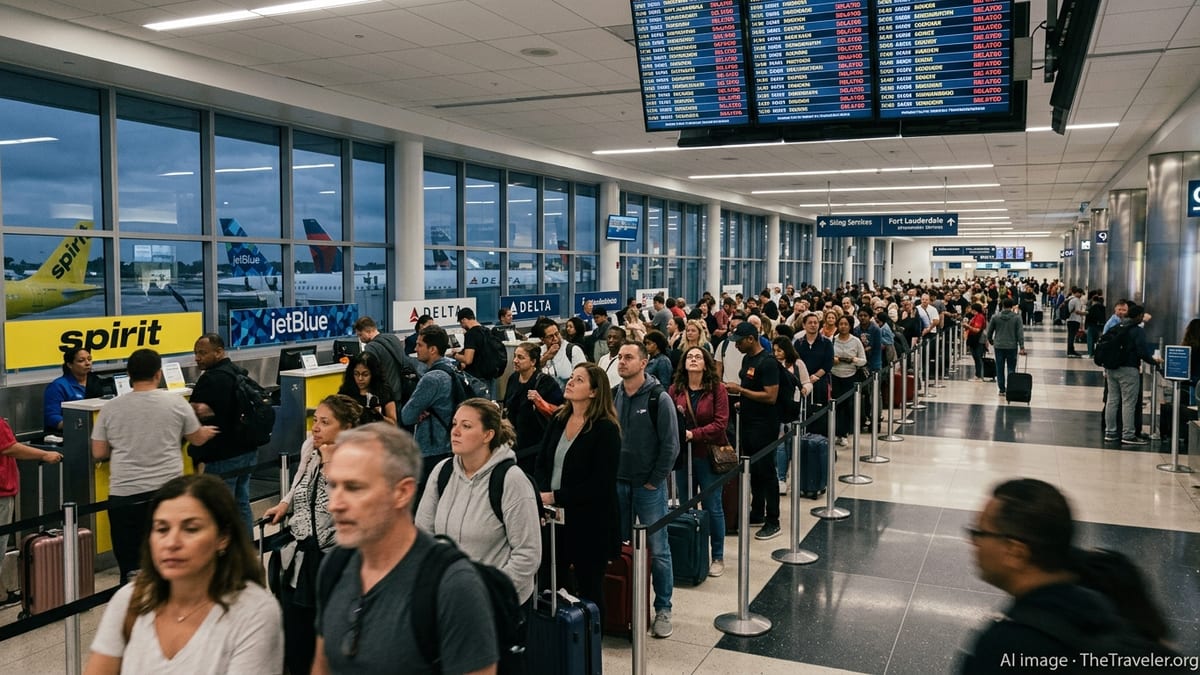
Travelers moving through Fort Lauderdale–Hollywood International Airport are facing another day of frustration as Spirit Airlines, Delta Air Lines, and JetBlue Airways suspend 17 flights and log well over 100 delays, disrupting connections to major cities including New York, Kansas City, Columbus, Detroit, Sint Maarten and several other key domestic and Caribbean destinations.
Get the latest news straight to your inbox!
Wave of Disruptions Hits a Major South Florida Hub
Fort Lauderdale–Hollywood International Airport serves as a critical gateway for South Florida and a major base for low cost and legacy carriers alike, with recent traffic data showing Spirit Airlines, JetBlue Airways, and Delta Air Lines collectively handling a substantial share of the airport’s passenger volume. Publicly available airport statistics indicate that Spirit alone accounts for roughly one third of all passengers at the airport, with JetBlue and Delta together adding another significant portion, underscoring how schedule changes by these three airlines can ripple across the network.
The latest wave of disruptions centers on 17 suspended flights attributed to the three carriers and a broader pattern of more than 100 delays across the departure and arrival boards. These interruptions affect both originating and connecting passengers, many of whom use Fort Lauderdale as a transfer point between domestic U.S. cities and Caribbean or Latin American destinations.
Operational data and traveler reports suggest that the disruptions are spread throughout the day rather than concentrated in a single time block, creating rolling challenges for airline operations, ground services, and passenger rebooking efforts. With Fort Lauderdale functioning as a key node in point to point networks, knock on effects are being felt at out stations as aircraft and crews fall out of position.
Connections Disrupted from New York to the Midwest
The suspended flights and extended delays are disrupting links between Fort Lauderdale and several major U.S. markets. According to published route information, the airport maintains regular nonstop service to New York area airports, Detroit, Columbus and Kansas City, with Spirit, Delta and JetBlue all playing roles in that connectivity. When even a small cluster of departures is removed from the schedule, the capacity loss can be significant for travelers trying to move in and out of South Florida on specific dates.
New York stands out as one of the most affected regions. Fort Lauderdale is tied to John F. Kennedy International, LaGuardia and Newark Liberty through multiple daily flights on major carriers. As some of these services are suspended or delayed, passengers face a reduced choice of departure times, higher rebooking pressure on remaining flights, and in some cases the need to reroute through alternate hubs such as Atlanta or Miami.
In the Midwest, disruptions on routes to Kansas City and Columbus are impacting both leisure and business travelers. Publicly available schedules show these are typically lower frequency routes, meaning that when one or two rotations are cut or significantly delayed, options for same day recovery are limited. Travelers on these routes may encounter longer layovers, overnight stays, or lengthy ground transportation alternatives when seats on later flights are unavailable.
Detroit, an important hub for Delta Air Lines and a key market for other carriers, is also feeling the downstream effects. Delays on Fort Lauderdale–Detroit services can lead to missed onward connections across the Midwest and Great Lakes region, complicating itineraries for passengers who rely on hub and spoke routing.
Caribbean Links, Including Sint Maarten, Face Strain
The latest disruption is not confined to domestic travel. Fort Lauderdale is a major launching point for U.S. travelers heading to Caribbean destinations, with Spirit, JetBlue and other airlines offering nonstop and connecting services. Routes to Sint Maarten, in particular, are sensitive to schedule changes because they tend to operate with fewer daily frequencies compared with large U.S. city pairs.
When a flight to Sint Maarten is suspended or heavily delayed, travelers may lose same day connectivity, especially if they are arriving into Fort Lauderdale from another U.S. city on a different carrier. With limited alternative flights and strong demand for Caribbean leisure travel, rebooking options can narrow quickly, leaving some passengers stranded at the hub or forced to reroute through other gateways.
The strain on Caribbean links is compounded by aircraft and crew positioning. If an outbound Fort Lauderdale flight to a Caribbean destination is disrupted, the returning segment may also shift or cancel, creating a two way challenge for both departing and returning passengers. Airlines must then juggle fleet assignments, sometimes pulling aircraft from other routes to restore service, which can in turn trigger new delays elsewhere in the network.
For travelers, the effect is often felt in cascading itinerary changes: a delay on a domestic feeder flight into Fort Lauderdale can lead to a missed connection to the Caribbean, while a canceled Caribbean segment can require last minute hotel stays and additional ground costs at either end of the journey.
Passengers Confront Long Waits and Limited Options
Publicly available accounts from recent travel days at Fort Lauderdale describe crowded departure areas, long lines at check in counters and customer service desks, and passengers struggling to secure alternative flights on short notice when their original services are suspended or significantly delayed. Low cost carriers such as Spirit typically operate with tighter schedules and less spare capacity, leaving fewer empty seats available for same day reaccommodation when irregular operations occur.
Industry data and prior disruption patterns show that rebooking during widespread delays can be particularly challenging at peak travel times, when flights are already near capacity. In these conditions, travelers are sometimes shifted to flights the following day or rerouted through secondary hubs, extending total journey times and increasing out of pocket expenses for meals, accommodation, and ground transport.
The experience can be especially difficult for passengers traveling on separate tickets or with complex itineraries involving multiple carriers. Because each airline manages its own bookings and policies, a delay or suspension on one leg may not automatically trigger protection on another, leaving travelers to negotiate changes and refunds independently.
Families, cruise passengers, and those with fixed check in times at resorts or tour departures are among the most exposed groups, as missed connections out of Fort Lauderdale can mean lost vacation days or shortened itineraries in destination markets.
Operational Pressures Highlight Fort Lauderdale’s Strategic Role
The concentration of disruptions at Fort Lauderdale underscores the airport’s strategic role in U.S. domestic and Caribbean air travel. Traffic reports from the airport operator show that Spirit, JetBlue and Delta collectively move hundreds of thousands of passengers through the facility each month, linking South Florida not only to major U.S. population centers but also to a wide mix of leisure destinations.
When irregular operations affect several airlines at the same airport on the same day, the resulting pressure on air traffic control, ground handling, baggage systems, and terminal infrastructure can intensify. Small schedule changes may escalate as aircraft depart late, crews reach duty time limits, and turnaround times lengthen, further propagating delays.
For the airlines, managing this type of disruption involves balancing short term recovery with longer term schedule stability. Decisions to suspend individual flights can prevent more severe knock on effects across the network, but they also strand passengers in the near term. Over time, repeated disruptions at a hub or focus city may influence traveler perceptions and booking decisions, particularly among passengers with flexibility to choose between nearby airports.
For travelers planning upcoming trips through Fort Lauderdale, publicly available guidance from airlines and airports emphasizes monitoring flight status frequently on the day of travel, arriving early at the terminal during periods of known disruption, and building additional buffer time into itineraries that rely on tight connections between domestic and international services.