

More news on this day
Flights linking Istanbul with key Gulf hubs Doha and Abu Dhabi were heavily disrupted today, as a cluster of 19 cancellations and 56 delays at Sabiha Gokcen Airport hit services operated by Pegasus Airlines, Qatar Airways and Turkish Airlines, stranding hundreds of passengers and complicating already fragile regional travel plans.
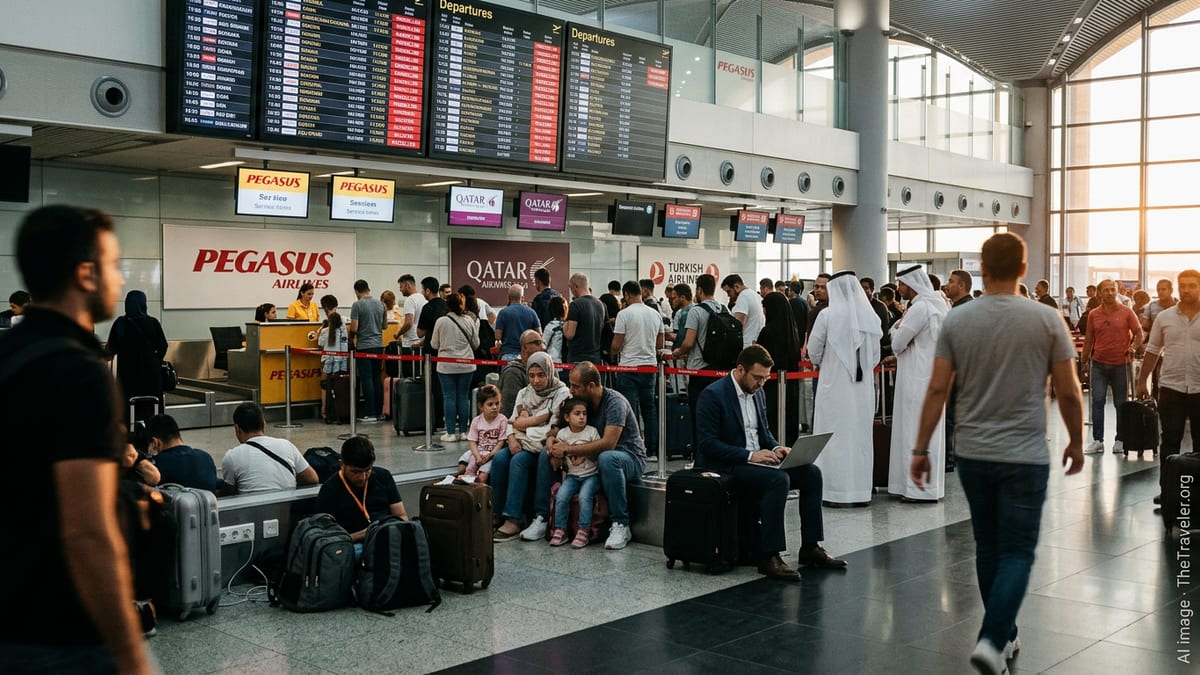
Ripple Effects Across Gulf and Anatolian Skies
The disruptions at Istanbul Sabiha Gokcen, the city’s busy secondary hub on the Asian side, came amid a broader spell of operational instability affecting airlines across Türkiye and the wider Middle East. The latest wave of cancellations and delays particularly affected routes connecting Istanbul to Doha’s Hamad International Airport and Abu Dhabi, two of the Gulf’s main long haul gateways, magnifying the impact for transfer passengers.
Airport operations data showed that a combined total of 19 flights were cancelled and 56 delayed over the course of the day, with Pegasus, Qatar Airways and Turkish Airlines among the hardest hit on services into and out of Sabiha Gokcen. While most disruptions remained under the two hour mark, a significant number of services encountered longer delays, forcing rebookings and last minute hotel arrangements for affected travelers.
Air traffic controllers and airport officials pointed to a mix of regional airspace restrictions, weather related flow controls and aircraft rotation issues as key factors behind the knock on effect. With several Middle Eastern corridors subject to temporary closures in recent days, airlines have been operating with limited scheduling flexibility, leaving little margin to absorb additional shocks.
Passengers reported crowded departure halls, long queues at transfer desks and scarce information on revised departure times, as carriers worked through backlogs of missed connections to onward destinations in Asia, Africa and Europe. For many travelers, the Istanbul disruptions turned what were meant to be straightforward transits through Doha and Abu Dhabi into extended, uncertain stopovers.
Pegasus, Qatar Airways and Turkish Airlines Under Pressure
Pegasus Airlines, which bases a large portion of its fleet at Sabiha Gokcen and operates an expansive network across Türkiye, the Middle East and Europe, was among the first carriers to adjust schedules. The low cost airline faced a squeeze on its turnaround times as late arriving aircraft cascaded into outbound delays, particularly on high demand routes overlapping with Doha and Abu Dhabi connections.
Qatar Airways, whose Istanbul services feed its global network through Doha, also reported a cluster of late departures and missed inbound connections. Even modest schedule disruptions at Sabiha Gokcen can have outsized consequences for its transfer model, forcing the airline to juggle rebookings and secure seats on later flights across multiple continents for displaced passengers.
Turkish Airlines, which serves both Doha and Abu Dhabi from Istanbul and coordinates operations across several Turkish airports, worked to reroute some passengers through its larger Istanbul Airport hub on the European side of the city. However, capacity constraints and existing high load factors on many long haul services limited the number of travelers who could be accommodated on alternative flights the same day.
Airline staff at Sabiha Gokcen spent much of the day processing reissues, handing out meal vouchers and arranging accommodation in line with differing company policies and applicable passenger rights rules. While some travelers were offered swift rerouting via other hubs, others were left facing overnight stays or multi stop itineraries to reach their final destinations.
Regional Airspace Tensions and Weather Complications
The latest disruption comes at a time when carriers across Türkiye and the Gulf are already grappling with constrained airspace and intermittent weather patterns along critical flight corridors. Recent security related restrictions in parts of the Middle East have led to longer routings and tighter slot availability, while seasonal weather systems have periodically slowed traffic flows into major hubs.
Operational planners at both Pegasus and Turkish Airlines have been forced to build additional buffer time into schedules serving sensitive routes, which in turn reduces flexibility elsewhere in their networks, including high traffic links between Istanbul, Doha and Abu Dhabi. When adverse conditions arise, the combination of longer flight times and limited spare aircraft often translates quickly into day of operations cancellations.
For Gulf carriers such as Qatar Airways, routing changes around restricted airspace can add extra flight time and complicate aircraft rotations, especially during peak bank periods when dozens of arrivals and departures are tightly sequenced. Any delay or diversion of Istanbul bound flights resonated through the timetable in Doha, squeezing both connection windows and turnaround times for onward services.
Today’s pattern of disruptions reflects this delicate operating environment, where local weather at one airport, regulatory decisions in another country and traffic congestion over a third region can converge to create a single day of concentrated disruption at a hub like Sabiha Gokcen. Aviation analysts note that such multi factor events are becoming more common as airlines stretch networks across politically sensitive and meteorologically volatile regions.
Passenger Experiences Highlight Strain on Customer Care
For passengers, the immediate experience was one of uncertainty and frustration. Travelers connecting between domestic Turkish cities and Gulf destinations via Sabiha Gokcen described receiving a flurry of rebooking messages, gate changes and rolling delay notifications throughout the day, with some reporting that their original itineraries had effectively become unviable.
Families bound for long planned holidays in Southeast Asia via Doha, as well as business travelers heading to meetings in Abu Dhabi and beyond, found themselves queuing at service desks for alternative routings or, in some cases, refunds. Social media posts from Istanbul showed crowded terminal seating areas and passengers sprawled on the floor near power outlets as they waited for fresh information.
Airlines sought to defuse tensions by issuing meal vouchers and, where required, arranging hotel stays, but the surge of disruption stretched staff and resources thin. Ground handling teams and call centers in Istanbul, Doha and Abu Dhabi all faced elevated workloads, as they attempted to rebook customers while also managing aircraft turnaround and crew duty time limitations.
Travel agents noted that the irregular operations highlighted the importance of flexible tickets and comprehensive travel insurance, particularly for itineraries built around multiple self connected tickets. Passengers who had booked complex journeys across separate airlines were often in a weaker position, with fewer automatic protections and a heavier reliance on ad hoc goodwill gestures.
What Travelers Should Do If Their Flight Is Affected
With schedules at Sabiha Gokcen, Doha and Abu Dhabi likely to remain fragile in the short term, aviation experts are advising passengers to monitor their flight status frequently in the 24 hours before departure and to allow extra time for connections. Many carriers are encouraging customers to use mobile apps and online tools for rebooking options when available, rather than relying solely on airport counters during peak disruption periods.
Travelers whose flights are cancelled are generally entitled to either a rebooking on the next available service or a refund, depending on fare rules and local regulations. In practice, options may be constrained by limited spare seats on popular routes linking Istanbul with the Gulf, particularly during holiday periods and major events that drive demand.
Passengers facing extended delays are being urged to keep receipts for any meals, transport or accommodation arranged independently, as some airlines may reimburse reasonable expenses that are not directly provided at the airport. Those holding travel insurance policies should also check coverage terms for delay and missed connection benefits, which can help offset unplanned costs.
Industry observers say today’s disruptions underline the continuing vulnerability of regional air travel to wider geopolitical and meteorological forces, despite strong demand and expanding route networks. As carriers refine contingency plans and invest in more resilient scheduling, passengers flying between Istanbul, Doha and Abu Dhabi may need to build greater flexibility into their own plans in the days ahead.