

More news on this day
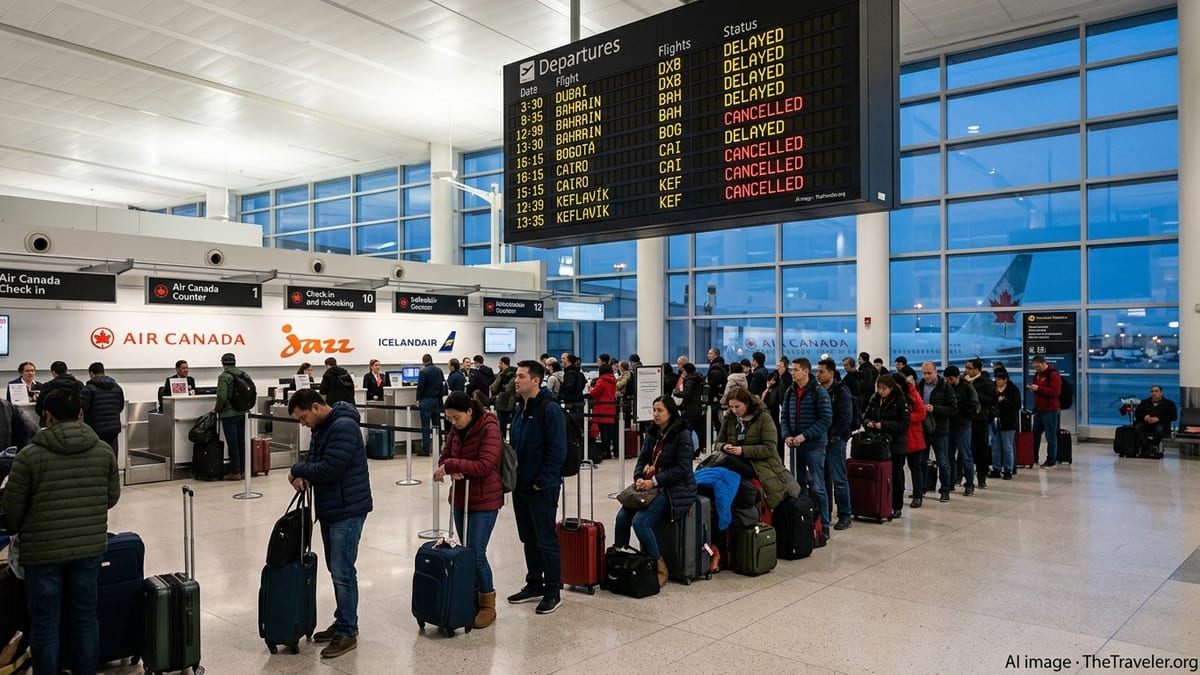
Passengers at Toronto Pearson International Airport faced mounting frustration as a wave of cancellations and rolling delays affecting at least five flights from Air Canada, Jazz and Icelandair rippled across key international routes, disrupting travel plans to Bahrain, Dubai, Bogotá, Cairo, Keflavík and several onward destinations.
Get the latest news straight to your inbox!
Wave of Cancellations Hits Key Long-Haul Departures
Publicly available flight-tracking boards and schedule data on March 19 indicated that a cluster of long-haul services from Toronto Pearson did not depart as planned, including flights operated by Air Canada and its regional affiliate Jazz, as well as an Icelandair service linking Toronto to Keflavík. The disruptions led to a temporary suspension of five scheduled departures, with knock-on delays on connecting itineraries across Europe, the Middle East and South America.
Reports from aviation tracking platforms showed Toronto Pearson departures to Bahrain, Dubai, Bogotá and Cairo particularly affected, along with an Icelandair-operated service to Keflavík that feeds into a wider transatlantic network. These routes are widely used by both business and leisure travelers, magnifying the impact when even a small number of flights are suspended on the same day.
Operational data suggested that some aircraft were rescheduled or reassigned, contributing to extended ground times and multiple rolling departure estimates rather than single, clearly defined delays. This pattern left many passengers facing repeated schedule changes as airlines adjusted their operations in real time.
While no single cause fully explained the breadth of disruptions, industry observers pointed to a combination of operational constraints and network pressures that can rapidly compound when several long-haul aircraft and crews are out of position at the same hub.
Middle East and South America Routes Among the Hardest Hit
According to published coverage on airline route networks, Air Canada’s Toronto connections to Dubai rank among its most significant long-haul services, with the route forming part of a key bridge between Canada and the Gulf region. Disruption on this sector can affect not only point-to-point passengers but also those connecting onward to South Asia, Africa and other parts of the Middle East.
Similarly, flights linking Toronto to Bahrain and Cairo feed into broader regional networks, where travelers often rely on carefully timed connections. The suspension or heavy delay of just one daily service can mean missed onward flights and forced overnight stays, especially when alternative departures are limited.
On the South American front, the Toronto to Bogotá corridor is typically a vital link for travelers heading into Colombia and beyond. Historical schedule data show that Air Canada and partner airlines operate multiple weekly flights on this route, and disruptions can result in crowded rebooking queues, constrained seat availability and added pressure on subsequent departures.
For many travelers booked on multi-leg itineraries, the ripple effects extended far beyond Pearson. Missed onward connections in hubs such as Dubai, Bogotá and Cairo can cascade into rearranged hotel reservations, tour changes and lost business appointments, underscoring how quickly a localized disruption in Toronto can become a multi-continent travel headache.
Icelandair Link to Keflavík Adds Transatlantic Complexity
The involvement of Icelandair’s Toronto service to Keflavík added another layer of complexity to the day’s disruptions. Keflavík serves as a strategic North Atlantic hub, with Icelandair’s network designed to connect North American passengers with a wide range of European destinations via short, tightly timed connections.
According to Icelandair’s published schedules and marketing materials, Toronto is one of several Canadian gateways feeding into Keflavík, alongside cities such as Vancouver and Halifax. When a single Toronto to Keflavík flight is suspended or heavily delayed, passengers may lose onward connections to major European cities, forcing airlines to rebook them on later Iceland departures or reroute them through alternative hubs.
Recent industry reporting has highlighted how Icelandair’s North Atlantic strategy relies on maintaining high on-time performance to protect these short connection windows. Any disruption on a feeder route like Toronto can therefore reverberate across multiple European destinations on the same day, as aircraft and crews are retimed and seat capacity is reshuffled.
Travel forums and social media posts in recent weeks have also reflected broader concerns among transatlantic passengers about schedule changes and short-notice retimings on routes via Keflavík, suggesting that the Toronto disruption fits into a wider pattern of pressure on North Atlantic operations.
Passengers Face Long Lines, Rebookings and Overnight Stays
As the cancellations and delays accumulated, travelers at Toronto Pearson reported extended waits at airline service counters and crowded gate areas, as those on suspended flights sought rebooking options. When multiple long-haul departures are affected simultaneously, the number of available seats on later flights or alternative routings can quickly become constrained.
Publicly shared accounts from previous disruption events at Pearson indicate that airlines often respond by consolidating passengers onto a smaller number of services, operating one-off recovery flights or rerouting travelers through different hubs. While such measures eventually restore network balance, they can leave individuals dealing with unexpected overnight stays, visa complications on rerouted journeys and the challenge of rearranging ground arrangements at their final destinations.
Passengers bound for Bahrain, Dubai, Bogotá, Cairo and Keflavík faced particular uncertainty because of the long distances involved and the limited number of daily departures on some routes. In many cases, travelers were offered rebookings one or more days later, or rerouted through cities such as London, Frankfurt or Madrid, potentially lengthening overall travel times by many hours.
Consumer advocates often advise passengers in such situations to keep records of delay notifications, boarding passes and receipts for meals and accommodation, as these documents can be important when seeking compensation or reimbursement under applicable air passenger protection rules.
What the Disruptions Reveal About Pearson’s Global Role
The latest wave of suspended flights and cascading delays underscores Toronto Pearson’s role as a critical intercontinental hub where operational issues can quickly affect travel far beyond Canada’s borders. Routes linking Toronto with Bahrain, Dubai, Bogotá, Cairo and Keflavík bridge major regions and serve as connectors for complex global itineraries.
Air Canada, Jazz and Icelandair rely on Pearson as a key node for their international networks, and publicly available route maps show that long-haul flights from the airport reach deep into the Middle East, Latin America, Europe and beyond. When weather, technical issues or crew-availability challenges disrupt a handful of these services, the impact is magnified by the number of passengers and connections involved.
The events of March 19 highlight ongoing fragilities in global aviation, where tight schedules, high aircraft utilization and sustained demand leave limited slack to absorb unexpected shocks. For travelers, the episode serves as a reminder to build buffer time into complex itineraries, particularly when connecting through major hubs on long-haul journeys.
As operations gradually normalize and airlines clear the backlog of displaced passengers, attention is likely to focus on how carriers refine their contingency planning at Pearson and other global hubs. Observers will be watching closely to see whether measures such as increased spare capacity, more flexible crew deployment or schedule adjustments can reduce the risk of similar multi-route disruptions in the months ahead.