

More news on this day
Air travel across the Gulf faced fresh disruption on March 22 as passengers at Muscat’s Seeb International Airport reported three short-haul cancellations and a series of delays on Gulf Air and Qatar Airways services, affecting links to Muscat, Bahrain, Doha, Luxembourg, Cairo and other major destinations.
Get the latest news straight to your inbox!
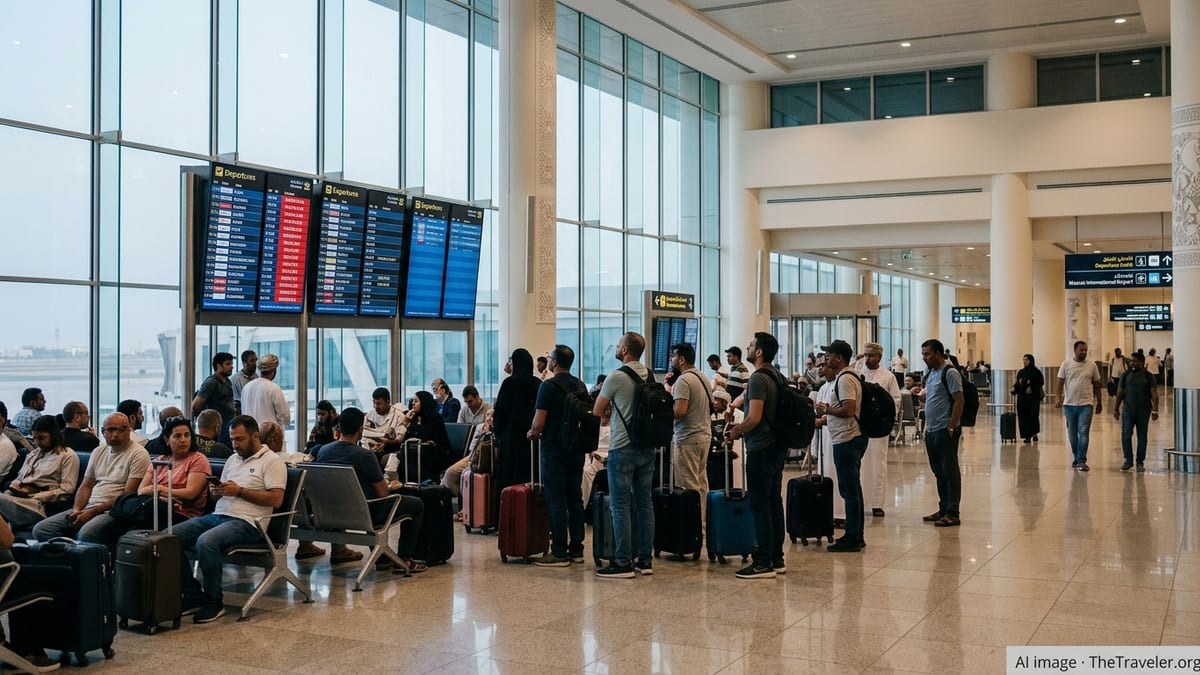
Regional Tensions Spill Into Oman’s Air Travel Hub
Seeb International Airport, serving Muscat, has remained technically open in recent weeks even as neighboring states have grappled with intermittent airspace closures and security concerns. Publicly available operational briefings earlier in March indicated that Muscat International was functioning normally, but warned that some flights to and from Gulf countries could face disruption when those states restricted their own airspace or scaled back schedules.
The latest wave of cancellations on March 22 has focused attention on how quickly conditions in the wider Gulf region can ripple through Oman’s main international gateway. With Qatar’s airspace only partially reopened under limited conditions after late February missile and drone attacks, carriers reliant on Doha as a hub have been forced to trim or reroute services, with knock-on effects for airports such as Muscat that normally benefit from dense regional connectivity.
Travel data consulted on Sunday showed that three services operated by Gulf Air and Qatar Airways involving Muscat, Bahrain and Doha were marked as cancelled, alongside a cluster of delayed departures and arrivals. While the number is modest in absolute terms, the affected flights include key trunk routes for onward connections to Europe and North Africa, magnifying disruption for passengers whose journeys span multiple legs.
Gulf Air and Qatar Airways Adjust Schedules Amid Constraints
Both Gulf Air and Qatar Airways have already been operating under constrained conditions since late February, when Iranian strikes on Qatar triggered the closure of Qatari airspace and a broad reduction in normal commercial flying across parts of the Gulf. According to published coverage, standard passenger services to and from Doha have been running on a significantly reduced basis, with priority given to evacuation corridors and essential cargo.
Under these circumstances, Qatar Airways has been cutting and consolidating departures, particularly on short-haul routes that feed its Doha hub. Publicly accessible customer advisories and independent tracking sites show repeated instances of flights in March being cancelled or converted to relief operations on short notice. For travelers originating or transiting in Muscat, this has meant fewer daily options to reach Doha and, from there, onward destinations such as Luxembourg and Cairo.
Gulf Air, which relies heavily on Bahrain as its connecting hub, has also had to navigate a congested regional air picture. While Bahrain’s airspace has not faced the same complete shutdown reported in Qatar, carriers in the area have periodically rerouted or thinned schedules in response to shifting security assessments and traffic distribution. Cancellations involving Bahrain–Muscat rotations disrupt not only point-to-point traffic, but also itineraries that link Oman with European and North African cities through Manama.
Passengers Confront Missed Connections and Overnight Disruption
The immediate impact for passengers at Seeb International Airport on March 22 has been uncertainty over departure times, missed onward links, and an increase in involuntary stopovers. Travelers booked on cancelled Qatar Airways services to Doha risk losing same-day connections to long-haul flights destined for Europe, including services that typically connect via Doha to cities such as Luxembourg.
Similar complications are arising on Gulf Air itineraries. When Muscat–Bahrain flights are removed from the schedule or heavily delayed, passengers heading for Cairo and other regional capitals via Manama can find themselves stranded mid-journey. Public accounts on social and travel platforms in recent days describe travelers being rebooked onto later dates, routed through alternative hubs, or advised to seek refunds and make fresh arrangements, often at higher last-minute fares.
For Omani residents and expatriates who rely on Muscat for access to regional business centers, the disruption comes at a sensitive time. The end of March typically sees elevated traffic linked to religious holidays, school breaks and events in Doha that had been marketed heavily before the latest security crisis. With capacity constrained, even a small cluster of cancellations can have outsized effects on price and availability across the region.
Wider Network Effects Reach Europe and North Africa
Although the cancellations and delays recorded in Muscat on March 22 are centered on short- and medium-haul routes, their impact extends into long-haul markets. Qatar Airways serves Luxembourg and numerous European cities primarily through Doha, so any reduction in feeder services from Muscat and other Gulf points reduces the ability of passengers to access those routes, even if long-haul segments remain scheduled.
Cairo, one of the region’s busiest air markets, is similarly exposed. Both Gulf Air and Qatar Airways route significant flows of traffic between Egypt and the broader Gulf via their respective hubs. When a Muscat–Doha or Muscat–Bahrain sector is cancelled, passengers booked through to Cairo may face long delays in securing replacement connections, particularly while airlines juggle limited aircraft and crew within a disrupted regional network.
Travel industry analysts note that such network effects are characteristic of hub-and-spoke systems in times of stress. Even airports that remain physically open, like Muscat, can experience rolling operational turbulence when partner hubs are constrained by security events or regulatory decisions. The result is a patchwork of cancellations, extended layovers and schedule changes that can persist for weeks after the initial shock.
Advice for Travelers Navigating Ongoing Volatility
Publicly available guidance from airlines and travel advisories suggests that passengers planning to transit through Muscat, Bahrain or Doha in the coming days should monitor flight status frequently and prepare for potential last-minute changes. Many carriers, including Qatar Airways, have periodically relaxed their change and refund rules for customers holding tickets during defined disruption windows, though specific eligibility conditions can vary and are subject to update.
Travelers are being encouraged by industry bulletins and consumer advocates to build in longer connection times where possible, especially when itineraries rely on Gulf hubs currently affected by reduced operations. Those with urgent travel needs are advised to consider alternative routings that bypass Doha if feasible, or to use carriers that maintain more direct services between origin and destination.
At Seeb International Airport itself, ground operations remain broadly stable, and there have been no indications of local security issues affecting the facility. The current challenges reflect broader regional airspace and network constraints rather than problems specific to Muscat. Even so, the events of March 22 underline how quickly conditions can shift for travelers in the Gulf, and how a handful of cancellations by key carriers like Gulf Air and Qatar Airways can cascade into wider travel turmoil across cities from Muscat and Bahrain to Doha, Luxembourg and Cairo.