

More news on this day
Travelers passing through Amman’s Queen Alia International Airport are facing fresh disruption after three Royal Jordanian Airlines services were grounded, triggering a cascade of delays on routes linking the Jordanian capital with Beirut, Maastricht, Addis Ababa, Cairo and other regional hubs.
Get the latest news straight to your inbox!
Grounded Flights Add Strain to an Already Volatile Schedule
The latest operational setback at Queen Alia International Airport comes against the backdrop of a month marked by rolling delays and cancellations across Jordan’s main gateway. Recent aviation data and travel industry coverage indicate that on several days in late March, the airport recorded dozens of delayed departures and a smaller but significant number of outright cancellations affecting multiple carriers.
Within this environment, the grounding of three Royal Jordanian flights has had an outsized impact. As the national carrier and primary user of Queen Alia International Airport, Royal Jordanian acts as a key connector between Amman and cities such as Beirut, Cairo and Addis Ababa, as well as European destinations including Maastricht via intermediate hubs. When several of its departures are pulled from the schedule, aircraft rotations and crew availability are disrupted, slowing operations on subsequent legs.
Reports from route trackers and airport boards show that even when flights continue to operate, departures have frequently been pushed back, with knock-on delays of an hour or more now common on some services. This pattern is particularly visible on short and medium haul routes in the Levant and North Africa, where tight turnarounds can quickly unravel once a single aircraft is taken out of circulation.
Travel commentary from regional outlets portrays these disruptions as part of a wider pattern rather than an isolated malfunction. Queen Alia International Airport has remained open, but its flight program has been operating below normal capacity for much of March, leaving little margin when unexpected technical or operational issues arise.
Destinations Most Affected: Amman, Beirut, Maastricht, Addis Ababa and Cairo
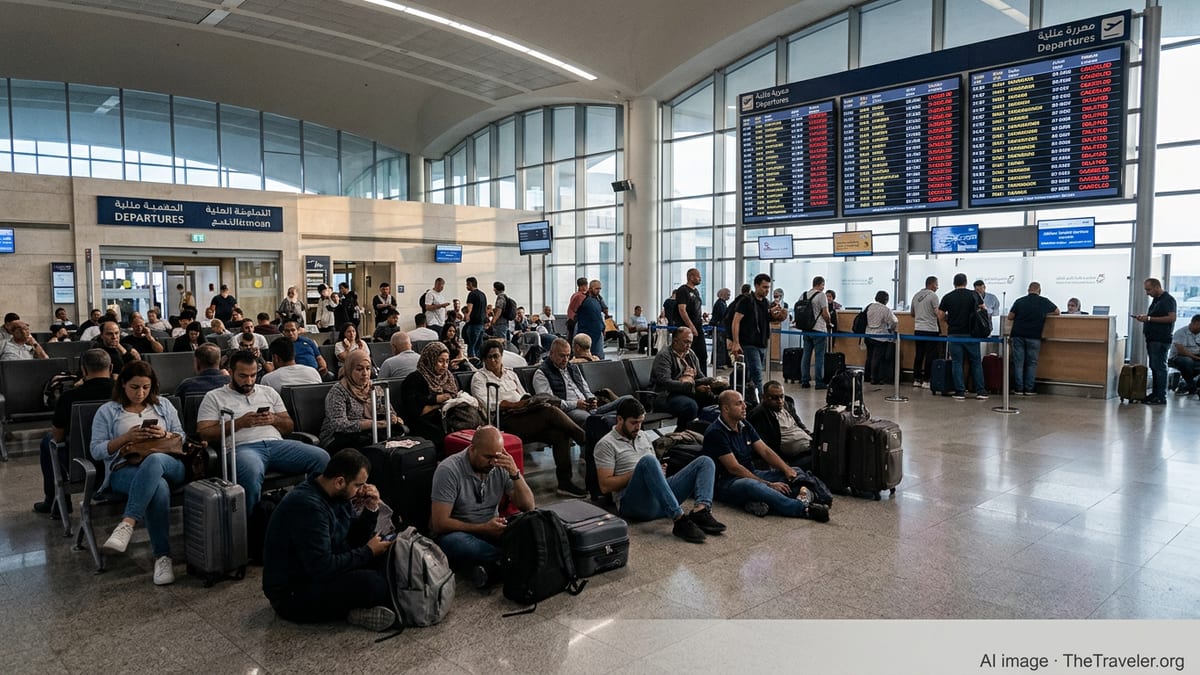
The immediate impact of the grounded Royal Jordanian services has been felt first and foremost in Amman, where departing passengers have encountered longer queues at check in and security, along with crowded waiting areas as delayed flights stack up. The airport’s role as a regional transfer point means that the effects extend beyond Jordan’s borders, affecting travelers whose journeys only begin or end in Amman on paper.
Beirut, which has relied heavily on a limited number of operators amid broader regional instability, is particularly sensitive to any schedule changes on the Amman route. Publicly available flight listings show that direct links between Amman and Beirut are currently concentrated in the hands of just a couple of airlines, including Royal Jordanian, so the grounding of even a single rotation can reduce daily capacity noticeably and force last minute rebookings.
In North Africa and the Horn of Africa, Addis Ababa and Cairo sit at the heart of important connecting networks. Travelers using Amman as a stepping stone between Europe, the Gulf and Africa have reported longer journey times and less predictable connections when flights from Queen Alia International Airport depart late or are rescheduled. When outbound aircraft to Addis Ababa or Cairo are delayed in Amman, inbound passengers on those routes can also face missed onward connections and extended layovers.
European itineraries touching Maastricht and other secondary cities are generally structured around one or two key daily links to larger hubs. The grounding of flights in Amman can therefore reverberate across codeshare and interline arrangements, particularly where Royal Jordanian operates a first leg to a major European gateway, with passengers continuing to their final destination on partner airlines.
Operational Context: Recovery Efforts Meet Renewed Disruption
The difficulties at Queen Alia International Airport are unfolding just as Jordan’s aviation sector had begun to record signs of recovery. Official traffic figures published at the end of March point to a gradual rebound in air movements compared with the most challenging months of the recent regional crisis, with more airlines restoring services to Amman and the number of daily flights climbing back toward pre disruption levels.
Industry trackers and travel media note, however, that operations remain fragile. Airspace in parts of the wider region has experienced periodic restrictions, and carriers have had to revise schedules in response to changing security assessments and demand patterns. In this delicate environment, the grounding of three Royal Jordanian flights at Queen Alia International Airport illustrates how quickly a localized issue can spill over into the broader recovery narrative.
Observers of Middle Eastern aviation point out that Royal Jordanian is far from alone in grappling with irregular operations. Recent days have seen multiple airlines adjust or suspend services to and from Jordan and neighboring countries, with Amman featuring prominently in advisories highlighting the risk of short notice timetable changes, longer flight times due to rerouting, and congested peak travel periods.
Despite these challenges, available data suggests that the trend line for traffic at Queen Alia International Airport remains upward compared with earlier in the year. The current disruptions underscore that progress is uneven, and that travelers should remain prepared for intermittent setbacks even as overall capacity improves.
Passenger Experience: Longer Waits, Tighter Connections and Rising Uncertainty
For individual travelers, the grounding of a few flights can translate into very tangible inconveniences. Accounts compiled by travel platforms and social media users in recent weeks describe extended waiting times in Amman as passengers seek clarification on their travel options, with some journeys stretching into unplanned overnight stays when connections are missed.
Those flying between Amman and Beirut, Addis Ababa or Cairo are especially vulnerable to tight connection windows. If a Royal Jordanian sector into Queen Alia International Airport arrives late due to upstream disruptions, the follow on leg may depart behind schedule or be consolidated with another service. This can leave passengers uncertain about whether to proceed through transfer formalities or seek rebooking on alternative routings through other regional hubs.
Advisories from travel specialists emphasize the importance of building in additional buffer time for itineraries that rely on Queen Alia International Airport as a connecting point. Recommendations commonly include arriving at the airport earlier than usual for departures, allowing ample time for security screening and potential congestion at passport control, and avoiding very short minimum connection times, particularly on itineraries that mix different airlines.
At the same time, some recent accounts suggest that not all flights are affected equally. Certain days and time bands appear to run relatively smoothly, while others see concentrated clusters of delays and cancellations. This uneven experience adds to the sense of uncertainty for passengers planning trips through Amman in the short term.
What Travelers Should Watch in the Coming Days
With three Royal Jordanian flights grounded and wider schedule volatility continuing, travel analysts expect a period of adjustment as airlines fine tune timetables and fleet deployment. Flight tracking services show ongoing variations in departure and arrival times at Queen Alia International Airport, signaling that the situation remains fluid rather than settled.
Publicly available information suggests that further timetable changes are possible as carriers respond to demand, operational constraints and any additional airspace advisories. Routes linking Amman to nearby regional centers such as Beirut and Cairo, as well as longer haul connections feeding through Addis Ababa or European gateways used for Maastricht bound traffic, are likely to remain under close review.
For travelers with imminent plans, the most practical guidance emerging from recent disruptions is to monitor flight status frequently on the day of departure, remain flexible about routing if alternative connections are offered, and be prepared for longer travel days than originally scheduled. Travel insurance policies that cover delays and missed connections may also play a larger role for itineraries involving Queen Alia International Airport in the current environment.
While the grounding of three Royal Jordanian flights is only one element in a complex operational picture, it illustrates how even limited schedule cuts at a key hub can ripple across multiple countries and regions. In the weeks ahead, the balance between recovering traffic volumes and maintaining reliable service through Amman will remain a closely watched indicator for travelers and the wider tourism sector in Jordan.