

More news on this day
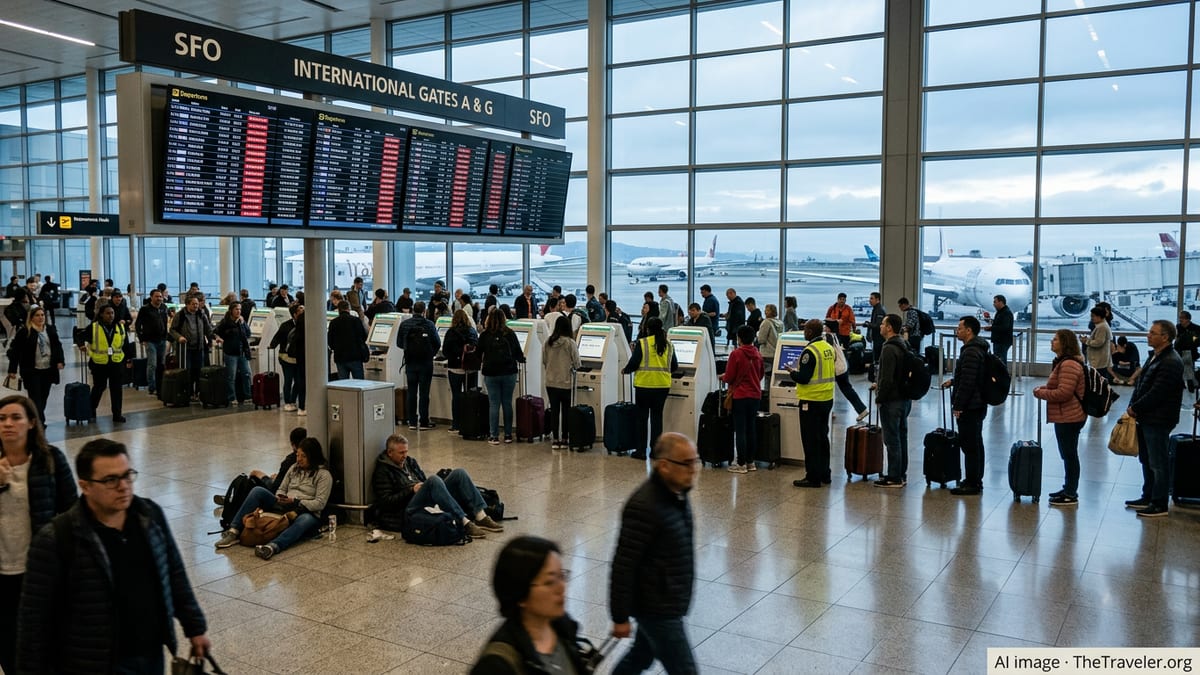
San Francisco International Airport is facing a sharp spike in flight disruptions as cancellations and reroutings on services to Dubai, Doha and other Middle East hubs ripple through domestic and transpacific schedules, leaving travelers with missed connections, overnight delays and uncertain itineraries.
Get the latest news straight to your inbox!
Regional Conflict Sends Shockwaves Into Bay Area Skies
Travel disruption at San Francisco International Airport has intensified in mid March as instability in the Gulf region continues to affect long haul operations. Publicly available information on airspace closures and partial reopenings across Qatar, the United Arab Emirates, Bahrain and neighboring states indicates that airlines are still struggling to restore normal schedules to major hubs such as Dubai and Doha. The result is an uneven patchwork of limited long haul services and canceled departures that is feeding into wider congestion at SFO.
According to published coverage on the 2026 Iran war and the related Strait of Hormuz crisis, airspace restrictions across multiple Gulf countries have triggered thousands of daily cancellations and diversions on routes linking Europe, Asia, Africa and the Americas. With Dubai and Doha typically serving as key connecting points between North America and destinations across South Asia, Africa and Australasia, interruptions on these corridors are having an outsized impact on West Coast gateways, including San Francisco.
Operational updates shared by major Gulf and European carriers show that schedules remain fluid, with some flights to and from Dubai operating on reduced frequencies and many services involving Doha still suspended or heavily curtailed. For travelers departing SFO, that has translated into abrupt last minute cancellations of through itineraries, as well as forced rebookings via alternative European or East Asian hubs, where capacity is also tight.
Routes to Dubai and Doha Face Ongoing Uncertainty
Published advisories on Middle East aviation activity indicate that Dubai International Airport has gradually resumed a limited number of flights since early March following earlier interruptions linked to the regional conflict. However, ongoing airspace restrictions and periodic security alerts mean that long haul operations between North America and Dubai have not fully normalized. Flight tracking data and carrier statements show gaps in the timetable, with some services operating and others canceled on short notice.
Doha has been more severely affected. Reports on Qatari airspace closures and subsequent partial reopenings describe a prolonged suspension of standard commercial flights at Hamad International Airport, with only restricted evacuation and cargo movements allowed for several days. Travel advisories and airline notices describe a phased plan to restart a small number of passenger services under emergency conditions, but with many routes, including connections from the United States, still off the board or pushed back into late March.
This uneven recovery has direct consequences for San Francisco passengers booked on itineraries that rely on Gulf hubs. Publicly visible booking and schedule tools show widespread reissuance of tickets, with airlines shifting travelers from SFO Dubai Doha routings onto alternative paths, if seats are available. In many cases, travelers face extended connections, overnight hotel stays at intermediate airports, and changed arrival dates as carriers navigate around closed or congested airspace.
Domestic Knock-On Effects Across the United States
The turmoil on SFO’s Middle East corridors is also intensifying pressure on domestic networks. U.S. carriers have issued flexibility waivers for trips touching the region, allowing passengers to change dates or routes without standard penalties. According to public advisories, these waivers cover travel periods from early March through much of April, encouraging customers to adjust their plans ahead of time rather than risk same day disruption.
As long haul connections through Dubai and Doha falter, more travelers are being moved onto alternative transatlantic and transpacific services from SFO, including flights to major European and Asian hubs. This has pushed some routes close to capacity and left fewer options for same day reaccommodation when weather or mechanical issues affect domestic segments feeding into San Francisco. Airline schedule data shows minor frequency adjustments on some cross country legs, as carriers attempt to balance aircraft and crew allocations against volatile international demand.
Within the United States, hub airports such as Chicago, New York and Dallas are absorbing additional transit traffic from passengers who can no longer connect through the Gulf. Online route tracking and community reports indicate that some travelers originally booked SFO Dubai or SFO Doha journeys are now traveling via Chicago to Dubai or via East Coast gateways to Europe and onward to final destinations. This redistribution is adding congestion to already busy domestic corridors, occasionally leading to rolling delays even on flights that do not leave U.S. airspace.
Stranded Passengers Confront Long Delays and Complex Rebookings
For travelers on the ground at San Francisco International Airport, the disruption is most visible at departure boards and ticket counters. Public posts on airline forums, social platforms and passenger discussion boards describe multiple examples of SFO departures to or via Doha being canceled within days of travel, with rebooked itineraries often delayed by a week or more. In some cases, passengers report being shifted onto the few still operating Dubai flights, then onward to Europe or Asia, creating longer and more complex journeys.
Reports indicate that rebooking options are highly dependent on route, fare type and alliance. Travelers with flexible tickets or those booked on major U.S. carriers sometimes gain access to partner networks through Europe or East Asia. Others on more restrictive fares, or traveling to secondary cities in South Asia or Africa, appear to face limited alternatives when Gulf connections are removed from the schedule. Some accounts describe passengers choosing to postpone trips altogether rather than navigate uncertain routings.
Industry analyses circulating in recent days note that airlines are prioritizing aircraft on routes where airspace is fully open and demand remains strong, which can further constrain options for those reliant on previously convenient Gulf hubs. At SFO, that has meant a relatively steady operation on core domestic and transpacific services, even as itineraries involving Dubai and especially Doha remain vulnerable to last minute changes. Travelers are advised in public guidance to monitor their bookings closely, use airline apps for real time updates, and consider carrying contingency plans for overnight stays or alternative routings.
Outlook: Volatile Schedules as Conflict Continues
Analysts tracking the aviation impact of the 2026 Iran conflict warn that flight schedules may remain volatile in the weeks ahead. Commentary in economic and transport reports links the ongoing Strait of Hormuz crisis and regional airspace closures to a broader shock for global aviation, alongside energy markets and shipping. For San Francisco International Airport, this means that routes touching the Middle East are likely to be among the last to stabilize, even if domestic and transpacific operations continue to run relatively close to plan.
Publicly available assessments suggest that a clearer picture for SFO to Dubai and SFO to Doha services will depend on sustained airspace reopening across Gulf states and a demonstrable reduction in security risks near major hubs. Until then, airlines appear set to maintain a conservative approach, operating only those flights that can reliably avoid restricted zones while retaining enough flexibility to adjust on short notice.
For now, passengers traveling through San Francisco are confronting an environment in which long haul trip planning involves more uncertainty than usual. Industry observers note that the experience at SFO underlines how tightly integrated global air networks are, and how quickly events thousands of miles away can cascade into visible disruption at a single West Coast terminal.